










Discover handcrafted, folk-crafted bean paste that fits into your everyday life
"He left behind the words 'I want the tea ceremony to be like the morning dew on the rice leaves, like the dianthus blooming in the withered fields,'" says Yamaguchi Shinpei of Saiundo. The tea ceremony, which was originally a samurai pastime, spread throughout the city, and the culture of confectionery also developed.

Fugetsudo is located along the Horikawa River, close to the national treasure Matsue Castle. 
The freshly wiped interior of the store is decorated with pottery by Kawai Kanjiro and calligraphy by Munakata Shiko.
"My grandfather was a stubborn and clumsy confectioner. Even during the war, he was the kind of person who would stop making sweets, saying that it would be better not to make them at all than to use sugar substitutes. He disliked elaborate, artistic sweets and wanted to make simple sweets that people would love every day. To achieve this, he selected each and every azuki bean and silently kneaded the bean paste. I think he shared his approach to craftsmanship. He hit it off with Kawai, and I heard that they frequently visited each other. I once heard that when he went to Kyoto to deliver some sweets, Kawai was so happy that he wrapped a matcha bowl in newspaper and handed it to him."
Kanjiro, as well as other distinguished figures such as Yanagi Muneyoshi, Hamada Shoji, Bernard Leach, and Munakata Shiko visited Shimane many times to teach folk art, and established not only Fugetsudo but also Saneido >or< Saiundo He also developed close ties with confectionery shops such as "Kyoto Sweets Shop." His legacy can be seen in the names of the sweets, the plaques, and his calligraphy.
Matsue, a city associated with Lord Fumai, who valued simplicity and simplicity and loved the handiwork of artisans, was likely well-positioned to connect with folk art. The taste of the confectionery shop, which was recognized by the folk art giant, is still loved today.
Fugetsudo
Kanjiro and I repeatedly tried different ways to create the look and taste of the dishes, faithfully recreating the scenery and flavor perfected by his grandfather.
The company was founded in 1886. The founder, Nakanishi Einosuke, gained a reputation for his beni-nagashi yokan (sweet bean paste made with white azuki beans), which he mastered at Surugaya in Fushimi, Kyoto. Later, the third-generation owner, Mansuke, built the foundations of Fugetsudo.
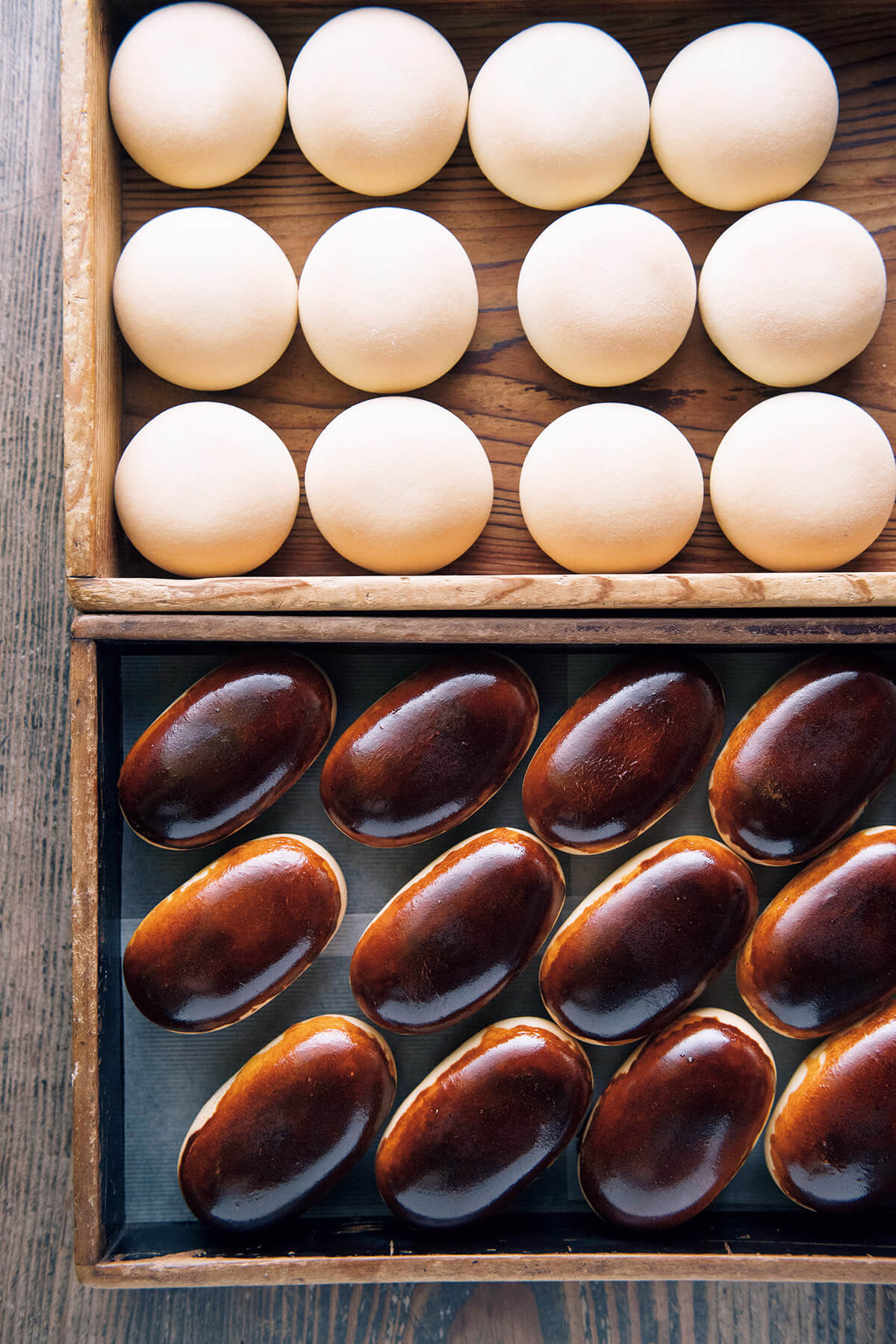
"Kuro Ogura," an Ogura bean paste created with the advice of Kawai Kanjiro, and "Yakumo Ogura," a castella cake baked on handmade washi paper, which expresses the Izumo pillow word, Yakumo, are original creations of the third generation. The seven types of sweets inherited from his grandfather have retained the same ingredients and manufacturing methods. Even today, he hand-selects Okayama-grown Bitchu Dainagon and white azuki beans, smashes lumps of Yaeyama brown sugar with a hammer, cooks the azuki beans, and kneads the bean paste.
They don't get greedy, and only make enough to sell out on the day. Despite its simple appearance, the taste is extremely delicate and free of impurities.

The simple sweets go well with the folk art-inspired tableware. Monaka, priced at 240 yen each, is made with bean paste and 100% glutinous rice. 
The Yakumo Ogura Hanzao (1,500 yen) is a castella cake sandwiched with Ogura jelly. Mansuke uses Izumo washi paper, developed by Living National Treasure Abe Eishiro. The cloud-like grill marks stand out. 
The Kuro Ogura Hanzao (1,600 yen) has a beautiful lacquer-like sheen and honey-boiled adzuki beans. The rich flavor of brown sugar and soft texture are also impressive. 
There are also photographs of him with Kawai Kanjiro and others. 
It was also loved by tea masters, including the head of the Urasenke school. 
Following Mansuke's words, "Sweets are meant to be tasted, not looked at," the stick-shaped sweets are not displayed and are cut into pieces for each order.
Saiundo main store
The sweets associated with Lord Fumai are wrapped in the free-spirited and energetic brushwork of Munakata Shiko.
The plaque hanging at the main store was created by Shiko Munakata. Through Kanjiro Kawai, Shiko developed a friendship with Eishiro Abe of Izumo Handmade Washi, and visited Matsue more than 10 times in his lifetime, building a close network. Shiko's brushwork is also featured on Saiundo's wrapping paper. Saiundo was founded in 1874 by the founder, Zen'emon Yamaguchi.
In the mid-Meiji period, Zenemon revived Wakakusa, a sweet that was a favorite of Lord Fumai and had been discontinued at the time, so the shop has a deep connection to Lord Fumai. This long-established shop has a strong connection between Lord Fumai and folk art.

A box of three Yamakatsura cakes costs 584 yen. Brown sugar yokan is poured over peeled bean paste, and then topped with minced white bean paste. The dish is made by Jukogama. 
A box of four Asashio cakes costs 951 yen. They feature a sweet potato dough and a slightly salty peeled bean paste. The dish is made by Jukogama. 
One Yuzuro is 486 yen. Mulched yuzu is poured with peeled bean paste containing Yoshino kudzu. The yuzu aroma is also vivid. The dish is made by Shussai kiln. 
A calligraphy piece of achievement that takes up the entire page.
Saneido Teramachi Main Store
Kanjiro named it after the purple layered bean paste, which resembles the sky at dawn.
In 1929, Oka Eizaburo, the founder of a famous Matsue confectionery shop, went independent and learned the recipe from the descendants of a confectionery shop that supplied the Matsue domain, restoring "Natane no Sato," a favorite of Lord Fumai. Kawai Kanjiro became friends with Eizaburo, a dedicated craftsman. Kanjiro gave the name "Before Sunrise" to a confectionery that he invented for a folk art exhibition.
It is made using the "shinonome" method, in which peeled bean paste is layered and pressed while still hot, and Kanjiro saw a twilight sky there. It is an exquisite name for a confection that melts in your mouth and leaves a refined aftertaste.

One bottle is 1,728 yen before sunrise. The title is a paper cut by Kanazu Shigeru, who was taught by Kanjiro. The vessel is made by Kawai Hisashi. 
Two Asashio pieces are 475 yen. The pottery is from Tsubakigama. 
A box of four Shikamura sweets costs 1,285 yen (reservations required). The name of the sweet comes from the white camellia "Shikamura" that Lord Fumai spotted on his way back from falconry and named it after. The sweet is made of white bean paste nerikiri (sweet bean paste paste) squeezed into a tea towel, with yellow bean paste crumbles used for the stamens. 
Shikamura blooms in the store's inner garden.