










The warm hospitality has me feeling refreshed and I vow to return
At dusk, a light suddenly comes on in the charming atmosphere of the ancient city of Kanazawa. It's a very elegant building. Apparently, it has been renovated into a modern space while skillfully preserving the best parts of the nearly 100-year-old traditional house. Once the noren curtain is hung, the evening session finally begins. There are a counter and a few tables on a raised platform. They fill up in no time.
Owner Araki Kazuo opened this restaurant in 2014, 10 years after he left Kanazawa with the desire to "open his own restaurant." To make his dream come true, he started out in Tokyo at a Japanese restaurant in Shimokitazawa, before joining Nakamura Teiji's company, which trains many young chefs. All of the bars opened by graduates, including Shibuya's Kotaro and Sakai Shokai, are renowned establishments. Naturally, this restaurant is no exception. The secrets of hospitality he learned are deeply engraved in Araki's heart and are alive and well here.

The store's name, "Sakaya," comes from the name of the store owned by his great-grandfather, Yasuburo, who sold sake and vinegar in a village on the outskirts of Kanazawa. When he came across a good old building that matched the name, he quickly decided to put the counter there and have an atrium above it.
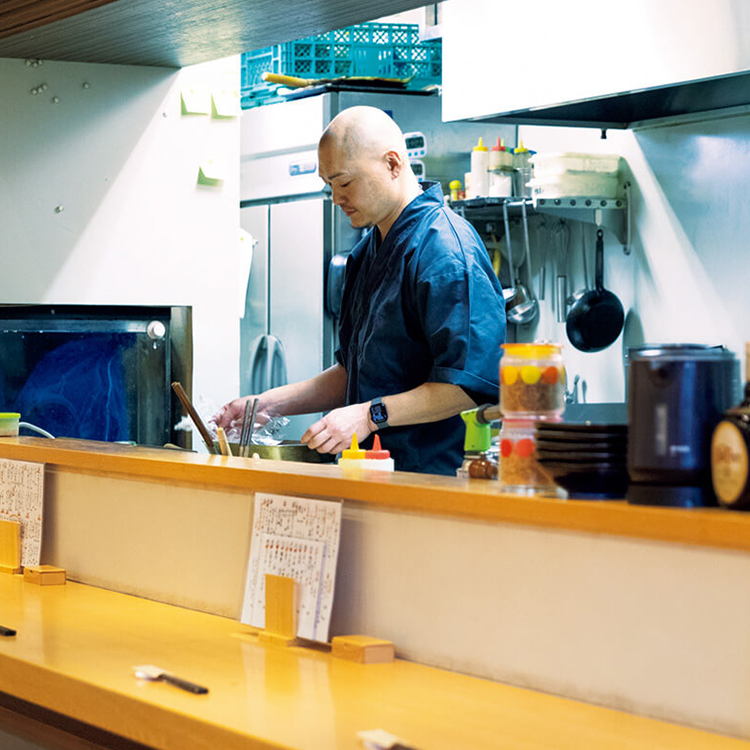
In the center of the counter, Araki prepares the sashimi. He cuts the vegetables. He treats the ingredients with love. He is very polite. "Do the obvious things as an obvious thing. Do the basics well. Don't forget to think from the customer's perspective." These are Nakamura's teachings. The importance of understanding the customer's perspective is ingrained in him. "I'm a serviceman. I want to do what the customer wants. To do that, I think it's important to notice even the smallest changes." He responds carefully to what the customer wants. That's how a pleasant space is created.

A gentle harmony of Japanese cuisine, wine, and sake
The menu features a variety of seafood and local produce from the Hokuriku region, including Kaga lotus root, white shrimp, winter yellowtail, pufferfish roe pickled in rice bran, clams, and Hyakumangoku shiitake mushrooms. Using ingredients unique to Kanazawa, they create dishes that are "fun to drink and fun to eat," pairing well with not only sake but also natural wine. Take, for example, potato salad, which has a unique flavor thanks to a sauce made with homemade pancetta, whole grain mustard, white wine, and butter. It has remained popular since the restaurant opened. Take, for example, namero, which is made with coriander, horse mackerel, and lemon, and pairs well with both wine and sake.
The owner's recommendation of natural wine is not just because he likes it, but for another reason. His wife, Saori, runs a natural wine shop called Brücke in Takaoka-cho, the same town in Kanazawa. He wants to convey the passion that producers have for wine, and to act as a bridge to pass the baton from producers to wine drinkers. With this in mind, the shop was named Brücke, which means bridge. The wines at Sakaya Yasaburo are selected jointly with his wife.
"Making our customers happy is a way to repay my gratitude to my mentor, Mr. Nakamura," says the owner. This is a warm bar filled with respect for the mentor and love between husband and wife.