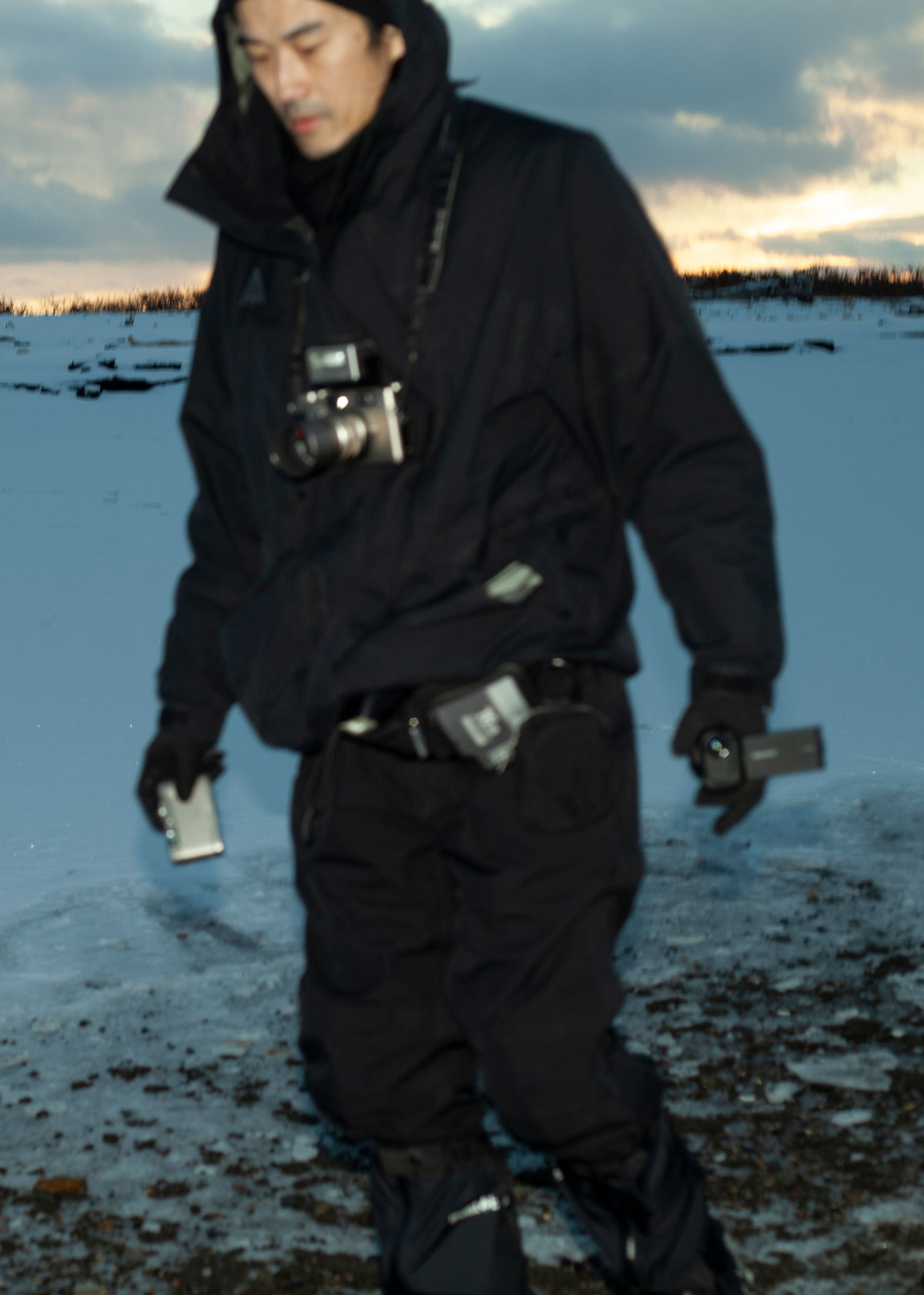











“It was the first subject I truly felt I wanted to pursue,” says Daisuke Yokota about his new photography exhibition. The exhibition “Plants, Darkroom,” which opened on January 28 and runs until February 28 at Studio 35 Minutes, a gallery located near Araiyakushi-mae Station in Nakano Ward features new works focusing on the midstream basin of the Tama River and the plants that grow wild there.
This exhibition follows the trajectory of “Plants, Tama River Midstream Area,” which was exhibited at the same gallery at the end of last year. While the previous exhibition centered on color photographs, the new works are all monochrome. Furthermore, as suggested by the inclusion of the word “Darkroom” in the title, these photographs were captured through Yokota's darkroom work.
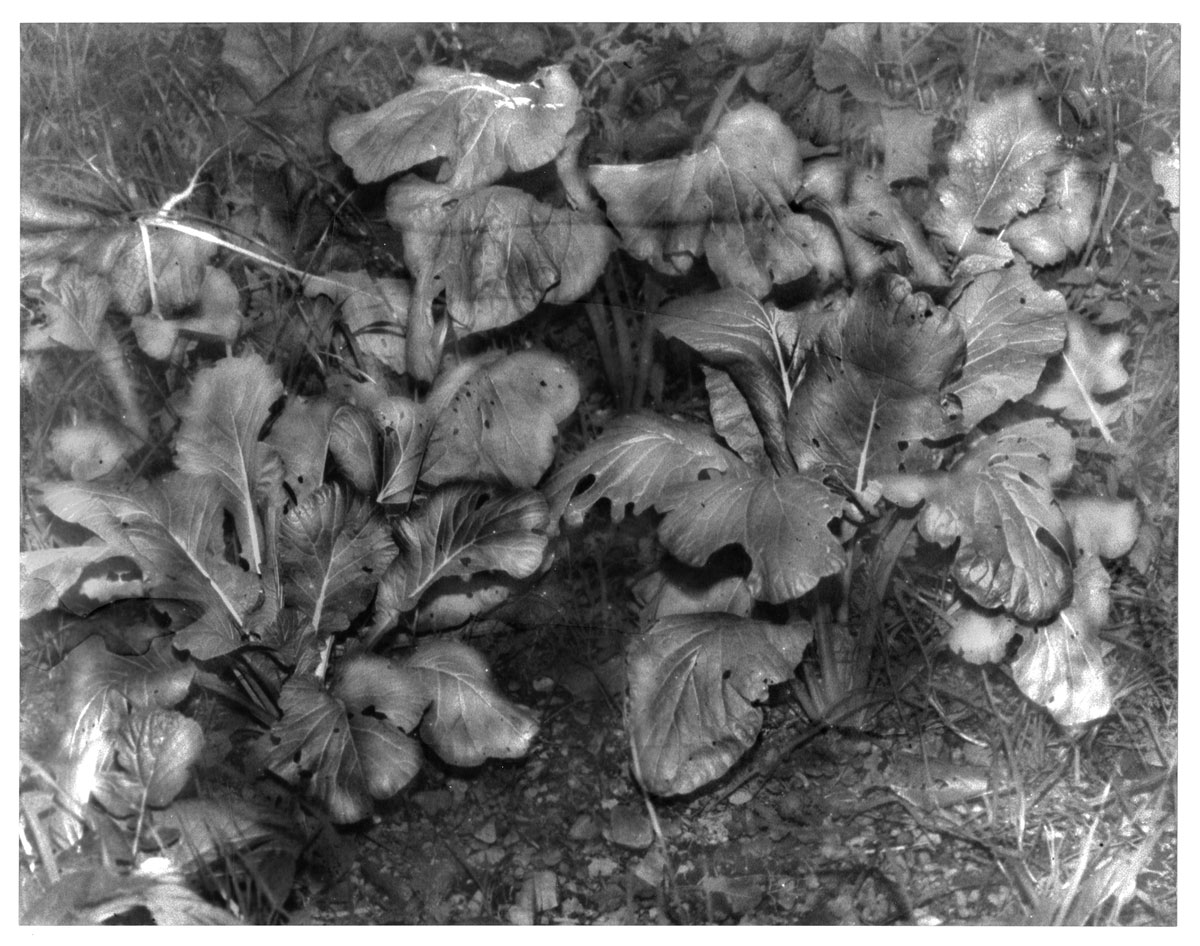
「Untitled (from Plants, Darkroom) 」2025 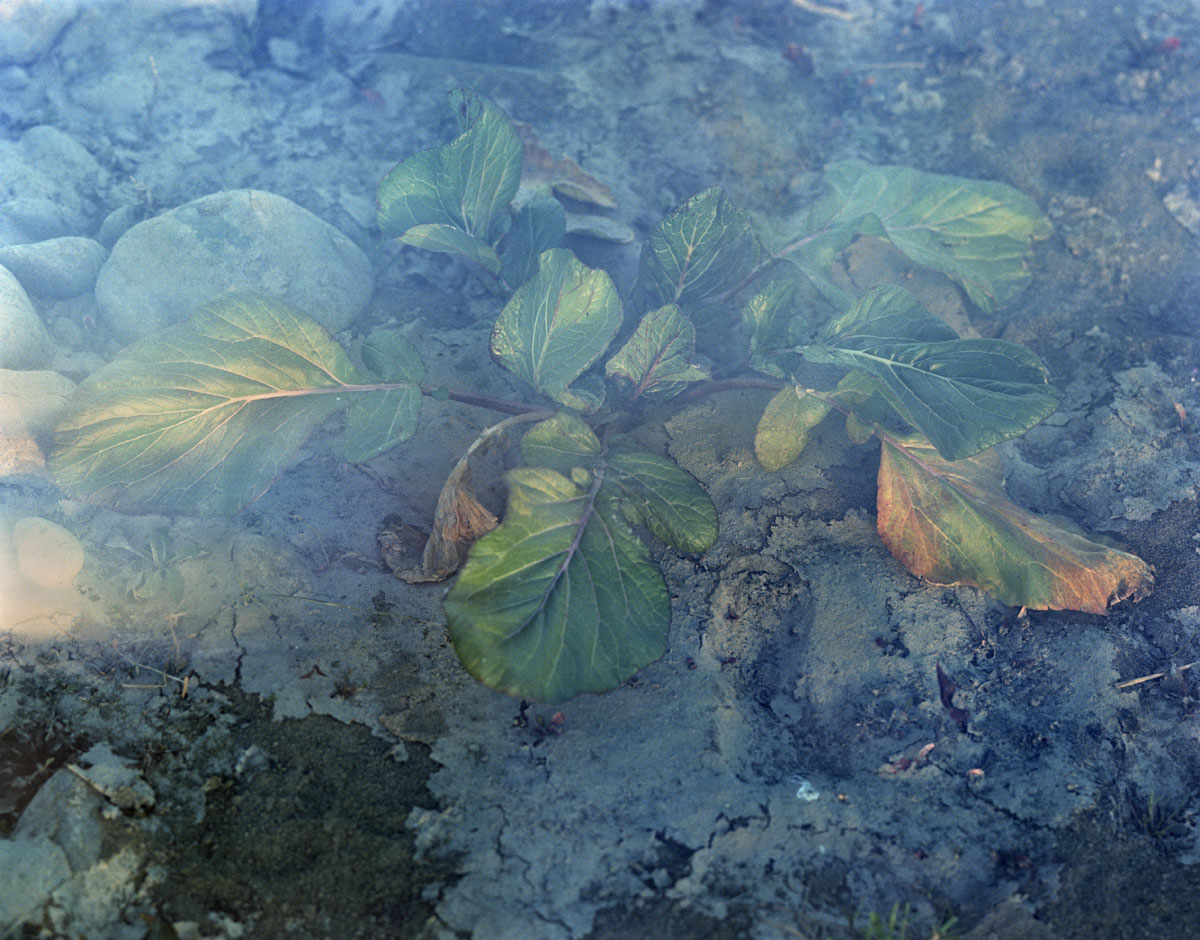
「Untitled (from Plants, Tama River Midstream Area) 」2025
A recipient of the Kimura Ihei Photography Award, and a photographer who has swept many of Japan’s most prestigious photography prizes, including Canon’s New Cosmos of Photography, Epson’s Color Imaging Contest (Photography Division), and Recruit’s 1_WALL, Daisuke Yokota is known for treating photographs themselves as objects, materializing it and presenting it like an installation, rather than simply showing the subject. Why, then, is Yokota now taking on works that approach straight photography of plants? We spoke with him in Kichijōji.
“There was a darkroom in my house,” Yokota says. Born and raised in Saitama Prefecture in 1983, Yokota began borrowing his father’s single-lens reflex camera during his junior high and high school years, which awakened his interest in photography. In high school, he had considered studying painting, but since several of his skateboarding friends were aspiring painters, he made a different choice. He chose to study photography instead, and enrolled at Tokyo College of Photography.
“Most of the classes at the school focused on commercial photography. But I was in the arts course, so I joined the seminar of landscape photographer Toshinobu Takeuchi. We went on a seminar camp, and while all the other students had big telephoto lenses, I only had a wide-angle lens, and that’s when I realized my approach was different. I also felt I couldn’t quite keep up with the seriousness with which the other students approached landscape photography. On the other hand, photography wasn’t just about taking pictures, darkroom work was still very common at that time. So while taking landscape photos, I also found myself enjoying the darkroom process.”
As mentioned earlier, Yokota’s home actually had a darkroom. “My father’s love of photography went so far that there was a fairly beat-up enlarger at home, and he had set up a simple darkroom to make prints. Apparently, both of my parents had aspired to be painters when they were young. So there were all sorts of things related to painting and photography around the house, and looking back now, I think that environment may have been a major factor in why I chose photography.”
While attending Tokyo College of Photography, Yokota primarily developed and printed the photographs he took at home, repeating this process over and over. “What I really enjoyed was the printing process. I discovered and learned a lot in the darkroom."
As graduation approached, Yokota had no intention of pursuing commercial photography. All he had was the determination to make a living as a photographer. “There were no guarantees, but I decided not to rush into any decisions. I figured that if I worked part-time I could somehow get by, and in the meantime, I would submit my work to competitions and wait for something to catch on.”
In 2008, Yokota won Epson’s Color Imaging Contest (Photography Division) and Canon’s New Cosmos of Photography in quick succession. However, Yokota says that he struggled until he won his first award.
“I entered a lot of competitions while working part-time in the architecture industry, but I kept getting rejected. I think I'd been rejected for about three years. Up until then, I had been using only film cameras, but I decided to change my approach, so I switched to digital cameras, experimented with Photoshop in my own way, and submitted work that I thought no one would want to see and that probably wouldn’t be appreciated. To my surprise, it was praised for its freshness and originality. After that, I was able to approach my work with a more positive attitude.”
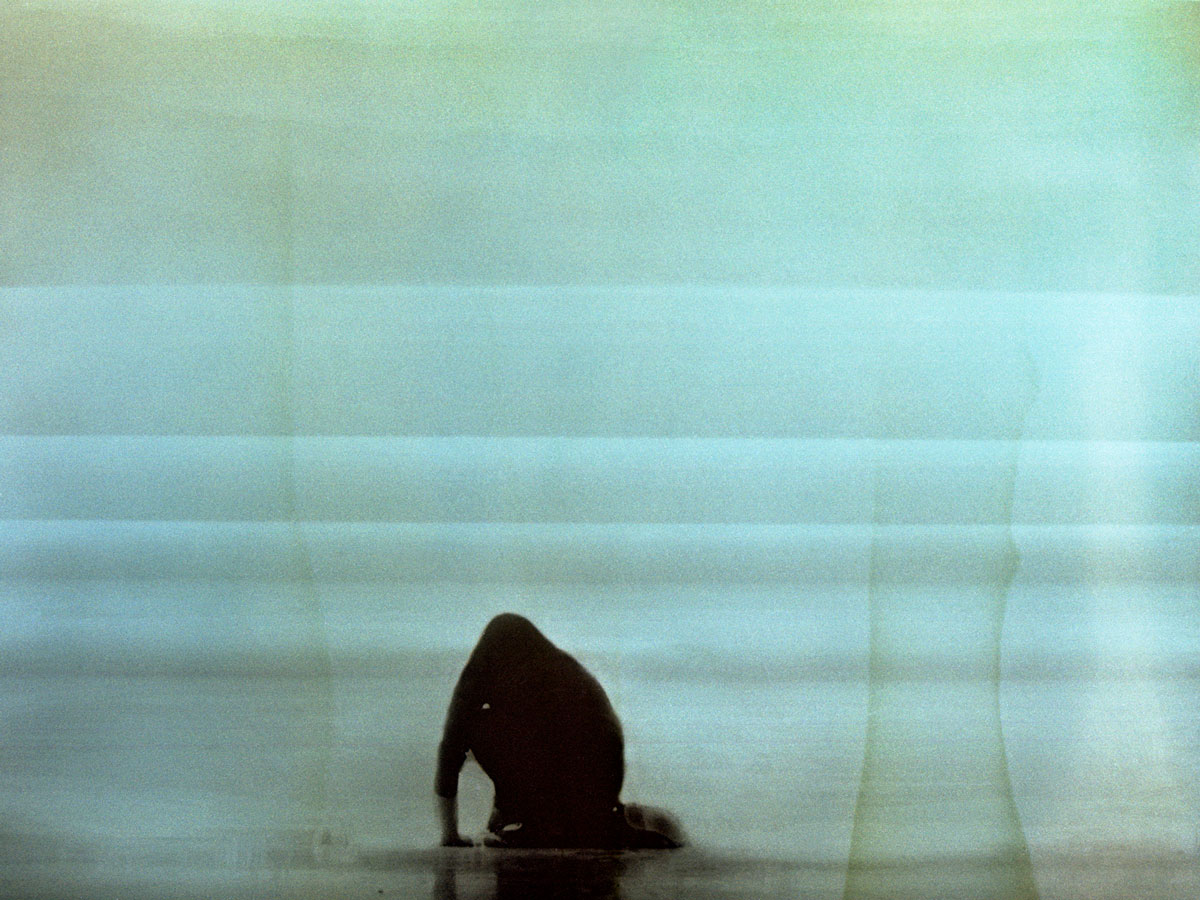
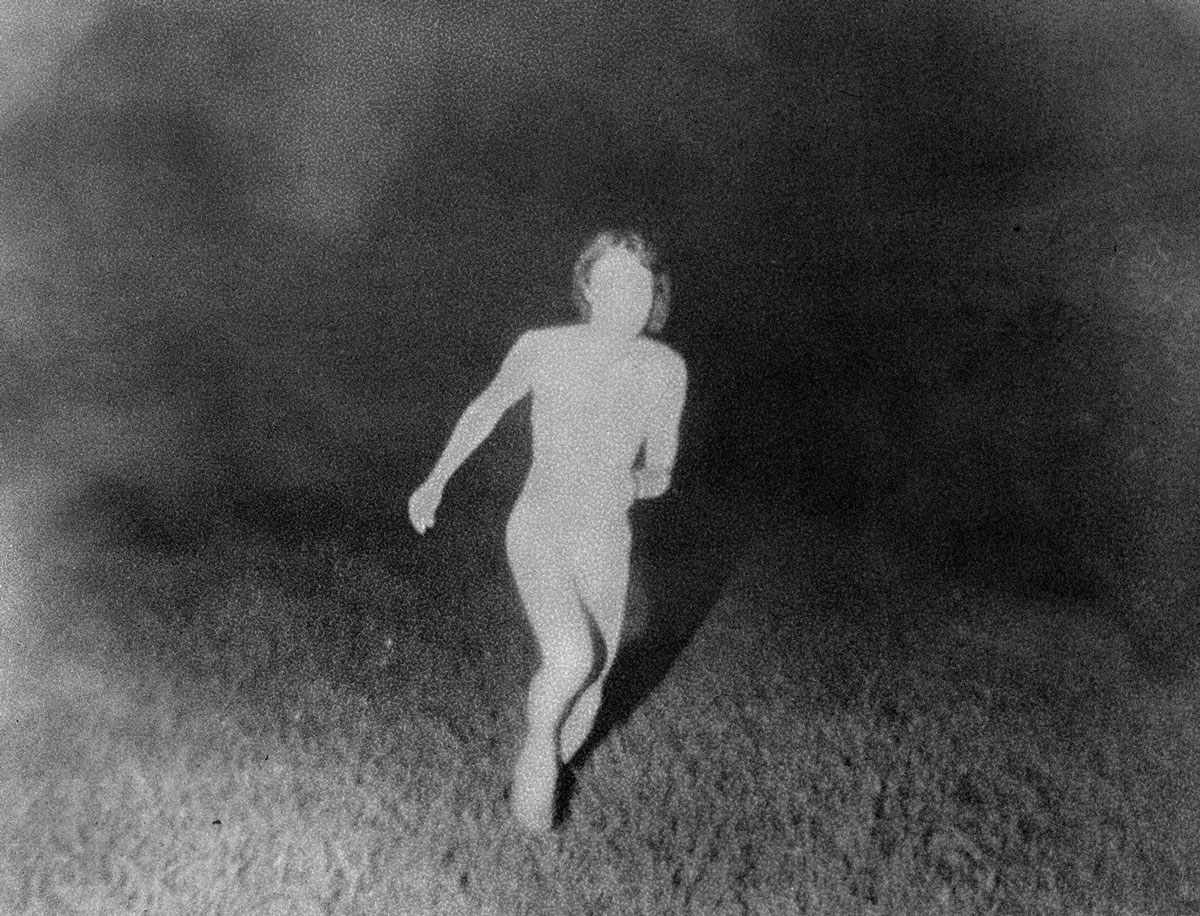
At that time, Yokota’s method was a complex one. He would shoot with a digital camera, manipulate the image in Photoshop, and then reproduce the output using a film camera. In other words, a process that was essentially a digital-to-analog conversion.
“When I took photos in the city and there were people in the frame, I would use Photoshop to leave only the outline of the person while erasing the surface details. Then, by photographing this illustrated photo again, I was essentially turning it back to a photograph, pushing the photograph to the very edge where it no longer is a photograph. Also, if you shoot with a film camera and deliberately develop the film at a high temperature, it melts and deteriorates, which makes you feel the photograph as a physical object. So, while asking myself how far I can go before it stops being a photograph, I feel like I'm adding all sorts of things to a container like a tank called a photograph.”
What does a subject mean to Yokota?
“I’ve always thought that the subject has to be important, and that’s still true today. But to be honest, the difficult part is that I just can’t seem to find a truly important subject. Finding something that holds that level of interest and that I can continue to pursue is incredibly difficult. Even back in vocational school, I struggled with the idea that if a subject is necessary for a photograph to exist, then perhaps I couldn’t make photographs at all. I keep thinking, ‘If I treat photography as a form of action, will I be able to find my own way?’”
One notable aspect of Yokota's career is the succession of large-scale exhibitions overseas, which began with a self-published ZINE.
“I started making ZINEs in 2011, and one of them was ‘Back Yard’. I sent it to magazines and writers overseas. The first response came from an international artist who had seen ‘Back Yard’ and invited me to exhibit as part of a group at the ‘Unseen’ photography festival in Amsterdam. That’s how I ended up going to Amsterdam.”
At that exhibition, Yokota received The Outset | Unseen Exhibition Fund award. He then held his first solo exhibition at the Foam Photography Museum in Amsterdam in 2014, quickly rising on the international photography scene. “It was an interesting period. A lot of new forms of photographic expression were emerging. I think the internet played a role in that as well. I was lucky.”
Takayuki Kobayashi of flotsam books, a photo book specialty bookstore that has had a long-standing relationship with Yokota, had this to say about Yokota's unique publishing activities.
“I think it’s interesting that Yokota produces his works as self-published collections in open editions without any restrictions. It’s not just a booklet compiling his work, but he seems conscious of using the book as a medium to present his work. You could say he does things in books that he can’t do in exhibitions, and conversely, does things in exhibitions that he can’t do in books.”
Those who have seen Yokota's exhibitions will be overwhelmed by the sheer scale of them. His distinctive style is three-dimensional, physical installations that are more like installations than photography exhibitions.
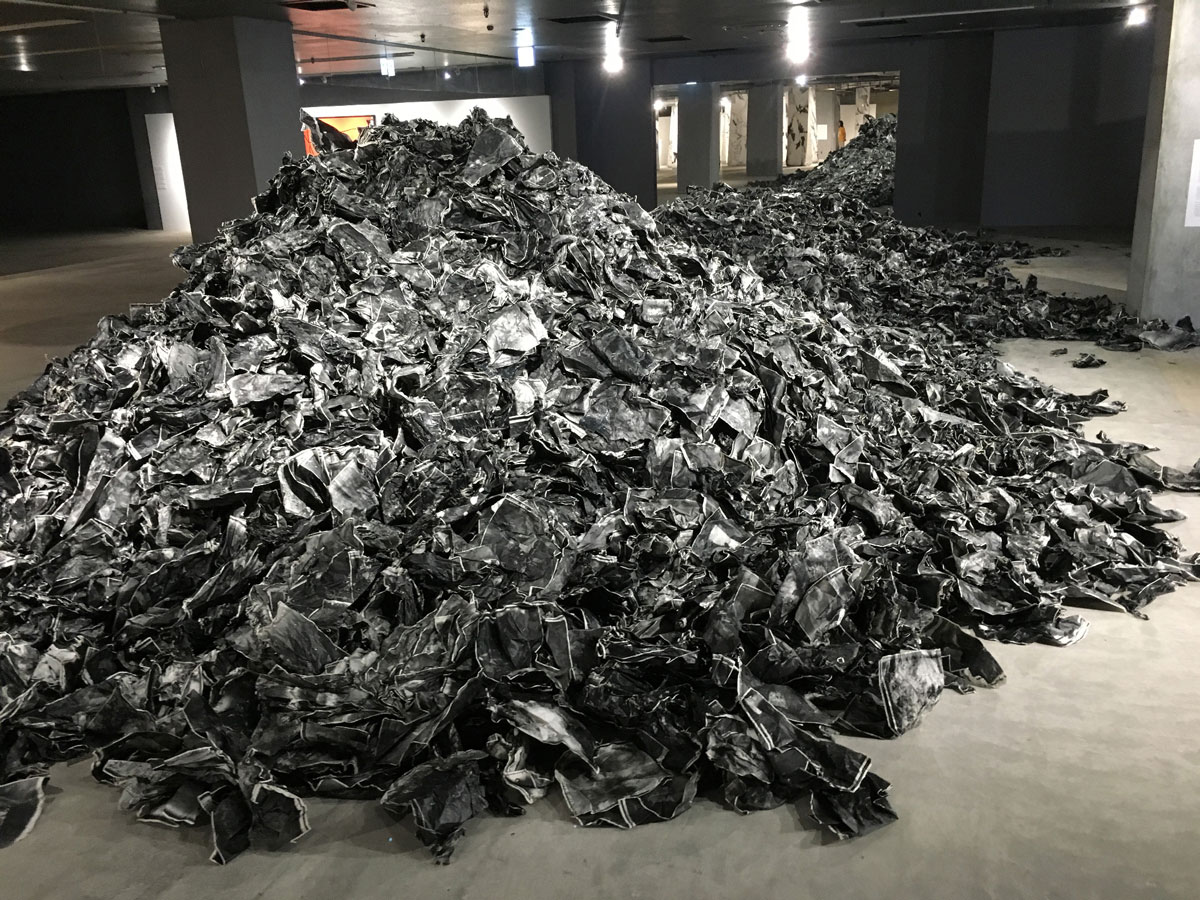
In 2023, Yokota’s photography exhibition multiplication, held at the temporary art space Nihonbashi Anarchy Culture Center, featured an expansive floor entirely covered with photographic prints, allowing visitors to walk on the images as they viewed them. I also experienced the exhibition myself, and even though the surface was coated, walking across photographic prints was a rare and memorable experience.
“Those prints are quite heavy, given the sheer area they cover (laughs). Removing and storing my works after my exhibitions are over is a lot of work.”
Furthermore, Yokota has presented works of “photography without shooting.” His large-scale series Color Photographs has an abstract, painting quality, born from the extreme technique of printing images from melted film.
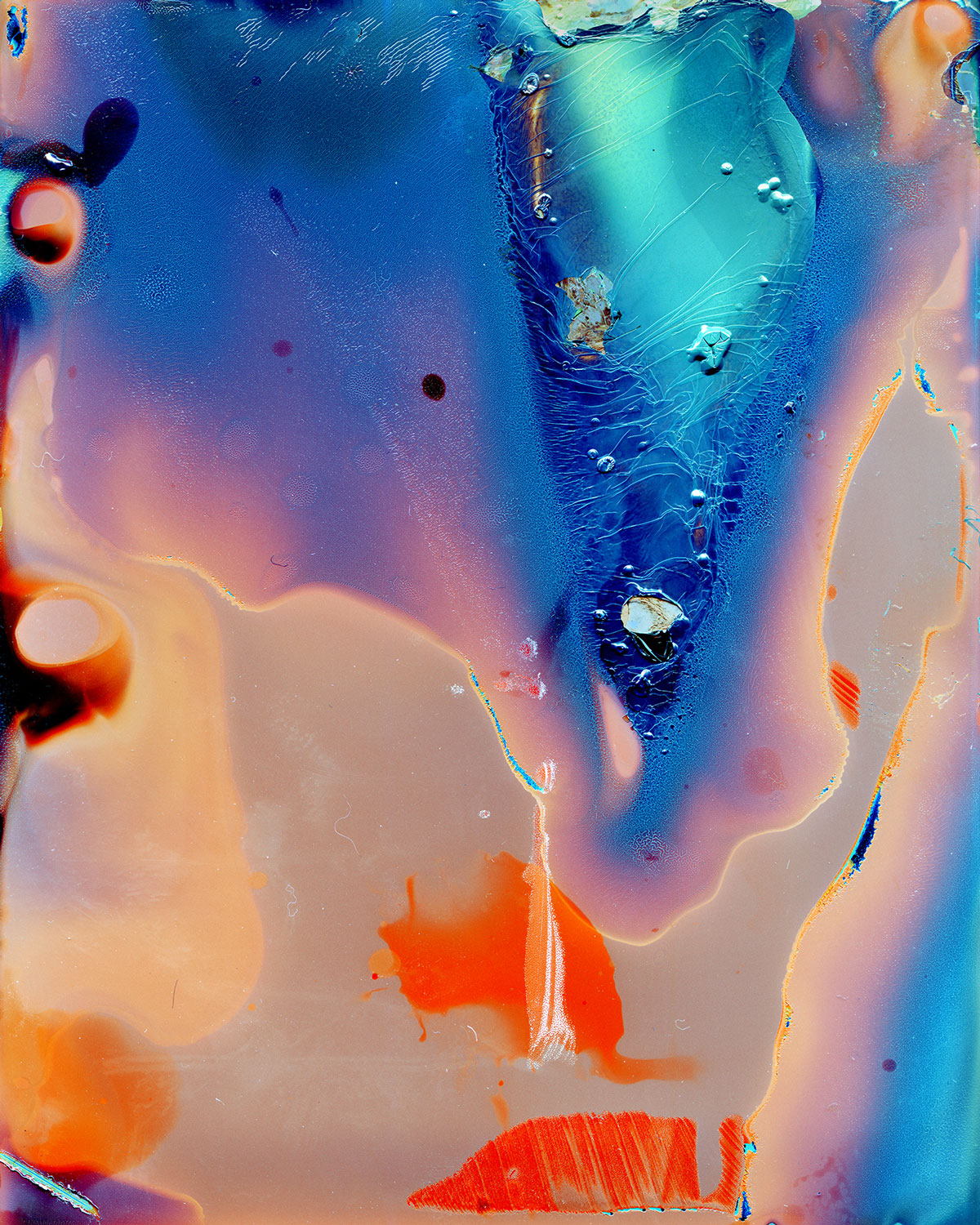
“For this series, I developed 4x5 and 8x10 film without being photographed. When the film is developed in boiling water, it melts, producing remarkably vivid colors.”
This is something like a photographic version of Jackson Pollock. Just as Pollock turned the action itself on the canvas into a work of art in his action painting, Daisuke Yokota transforms the actions performed on film into photographic prints, a radical practice that could be called “action printing.”
“I think this could only have been done in the era after digital cameras. In the days when only film existed, no one would have done something so wasteful. Now that taking photographs with digital cameras has become the norm, we can face photography in a digital environment and reconsider it as a material in its own right. For me, photography isn’t just a record of shooting, it can be separated from that act and reconsidered as a medium, with new possibilities to explore. When I tried it, the results were much more interesting than I expected. I was surprised by the finished product, and it made me realize that film has this kind of side to it, and I simply wanted to show everyone.”
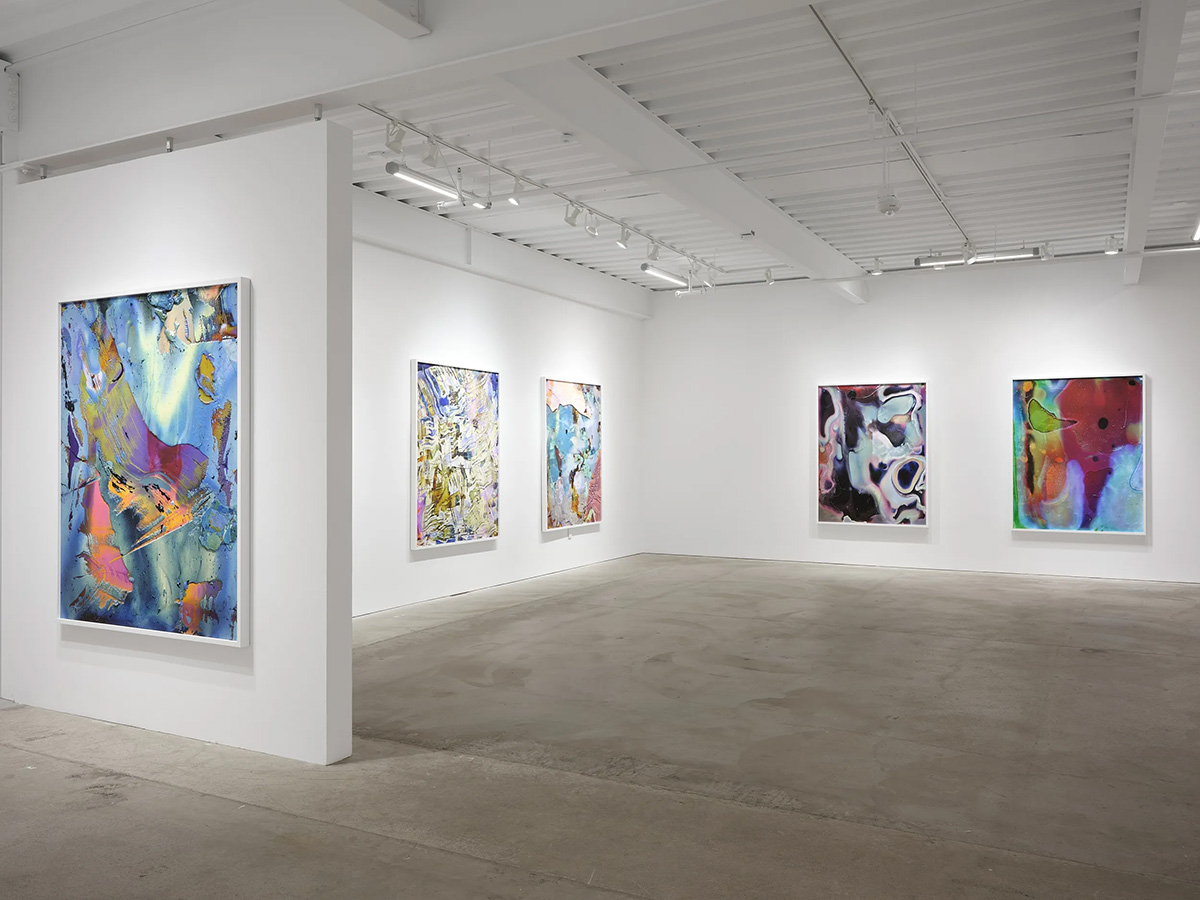
Many people see photography as something that exists because of a subject. However, Yokota reconsiders photography itself as the subject.
“With digital photography, you tend to think of a photograph as just light and information. But with film, a photograph is made as a physical object. There are many stages, from developing to printing,and a photograph exists after going through these processes. Perhaps because of my struggle with not having a subject, I arrived at photography without a subject.”
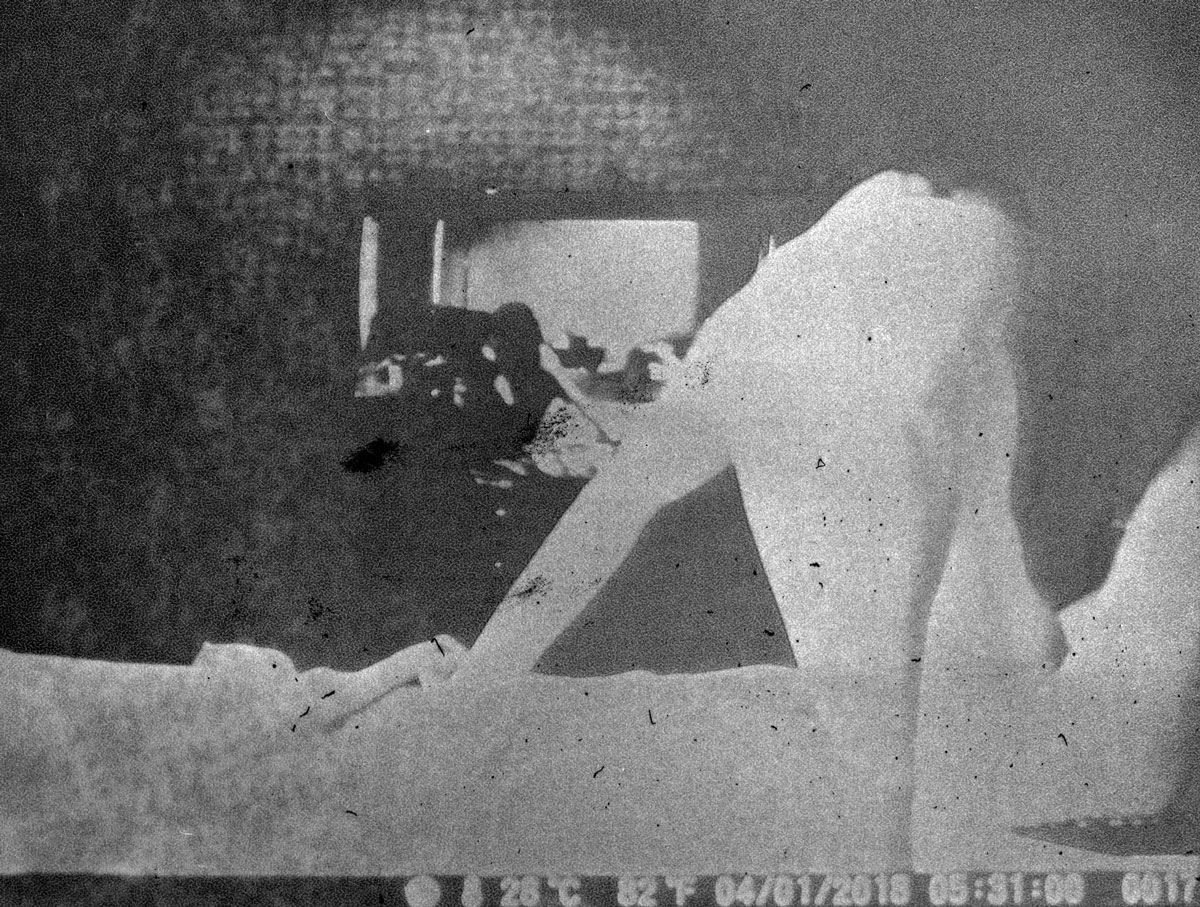
Even as he continues to pursue photography without a subject, the fashion photographs Yokota contributed to the second issue of the independent fashion magazine VOSTOK left a strong impression, featuring Yokota himself as the subject. Shot in a hotel room, the series was photographed from an anonymous perspective, as if he were being watched by someone, prompting a reconsideration of the relationship between photographing and being photographed. The result is a work that feels almost like a photographic essay in visual form.
“Around the time I received that shooting offer, I would hole up alone in a love hotel and spend the entire time repeatedly taking photographs. I placed the camera in the room and made myself, the photographer, the subject, creating a one-to-one relationship between camera and subject. A love hotel room has no windows and is dimly lit, so when you turn off the lights, it becomes completely dark. The room itself turns into a pitch-black box. Being inside that box-like room felt, metaphorically speaking, like a camera obscura. The box itself becomes the camera, and the very act of trying to photograph myself inside it becomes a kind of critique of photography.”
Yokota’s new work at Studio 35 Minutes, as mentioned at the beginning, is an extremely straightforward kind of photography for him. Taking plants from the midstream of the Tama River as its subject, the work involves no radical manipulation, nor any destructive use of film or medium. However, his unmistakable imprint remains in the prints and the exhibition. And though I’m not sure whether this word is appropriate praise for his photography, the work is undeniably very beautiful. This major shift in Yokota's work is reminiscent of photographer Takuma Nakahira's move toward extremely straightforward photography and botanical photography after he suspended his work in the radical magazine provoke, which was criticized for its "abrasive, blurry, and out-of-focus" nature.
“To put it extremely, those plants were the first subjects I truly felt I wanted to keep pursuing. The reason I was so drawn to them was that I had been feeling unwell recently due to some mental and physical issues. I had been continuously engaged in reconstructive photographic processes, and I had become a bit unwell, so I had to stop working on my photographs. In the midst of all this, I had the opportunity to see a video of a YouTuber eating wild plants, and the place he was visiting was a place I often pass through in the midstream of the Tama River. I’d always liked plants. When I was little, I used to make jam from fruit I picked in my neighborhood. So when I watched that YouTuber talking about wild plants, I thought maybe I could incorporate wild plants into my life to improve my well-being. When I revisited the midstream of the Tama River, I realized there were so many plants that must have always been there, yet I had never truly seen them before. They appeared incredibly beautiful to me. At first, I wasn’t going there to take photographs, it was more about improving my daily life, almost like a kind of therapy. But through that process, I began to want to photograph nature as a subject. That feeling was a first for me, so it felt very fresh. It was as if I was able to confront the subject in a very straightforward way.”
With these photographs, as long as they functioned as a record of certain plants along the Tama River at a particular moment in time, I was OK with it. I didn't need to have my own expression or concept, so it felt more like I was rebuilding my foundation, reassessing the starting point of photography."
Kota Sake of the gallery Studio 35 Minutes has this to say about Yokota's plant works.
“The color works from the first phase (Plants, Tama River Midstream Area) are closer to straight photography compared to his earlier works, which emphasized the developing and printing processes. They place greater importance on ‘seeing’ rather than ‘making.’ Meanwhile, the black-and-white works from the second phase (Plants, Darkroom) are prepared through a Yokota-style process, so even though they come from the same negatives, they leave a completely different impression from the first phase. In this Plants, Tama River series, ‘seeing’ and ‘making’ have begun to merge, and it feels as though a different world has emerged compared to his earlier works. I was surprised that he had reached this point.”
When it comes to photographs of plants, one inevitably recalls the Englishman William Henry Fox Talbot, who invented the negative–positive process known as the calotype and published The Pencil of Nature, the world’s first photobook.
Talbot originally developed photography as a tool for botanical study. Yet this revolutionary technology—and the new visual language it made possible—ultimately secured his place in history.
“Photography of plants can be said to be the origin of photography. As I became more interested in plants, I started looking into related books, and that was fascinating. When you look at things with knowledge, the scenery completely changes. That’s something I experienced firsthand. If you don’t have interest, you simply can’t see things. Even if they’re right there, you treat them as if they don’t exist. So I feel like the reason I started taking photographs is that they only exist when you look at them with interest. It's the obvious foundation of photography, so to speak, but I hadn't experienced or appreciated it myself, and it was a huge realization for me.”
“I think this plant series was an act of rebuilding my foundation and redefining how I approach photography. There’s a possibility that I may return to my previous style in the future, but the current challenge is how to reflect the changes I gained here in my work. I want to explore the system of photography, the question of ‘What is photography?’ through experiences in my own practice, and to recreate that understanding. This isn’t just about shooting, it also involves incorporating techniques that have historically been used in photography, as well as techniques that may emerge in the future, into my own work. However, in order to maintain this, I think it's absolutely necessary to have new curiosity, knowledge, and subjects to confront. This time, I had an experience through plants, so I feel like I want to use that as a hint for further exploration.”
Kobayashi of flotsam books sees Yokota's change as follows.
“To put it simply, I feel this could be called a turning point. However, the aspect of his work that I had sensed before, the exploration of ‘What is photography?’ and the expansion of photography’s boundaries, as if to say ‘This is photography too, right?’, has quieted down. It feels as though he has returned to a more straightforward approach, going out to take photographs, shooting, developing them.”
This plant series seems, for Yokota, both a step forward and a return to the origins of photography. Throughout it, his profound questions about photography and his enduring sense of hope run consistently beneath the work.
“Plant photography is a subject from a very long time ago in the history of photography, but I thought that when I lined up my works on a table, people would perceive them as if they were all lined up in the same line. They exist as the same thing in a photograph. This time, it feels like I'm going back to my roots, but also like I'm moving forward. I hope that my photographs can and will continue to change.”