









Growing up as a shopkeeper: Zhu Hee-cheol, "The Philosophy of Bazaars and Clubs," Vol. 6

Shops are mysterious. They are "public" places that anyone can drop into, but once you step inside, they are also filled with the "private" charm of the shop owner's particular attention to detail. The mixture of "public and private" creates a space that is different from both home and public facilities. "What is a shop?" Philosopher Ju Hee Cheol writes about a familiar and important issue.

text & photo: JU Heechul

To the list of serials

Behavior acquired in a home where the boundaries between public and private are blurred

There's something unique about people who grew up in homes where their parents were in the hospitality business.

Ah, I think that's definitely the case with this person.

I'll be honest, I'm like that myself, so I can quite easily spot the signs of similarities. Especially if the person in question is an only child or the eldest child, I should be able to spot them with a fair degree of accuracy if I spend a little time with them. I guess I have a unique way of looking at people.

I observe people with eyes rooted in a certain wariness and tension, but at the same time a mixture of the interest and anticipation I can't help but feel for new people. I don't stare at them. I casually leave them to their own devices, or respond appropriately, but I also quietly follow their every move and expression with the corner of my eye or with any sense of presence.

The "shop" I grew up in was a Christian church.

I'm sure I'll be criticized for calling it a "shop," but in today's capitalist society, religion also has to have an aspect of a service industry. And because it is deeply connected to people's lives, aging, sickness, and death, it is potentially a service industry that continues 24 hours a day, 365 days a year.

For over 40 years, until his retirement in March of this year, my father served as a pastor in a Protestant Presbyterian church, and my mother served as the pastor's wife. As the eldest child, I played the role of the pastor's son until I left home at 18, and even after that, whenever I returned home.

Most readers are probably unfamiliar with Christianity, so I'll explain a little. In Japan, temples and shrines are more familiar, but the head priest of a temple or a Shinto priest of a shrine probably owns the land or building as a family business. In contrast, in the case of a Christian church, this is not the case in principle.

Although it varies depending on the denomination, Christian pastors and priests generally obtain their qualifications by graduating from a theology school and then being employed by a religious corporation called a "denomination." They are then dispatched to individual churches within the denomination, or are invited to serve in the case of a church with strong authority, and take up pastoral duties.

In the Presbyterian denomination where my father worked, individual churches have a strong authority. With elders as leaders, the congregations run their churches independently. The pastor is merely invited to the area and does not have any ties to the area.

Since I was born, my father has worked at three different churches, finally serving as pastor at a church in Kitakyushu for nearly 30 years, before retiring and leaving the area. I don't know about other places, but in my father's denomination, it's considered good for retiring pastors to leave their post so they don't have any influence over the appointment of their successor. So, I no longer have a place that I can call "hometown," and I no longer have a "family home."

Our family is a pastor in that position. Ever since I was old enough to understand, I have always felt that my livelihood depends on the generosity of the parishioners who gather for Sunday services and other events, and more specifically, their donations.

This is also shown by my attitude. I was always conscious of my behavior, the words I used, and my facial expressions so that I would be as liked as possible, or at the very least, not disliked. This was not because I liked or was interested in people, but because it was a necessity in life. Since reading people's moods in this way had become a habit, I continued to do so even after it was no longer necessary.

The living space where a pastor's family lives is usually a parsonage attached to a church, which is connected to the chapel, which is essentially a place open to everyone. Therefore, there is no such thing as a completely private space for a pastor's family. As a child, the chapel was also a playground, and I grew up reading books donated to the parish hall.

Even today, people don't feel comfortable in spaces that are designed to be lived in by just a "family," such as a home or a family apartment. However, even if they were raised in the same way, there are probably some people who dislike this and would rather live in a space where public and private areas are clearly separated.

In my own case, I have always had the desire to have "my own things," something that was almost nonexistent in the environment I grew up in, but these were things that could be owned by an individual, like clothes. I have a strong sense that buildings and spaces are not something that someone should occupy privately.

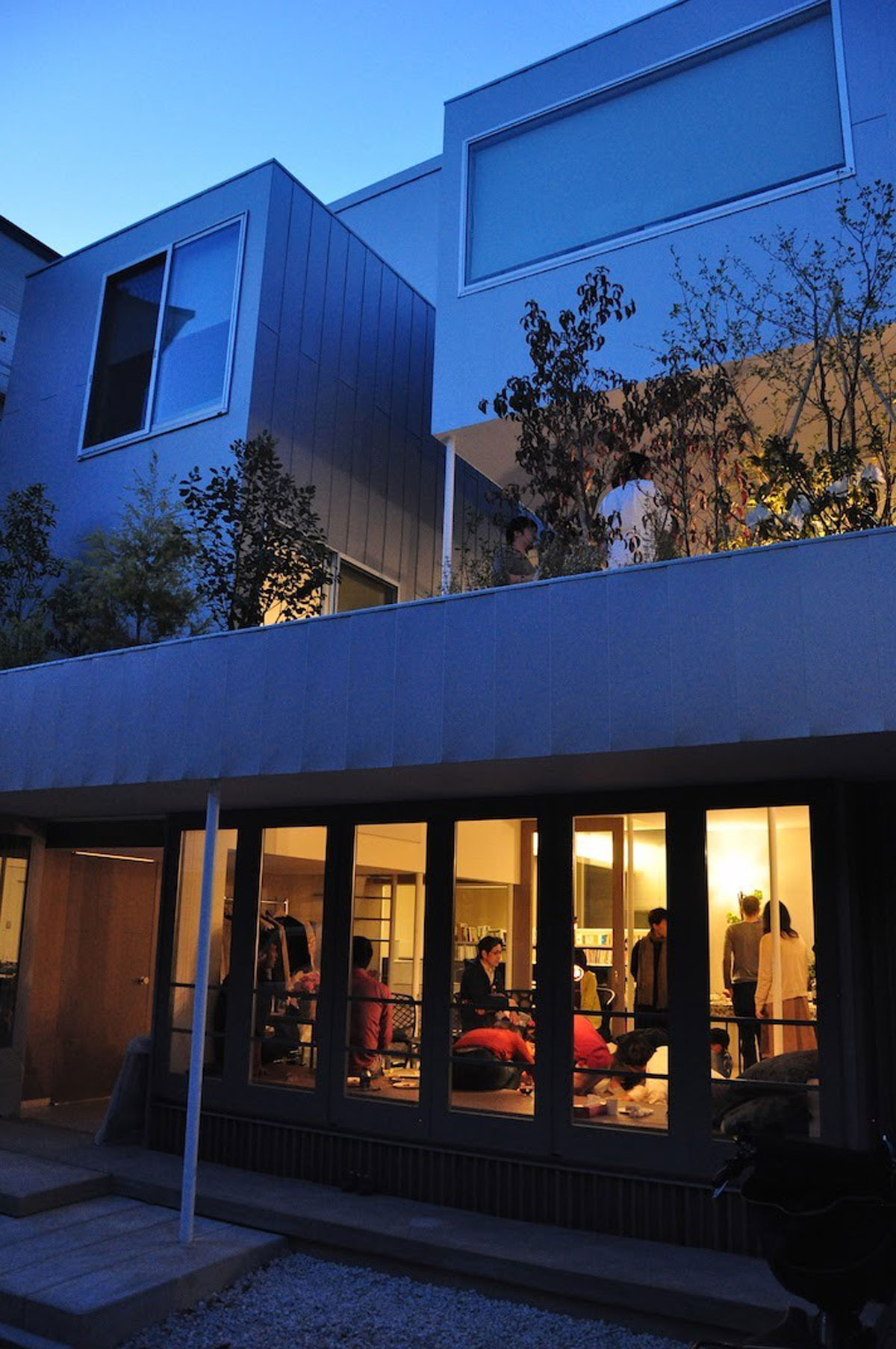
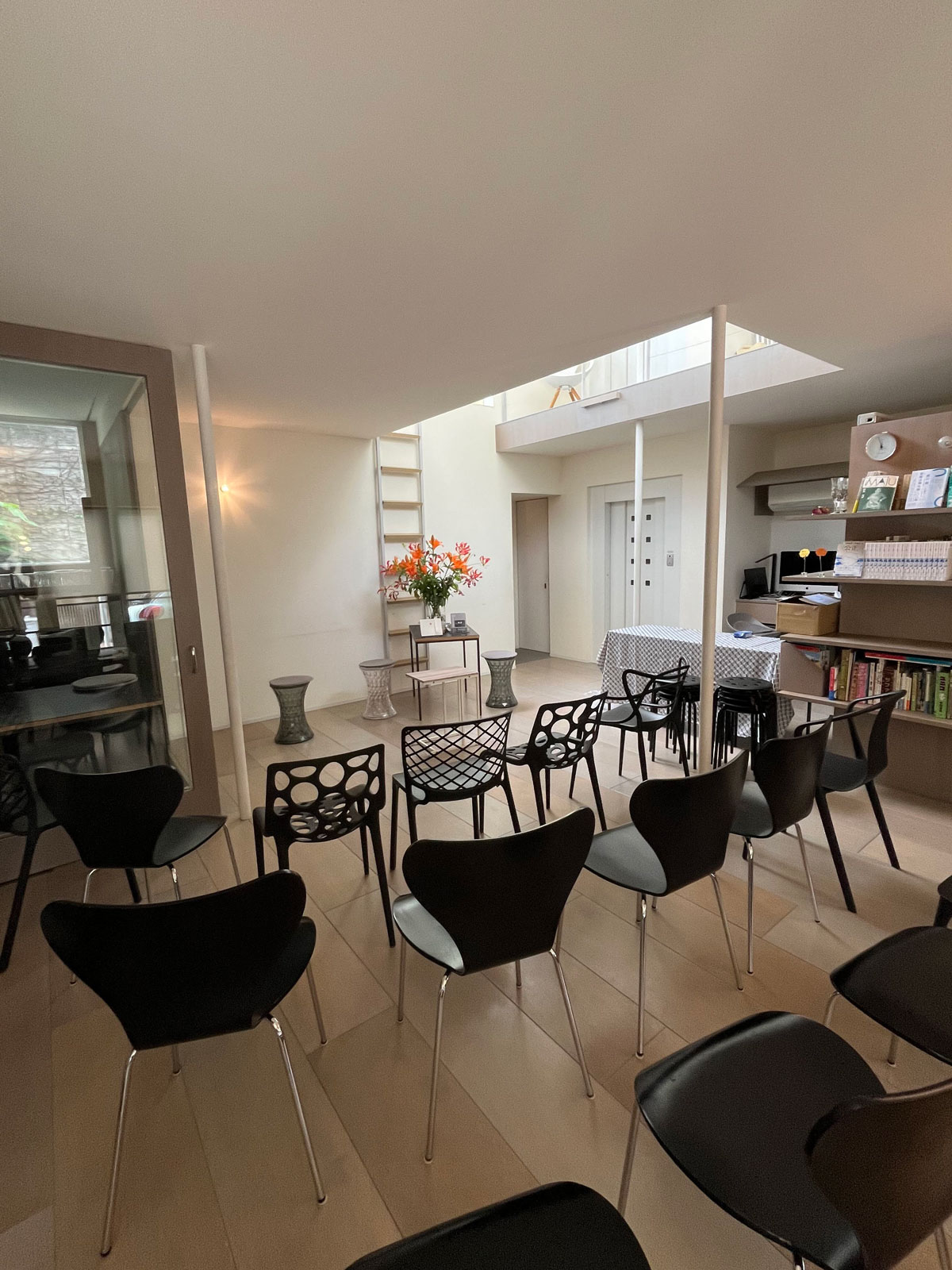
He currently lives in a residence with an attached salon where private and public spaces are connected, and holds events there.

Beauty and imperfection born in a community space

The basic premise of a church is that it is a community connected by faith. Of course, that's true, but it's also a gathering of flesh-and-blood people, strangers to each other, so there are all sorts of issues. Relationships, pecking order, likes and dislikes. If religion is about acknowledging and confronting "weakness" in some sense, then a church made up of a group of people with such weaknesses is bound to encounter all sorts of difficulties.

Many Christian terms are related to sheep, such as "pastor" and the term "pastoral care" used to describe the pastor's duties. Believers are a flock of frail sheep, and Christ is the "good shepherd." A pastor fulfills the duties of an inadequate shepherd. This is merely a mission entrusted to him, and he is not the master of the sheep.

On the contrary, I have sometimes thought of the pastor and his family as a kind of sacrifice offered to maintain the community, just like the "lamb for the burnt offering" that appears in Genesis 22, the early part of the Bible, which I would pass the time by reading during the services I was forced to attend.

Another philosopher who, like me, was the "son of a pastor," was the famous Friedrich Nietzsche.

Nietzsche is the philosopher famous for the phrase "God is dead," but his father was a pastor. However, Nietzsche's father died before he was five years old, so my situation is somewhat different.

However, because it is easy to understand, the standard answer to the standard question, "Why philosophy?", while trying to gauge the other person's reaction, is often, "I grew up in a pastor's house, so I started reading Nietzsche during my rebellious phase..." This is not entirely true, but it is not false either. Nietzsche's mixed love-hate attitude towards Christianity and the church often overlaps with my own.

In The Antichrist, in which he advocates "anti-Christianity," Nietzsche states the following:


***

The word "Christianity" is a misunderstanding. Fundamentally, there was only one Christian, and he died on the cross. The "Gospel" died on the cross. It is a terrible mistake to see the mark of being a Christian in "faith." Only Christian practice, only the life lived by the man who died on the cross, is Christian.

***


As the son of a pastor, Nietzsche may have seen many different sides to Christians and church organizations. Nevertheless, he spoke passionately about the way in which Christ lives his life, which is at the core of Christian ideals. I agree, and there is almost nothing to add.

In the "shop" that is the church, there are certainly beautiful moments and touching scenes of people behaving in a way that is rooted in faith.But even more than that, there is also a lot of ugliness and injustice that may or may not be related to faith, or that arise because of it - in short, the injustice that comes from being a community made up of imperfect, living human beings.

And just because the latter is abundant doesn't mean that the beauty of the very few former is negated or diminished in value. In fact, it may be that it is precisely because it is so rare that it is so wonderful. We are generally not right, but we can be moved by what is right. If this is what we call "faith," then I want to tell Nietzsche, whose harshness I shared with myself as a teenager, that perhaps we should relax a little and forgive ourselves and those around us.

The salon space is reminiscent of a temple hall. It was designed by Yoshiaki Taguchi of the architectural firm Suzumebachi.

What should you be looking for and what motivates you to go to a store?

Whenever I think of the "shop" I go to now, I think of the church I grew up in. Especially shops that have a community feel, where customers connect with each other and become friends. The shop owner, like a pastor, gives up his life to a greater or lesser extent, leading or not leading the flock of "customers" who gather at his shop.

As with churches, customers do not only come for the purpose of the functions the place provides, but also out of habit, to see the pastor or other parishioners, or to eat. From my many years of observation as a "shop assistant," I can say that the customers you should be most wary of are those who "come to see the owner."

Generally, parishioners who come to see the pastor often end up feeling disappointed or dissatisfied that the pastor doesn't care for them, and leave. Such people see love and attention as a distributed resource, and if they feel that they are receiving less love and attention than others, or that it has decreased compared to the past, they will suddenly change their attitude and become a source of trouble.

It's best not to go to church or a store with that kind of motivation.

It's best to attend for your own sake. For your faith. To have some time away from home. Or to contribute to creating a space with the people you meet there. Growing up as a "child" in the church, the good customers and grateful believers are those who quietly attend for their own sake, give a sustainable amount for you, don't rank people based on the amount they donate, don't expect anything in return, are willing to serve, and continue to attend quietly. Even if they are only a small minority, it is because of believers like these that the church group continues to exist.

As for myself now, I still go to the store for myself.

In other words, to play the role of the "ideal customer" that I wished my former self had. Perhaps I am now striving every day to be a "good customer" for my younger self. Perhaps this is because growing up as a "shop girl" has left me scarred, but since that scar is who I am, I have no choice but to live with it.

So today, I go to the store for myself.

Like the pastor, I want to at least respect and be grateful for the imperfect shop owners, the people who offer their lives to me, and not take anything away from them. I want to give them the appropriate compensation, a contribution that will allow the place to continue. In essence, that is also directed towards my former self.

Of course, I myself am imperfect, sometimes not right, and not always able to behave well. But the ideal of being a "good customer," even if imperfect, is simply empty if no one tries to live it. I want to let my younger self know that there are customers like that, or at least those special customers who aim to be that way.

It's like a faith that's not for anyone else, but for yourself.

The classical Japanese translation of the Bible is my favorite and the one I read most often. My sense of Japanese writing style may be rooted in this book.

To the list of serials

FEATURED MOVIES
Featured Videos

BRUTUS
OFFICIAL SNS
Brutus Official SNS

FEATURED MOVIES
Featured Videos