









July 2025. A poetry gathering sponsored by BRUTUS was held in the scorching heat of Shinjuku. The participants were musician Ozaki Sekaikan, poet Shizuka Omori (who also served as moderator), Hiroshi Homura, Akira Aomatsu, Naoko Hiraoka, and novelist Ko Machida, a total of six people.
First, each participant submitted one tanka poem on the theme of "summer." A total of six poems were shared with the author's name hidden, and before the poetry gathering, participants each chose one special selection (the work they thought was the best) and one regular selection as runner-up. The results of the selection are as follows. Authors will not be allowed to vote for their own works.
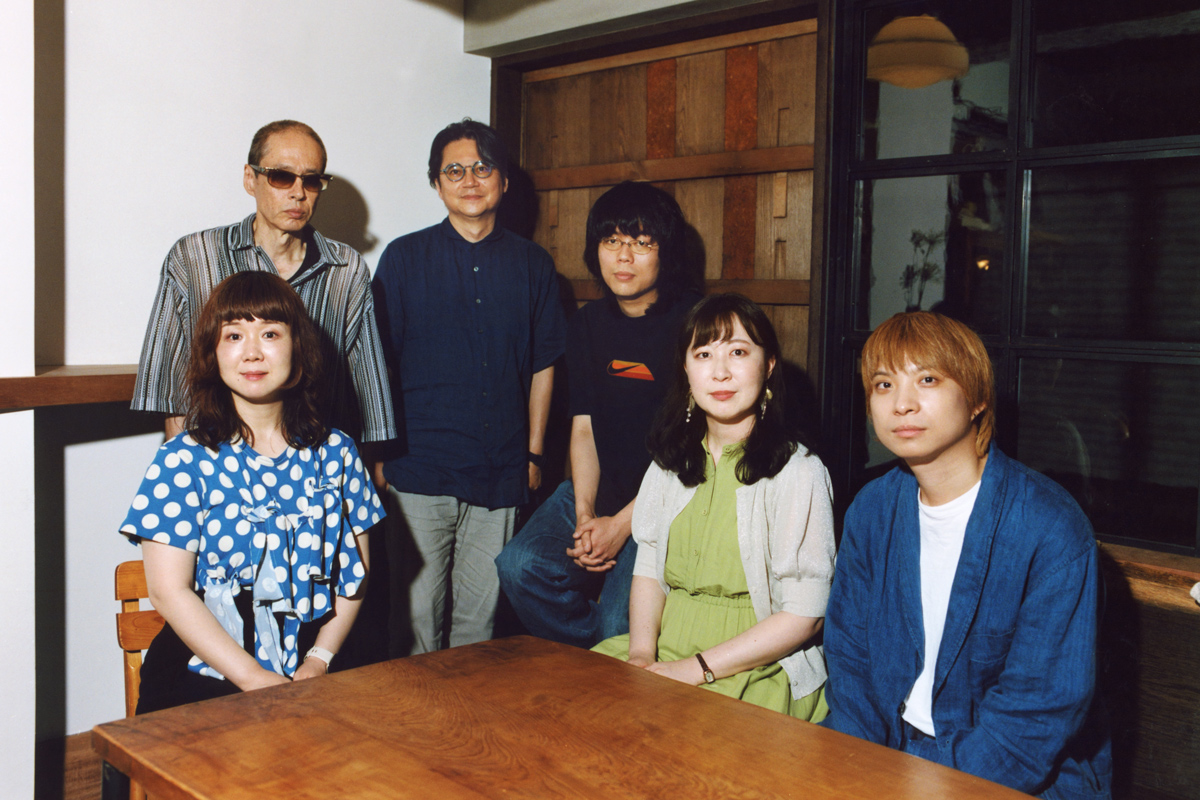
Ozaki (bottom right) jacket: 49,500 yen (BLUE BLUE JAPAN/HOLLYWOOD RANCH MARKET TEL: 03-3463-5668)
Which song are you interested in? One special selection and one regular selection
At the poetry gathering, it is first announced who has selected which poems for the special and regular selections, and then the participants take turns commenting on a total of six poems. Because the number of participants is small this time, there are times when participants will have to comment on the poems they have written. However, they are asked to participate in the discussion as if they are unaware of this so that no one will notice.
After all the poems have been reviewed, the author will be announced. Readers can also choose their own special or regular selection and read on while trying to guess who wrote which song, which will make the experience even more enjoyable.
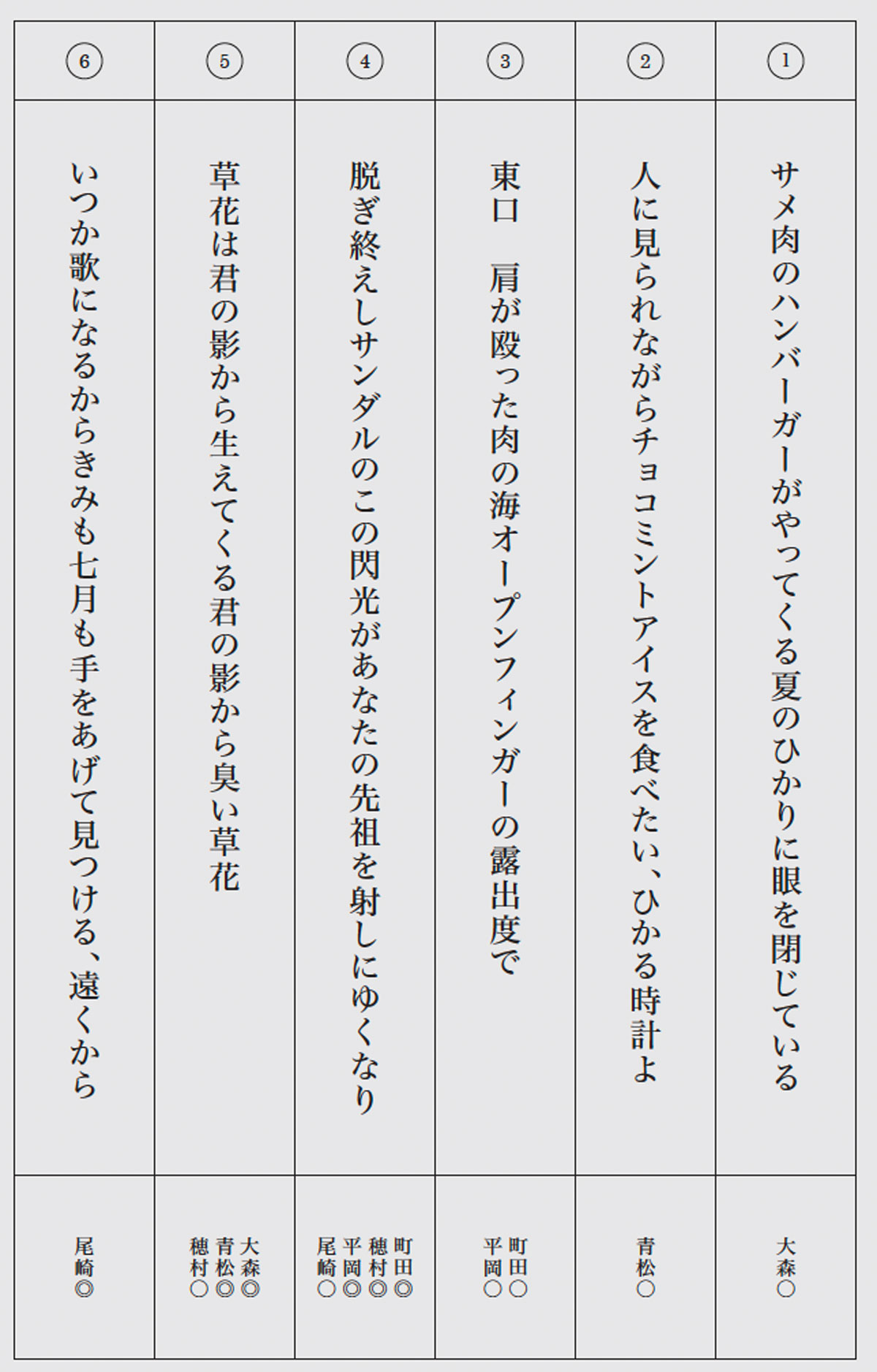
① Predator and prey reversal: The mystery of sharks turning into hamburgers
Shizuka Omori
I'm Omori, your host for today's event. Thank you for your attention. Let's start with item 1. I'll give my review here, as I chose the average selection. "Shark meat hamburger" is a real food, but first of all, sharks are thought of as the representative creatures that eat people.
Hiroshi Homura
The shark may be eating humans, giving it a vague sense of cannibalism...
Omori
That's true. And the gap between that shark being turned into meat and then made into a hamburger really exposes the strangeness of this world. If this were a steak, we could imagine "shark meat" as animal meat a little more realistically, but in a hamburger, it seems a little more comical, or like a fake.
Ozaki Sekaikan
If I ordered a set meal, I wondered what kind of drinks and side dishes would come with it (laughs).
Omori
At first, I also thought it meant something like "the hamburger you ordered is delivered," but the second line says "with your eyes closed." In other words, you wouldn't even notice it being delivered. So I interpreted it as the summer when something like the concept of shark meat hamburgers arrives, like "the circus is coming to the village."
At first glance it seems easy to understand, but when you read it carefully, the meaning seems to diffuse, which matches the brightness of a summer day and the feeling of being in a feverish state, and I found it very fascinating.
Ko Machida
The fact that he specifically wrote "shark meat" gives me a sense of the artist's intention. In the summer, we become more aware of things like vitality and desire. There's even a word for that, "carnal desire," and summer is when images of violent sexuality are amplified within us.
But perhaps because they dislike it, or perhaps because they are dazzled by or yearn for such dark desires, they close their eyes and try to block it out. I felt that the film presented the precariousness and violence of life and sexuality that emerges in the summer, as well as the rejection and yearning towards them.
② Chocolate mint ice cream and a watch = exhibitionism and the finiteness of time?
Omori
Now, number 2 is Aomatsu, who was elected through the regular selection process.
Akira Aomatsu
Does the "watch" in this case refer to a watch with a luminous display like a smartwatch, and is it called a "glowing watch"? Or is it shining because sunlight is reflected off the glass face? Either way, it doesn't have the "I'm eating ice cream in the summer and enjoying it with everyone!" vibe. That's because they've chosen a "different" flavor, chocolate mint, instead of vanilla or regular chocolate.
The reason I voted for this song is because the rhythm is interesting. In my reading, "hito wo mie ni" (be seen by people), "nanagara chocomint" (chocolate mint while doing something else), "to ice cream" (to ice cream), "itai wo" (want to eat), "itai wo" (want to eat), and "itai shining clock" (shining clock) are all 7. I thought it was clever how they were able to accurately indicate that the last 11 syllables would be 4 + 7 by using a comma to replace the missing character in "itai ni" (want to eat).
Homura
I don't really understand the desire to "eat mint chocolate ice cream while being watched by others." I can understand wanting to "eat it secretly" or "share it." And as for the interpretation of the clock, I felt it contained a more symbolic meaning.
"Hikaru" is deliberately written in hiragana, and in tanka, clocks and keys are highly symbolic and are often used as special tools. I think the energy that has been building up through that desire is now sparking a tanka-like spark.
Machida
I didn't know this, but it seems that chocolate mint ice cream is a food that has mixed reviews. Some people say it tastes like toothpaste, while others absolutely love it. Wanting to eat something that is far from everyone's cup of tea is a statement of individuality and identity, isn't it?
In other words, it is a form of social media-style self-display, or even a desire for recognition. By bringing in a clock, an item that symbolizes the finiteness of time, I felt a sense of transience, as if betting on that shining moment.
Ozaki
For the same reasons as Machida-san, I felt that this song was very modern. I think the protagonist thinks of chocolate mint ice cream as a kind of accessory to draw attention to himself.
However, ice cream melts and crumbles over time, which is why the word "clock" comes to life, symbolizing finiteness.
3. The crowded streets of Shinjuku East Exit are a "sea of flesh"? A summer where exposed skin and hearts clash
Omori
For ③, I would like to ask Mr. Hiraoka and Mr. Machida, who were both elected through the regular election.
Naoko Hiraoka
Intuitively, I thought the setting would be the east exit of Shinjuku Station, where the densely populated, chaotic energy of the space and the sense of people rubbing against each other in an unavoidable, violent way rises along with the summer heat.
It is also striking how many body parts appear, such as "mouth," "shoulder," and "fingers." Perhaps the "sea of flesh" is a metaphor for a crowd.
Machida
"Open finger" refers to gloves used in martial arts where the fingers are exposed. There is a technique called a palm strike, which uses the underside of the palm instead of the fist, and it is apparently extremely painful.
In other words, I thought it must be a pretty extreme level of exposure. I don't mean just sexy, but an incredibly high level of exposure that comes with a strong shock.
Aomatsu
To what extent should we interpret the word "exposure" as a sexy line? Personally, I don't want people who see a group of people as a "sea of flesh" to say anything too sexy (laughs).
Hiraoka
I interpreted "exposure of open fingers" as simply referring to the amount of exposed skin, meaning "half of the hand is exposed = high exposure."
Homura
I agree. If it had a physical meaning like "the power of a palm strike," I think it would be written as "with the power of a palm strike."
Ozaki
In the summer, we wear light clothing and our skin is exposed. This means there is less fabric to protect us than in winter, and we feel a little vulnerable. And then, our shoulders bump into someone.
Despite the intention to "avoid collisions," one realizes that one's shoulders have taken up a "punching position" like open-fingered gloves - I thought this work expressed the disconnect between the mind and body.
4. A love song? Or a curse song? What is the meaning of the flash of light that strikes the ancestors?
Omori
In ④, Machida, Homura, and Hiraoka received special selections, while Ozaki received regular selections.
Machida
"You" usually means "someone other than yourself," but in this song, I think it means "yourself." "Ancestors" doesn't mean ancestral spirits or memorial tablets, but something like the "core" within oneself.
In other words, the word "ancestor" refers to one's history and the things that make one who one is. Also, when it comes to "going to shoot," what is being shot is "this flash of sandals," and the image of sandals glowing on the dirt floor of the entrance came to mind.
But while it's impressive, it doesn't seem to make much sense. So I thought that maybe the light is reflecting off the metal fittings on the sandals. And that light is being shone towards one's core. To be precise, it says "going to shine," so it's a poem about the future, about "going to shine."
Homura
I imagined sandals being taken off outdoors, like on a beach or in a meadow. In other words, "flash of light = sun." So, the image is like the sandals that had been hidden by the feet reflecting the sunlight. I find the expression "shining" interesting, as it makes it seem like the light has a will of its own.
This song also conveys a spirit of rebellion against the conventional flow of time, which holds that we are who we are today as a result of blood ties to our ancestors - a linear, irreversible model.
It says that a flash of light that occurs in the "here and now" travels back in time to stab your ancestors. If this were a knife instead of light, stabbing your ancestors would erase the "you" of today. But because it is light, it can stab, or rather, shoot, without causing any harm. I read it thinking it was a song about love with a twist.
Hiraoka
It's interesting that it's not "I took it off" or "I finished putting it on," but "I finished taking it off." It puts the emphasis on the act of taking it off, and it gives the impression that it takes time and effort to take it off.
The protagonist in the story moves forward, that is, towards the future, but I imagined the sandals being taken off flying towards the past, or towards their ancestors, using the reaction force of that momentum.
Also, contrary to Homura-san, I think it's a song with a strong curse, like going to stab with the knife of light, and if you stab your ancestors, then you, their descendants, will never be born.
⑤Shifting the symmetrical structure: the foreign substance known as "smell"
Omori
For this song, Aomatsu and I received special selection, while Homura received regular selection.
Homura
This has a loop, or rather a gatefold-like structure, and has a great sense of rhythm. There's a song by Yoko Nagai called "Andalusia in the sun, but it's too long, but it's too long, and Andalusia in the sun," and it has a similar structure.
Another characteristic is that the song is based on the ka sound, with words like "kusahana" (flowers), "kimi" (you), and "kage" (shadow). There is one strange thing in the last line of this song, and that is the word "kusai" (smelly).
Aomatsu
I was drawn to the way he manipulated the fixed form of tanka poetry. "Smelly" is, if anything, something unpleasant, but I think the fact that he deliberately included that unpleasant feeling is proof that he was approaching the fixed form with a clear intention.
Omori
It starts with "Kusahana" (flowers) and ends with "Kusahana" (flowers). "Kimi no Kage Kara" is placed above and below, creating a symmetrical shape, but the key to making the song interesting is figuring out how to shift this.
The word "smelly" plays that role. If you read only the first line, you get a pastel-toned image with a series of very cute vocabulary, but I was drawn to the dynamism of the way the color tone changes completely with the use of "smelly" in the second line. In fact, the strong smell rising from the breath of summer grass can be described as "smelly," and there is a sense of the earnestness of life force in it.
Ozaki
The loop-like structure can be confusing, but there's also a sense of security. It's like a maze where you know exactly where the exit is. I thought it was a gentle song with just the right amount of confusion and just the right answer, like a real escape game.
Machida
The structure of repeating the same content twice is musically equivalent to repeating lyrics, and it's like a call-and-response in a live performance. Like, "That got the crowd excited, let's do it again!"
Aomatsu
It may sound strange to say this, but I felt that by repeating phrases that at first glance seem appropriate, it created an effect that brought the framework of tanka, or in other words, the "formula," to life.
⑥ The pop and dual nature of “Someday It’ll Become a Song”
Omori
Now, the last song. Ozaki-san, who was selected as the special selection for song ⑥, please.
Ozaki
The sound comes in a little before the meaning, and it's neither too fast nor too slow, with just the right balance, which I found very pleasant.
Also, the comma after "Raise your hand and find" is very effective, and I felt it created a light and pop feel, like "You can go anywhere!". It also has the feel of a Japanese movie title that students might go see on a date during summer vacation.
Aomatsu
I think it becomes a song when the refrain "from" is repeated, "from far away" and "from someday it will become a song," and that's where Ozaki says "it has the feel of a movie title that students might go see on a date during summer vacation" comes into play.
Machida
"Someday it will become a song" is the ideal of the main character in the story, and although he tries hard to achieve it, he still feels that it is impossible...I think that's what it means.
I ended up submitting this song at the very last minute, but the author was also having a hard time writing it, and I think he was making excuses to his editor, saying, "It's okay, I haven't written it yet, but I'm sure I'll write it someday!" (laughs).
Hiraoka
I felt like this song was saying some cold things. Whether it was "You" or "July," it seemed like the main character was gathering material for the song from his surroundings. And the song itself is just too beautiful for that coldness. Lines like "It'll become a song someday" seemed a bit insincere.
Omori
The impression you get will be completely different depending on whether you look at it in a positive way, as if a person will one day become a song after death and blend into the world, or as Mr. Hiraoka says, as if it's cruel that they are used as material for a song.
Homura
I read "Itsuka Uta ni Naru" as a song that dreams of brightness. The song contains multiple lines, but the six syllables in the first line have a soft sound, so it didn't feel as cruel.
Hiraoka
However, I think that if we interpret this as a bright and beautiful song, there is nothing to read into it. I would like to read the "kara" in "It will become a song someday" as containing a complex sense of worry.
The meaning is almost "It will become a song someday," but in reality it is "It will become a song someday." This duality makes the song seem even more appealing.