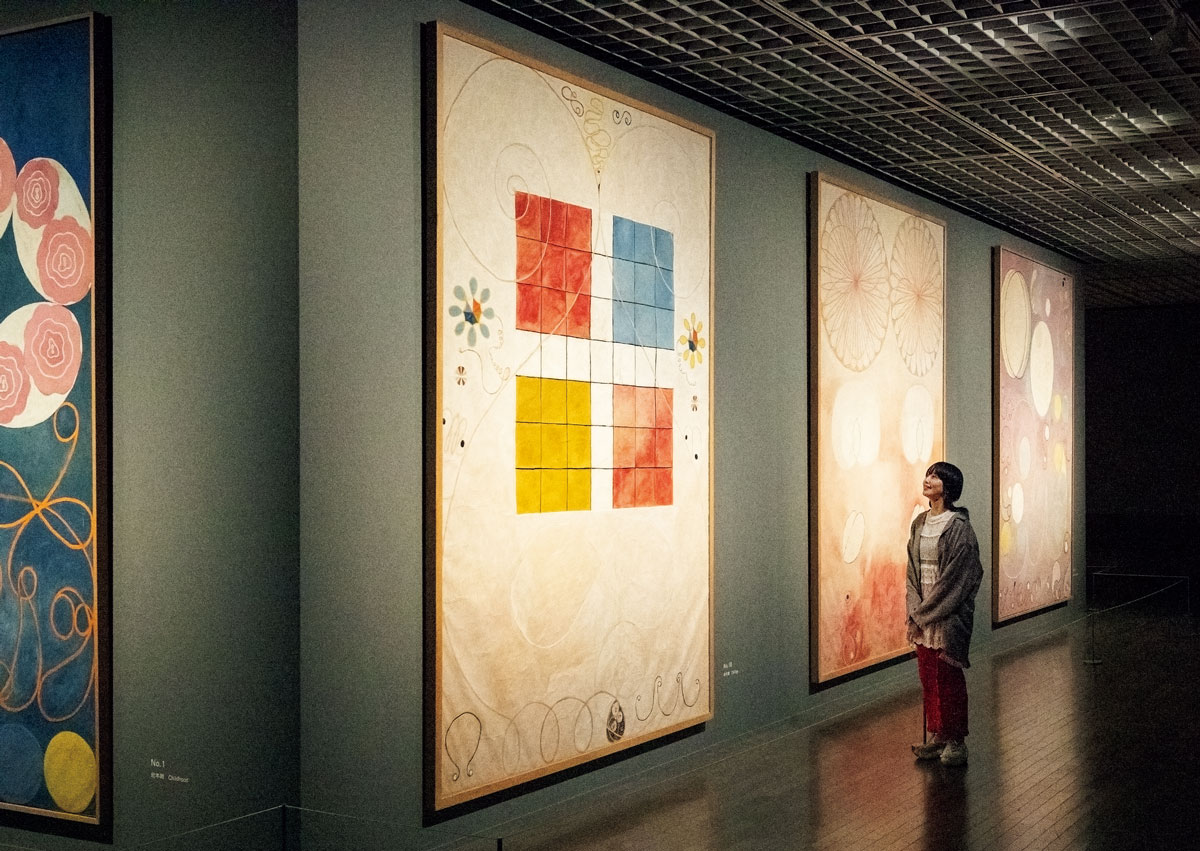










The Hilma af Klint exhibition currently being held at the National Museum of Modern Art, Tokyo, has been attracting attention among art lovers as one of the highlights of the year, but not many people in general are familiar with her name.
This is no surprise, as af Klint was a Swedish female painter active from the late 19th century to the early 20th century, but she has only recently begun to attract attention. In fact, she has suddenly come to be known as a "pioneer of abstract painting," having worked on abstract paintings before Wassily Kandinsky and Piet Mondrian.
As a result, exhibitions were held at famous art museums around the world, and the Guggenheim Museum in New York recorded a record of over 600,000 visitors.
Now that this long-awaited first exhibition in Asia is being held, we asked graphic designer Asuka Wakita to look around the exhibition and get a glimpse into the secrets of how af Asuka Wakida, who was devoted to esoteric thought and spiritualism and from there reached the realm of his unique abstract painting, tried to represent the "invisible world."
Abstract paintings have something in common with graphic design in the sense that they are composed of lines, shapes, and colors, and the two have a history of influencing each other, but what did Wakita think of af Klint's work?
"In the past, I had the impression that his paintings were more of a play on colors and lines, or more of a structured painting, but what I found interesting was that a spiritual world is now embodied in each and every color and motif. There are letters and things that resemble letters, but rather than as designs, it's as if he values the meanings embedded in them. The same goes for the colors. For example, blue represents femininity and yellow represents masculinity. I don't think it would ever turn out like this if he had painted solely based on the intuitive pleasure of matching colors."
Although af Klint initially painted representational paintings, he began to acquire an abstract visual language by receiving revelations from spiritual beings through participation in seances, which were popular in the late 19th century, and by automatically writing down these messages.However, did these images really "come down" from somewhere?
"When I was a student, I had the opportunity to meet Shuntaro Tanikawa, and when I asked him how poetry is born, he said, 'People often say that poetry comes down, but that's not true. It's like putting down roots and drawing something up from there.' That made a lot of sense to me. Hiruma is a passionate researcher, and in his later years he produced diagrammatic representations of plants and loved analysis. Even if it wasn't conscious, I think that's where the motifs came from."
In later years, af Klint devoted himself to organizing his works and documents in order to preserve them for future generations. This is why we can now see the full picture of his work, but his perspective as an editor and archivist is also noteworthy.
"He doesn't just create and leave it at that. He's also creating an artist book. He said he didn't think his work would be immediately understood by the world, which is why he's so passionate and determined to leave his work behind so that it can be understood even after he's passed away. If I were in Hiruma's position, I might have given up halfway through. I have the utmost respect for his unwavering belief in his own work."