








The hand speaks volumes #11: A coffee evangelist who specializes in dark roasts

Working hands tell an eloquent story about a person's work and the life they have lived. From masters to those on their way, to young people just starting out, this portrait and interview series takes the time to listen to the voices of people on various paths.

photo: Masanori Akao / text & edit: Teruhiro Yamamoto

To the list of serials

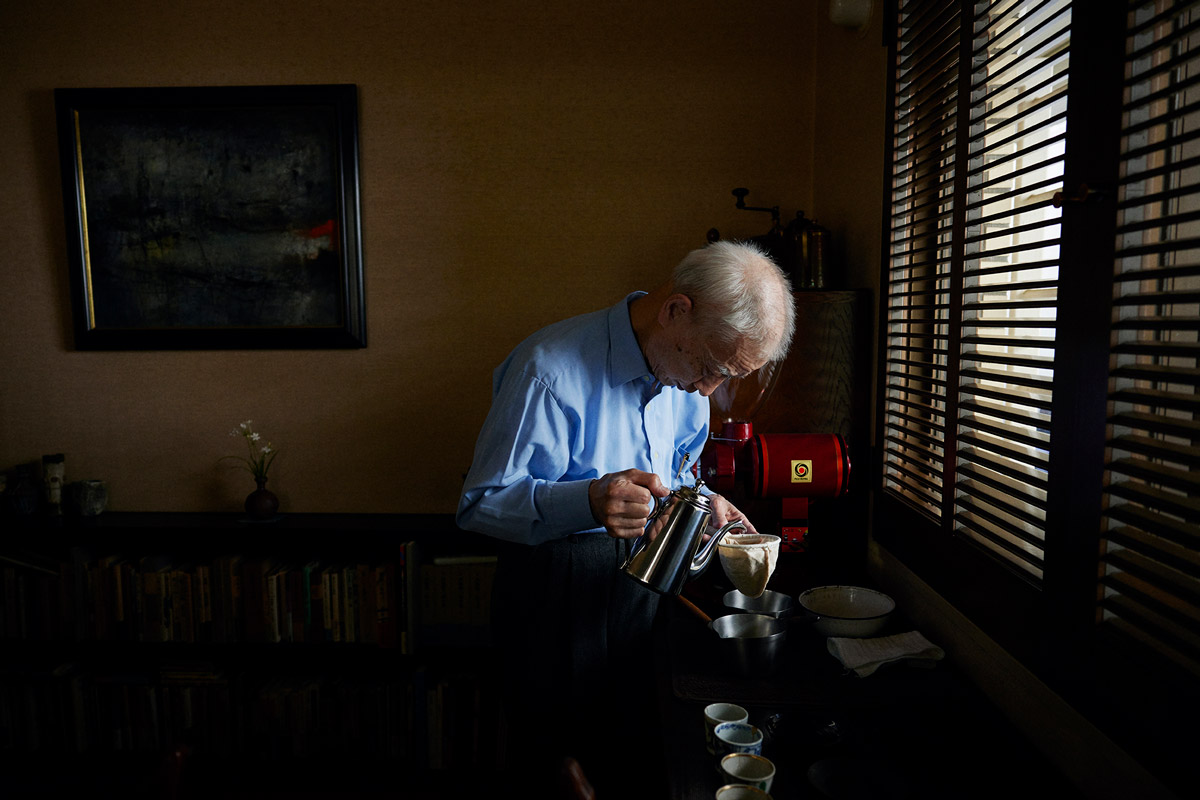
Without turning the pot, he pours hot water straight from the spout and swirls the cloth dripper held in his left hand. Surrounded by the mellow aroma that rises with the steam, he slowly brews the coffee. Katsuji Obou's serene manner has not changed since those days.

Daibo Coffee Shop, which was in Aoyama for 38 years from 1975 to 2013, is known as a legendary shop that serves the best coffee. When I mentioned this at the beginning of the interview, Daibo replied bluntly, "I think it's a misunderstanding that I had mastered coffee. I just made coffee that I thought was delicious."

If there are 100 people who brew coffee, there will be 100 different flavors. "Maybe that's why coffee is drunk all over the world. So I'm surprised when people call me a master." However, he also says, "I thought it would be dishonest to serve something that I didn't think was delicious."

As a high school student in Morioka, Obou frequented coffee shops for a reason other than the coffee. "A close friend of mine was knowledgeable about literature, and he would ask me if I knew this book. I enjoyed that. It was forbidden for students to go to coffee shops alone, so that made me want to go all the more."

While spending his teenage years like this, he developed a desire to open a coffee shop like that someday. He got a job at a bank and moved to Tokyo, where he became an accountant at a company started by a senior colleague, and then worked at the coffee shop that senior colleague had started. Then, in his late twenties, he went independent and started "Obo Coffee Shop."

"At the time, Mocha, a coffee shop in Kichijoji, had a reputation for its delicious dark roast coffee. But when we tried roasting the beans ourselves a little further, we realized ours was even better. That's when we decided on the key to dark roasting."

He first encountered the Nel drip style at another coffee shop. "I was sitting at the counter of Cafe de Rambre, watching them brew coffee, when I saw a single, smooth line drawn through the Nel drip, and I knew that this was the way to go." It's an interesting story about how the now legendary Obou used to frequent the coffee shop of his predecessor in his youth.

Perhaps due to the location in Aoyama where Daibo Coffee Shop is located, "Many customers spent time alone. It was a place where they could reflect on themselves." James Freeman, the founder of Blue Bottle Coffee and a key figure in the third wave of coffee, also visited the shop and later told Daibo, "I felt that I shouldn't disturb that tranquil atmosphere."

We have a wide variety of customers, and we want them to come back again and again. That's why we believe that our coffee should be strong and bitter, perfect for those who want to spend time alone.

Obou believes that "all responsibility lies in the roasting." He uses four types of beans: Colombia, Ethiopia, Tanzania, and Guatemala. He uses beans that have been imported for a long time and are readily available, and "he thinks that he should somehow make them delicious by changing the way he roasts them."

Roasting begins with the heat on full blast, then gradually reduces the heat. When it looks like it's about to pop, reduce the heat even more to delay the pop. Once it pops, reduce the heat again, and it takes 30 minutes to roast 1 kilogram of one type of bean. The flavor can lean towards bitter or sour. The ideal is to have both bitterness and sourness wrapped in sweetness, but this is not easy to achieve.

"As the beans are roasted, they suddenly lose their strength. The strength is probably due to the acidity, which disappears. The bitterness of the beans also disappears, but the bitterness of deep roasting suddenly emerges. The point just before that is the key." If the point of zero acidity is 7.0, then the coffee is at 6.9 or 7.1. Each of the four types of beans is assigned a role, roasted separately, and blended.

In 2013, Daibo Coffee Shop closed due to the demolition of the building. "I trained so that I could continue for another 10 years. I thought I would be working standing up all the time." Now, he spends his days giving coffee workshops. "Even when I do that, I always tell my students to do it with the intention of creating their own flavor."

The number of coffee shops has increased dramatically, and Obou says with a quiet smile, "100 people, 100 different flavors. That's a good thing." And today, he brews coffee again, telling himself, "I'm responsible for the flavor."

To the list of serials

FEATURED MOVIES
Featured Videos

BRUTUS
OFFICIAL SNS
Brutus Official SNS

FEATURED MOVIES
Featured Videos