








In recent years, Kiyosumi Shirakawa, Tokyo, has become known as a town for coffee and art. When I visited KINOKO SOCIAL CLUB, located on the first floor of a dark brown building close to the station, I found a glass unit in one corner of the floor, with beautiful mushrooms sprouting inside, giving it the feel of an indoor mini farm.
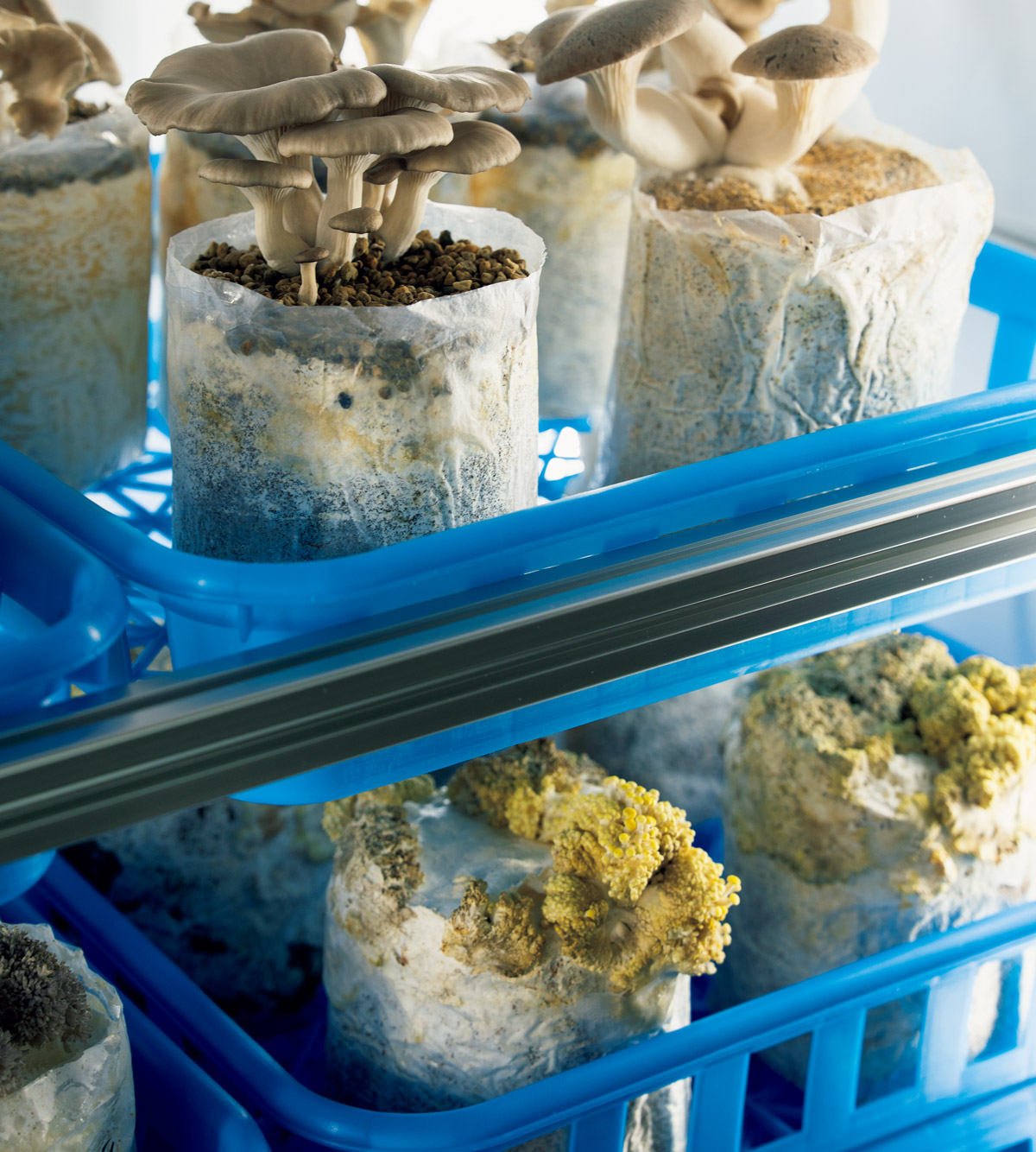
"With the cooperation of a local coffee shop, we create mushroom beds using the coffee grounds produced there and cultivate mushrooms. This is a factory and cafe where you can watch the mushrooms grow up close and eat the food they make. The place where the ingredients are grown and the place where they are eaten are connected, allowing you to experience a cycle that is hard to see in the city. We opened this place in April 2025 as this kind of place."
So says representative Taichi Manabe, who moved to Kamiyama Town, Tokushima Prefecture in 2014. In 2016, he co-founded the Food Hub Project with the town hall and has been involved in a variety of activities based on the theme of local economic circulation.

"As an agricultural corporation, we don't just grow crops; we develop and manufacture processed foods using local ingredients, run a restaurant, bakery, and grocery store, and provide school lunches. Over the past 10 years, I've finally come to realize that I'm contributing to the community through everyday food. At the same time, I've been thinking for several years now about whether I could do the same thing in Tokyo."
Manabe has put down roots in Kamiyama, connecting with not only locals but also people from Japan and abroad, while continuing to cultivate the satoyama through food. After 10 years of doing so, he decided to cultivate the city and started KINOKO SOCIAL CLUB in Tokyo.
Aiming for urban food production and recycling-oriented agriculture
Why did Manabe focus on mushrooms? There were two reasons.
One reason is that mushroom cultivation using coffee grounds has been practiced around the world for some time.
"Among people interested in zero-emission agriculture (reusing waste to produce crops), it was fairly well known that you could grow mushrooms using coffee grounds. In Kiyosumi Shirakawa, where I serve as manager of the restaurant, the Blind Donkey, we are able to make food from organic matter that would be considered waste in cities, while still maintaining our connection to the local community. We also have a chef on-site, so we can even serve the food. I thought that perhaps we could realize the short food supply chain that we had established in Kamiyama."

The cafe's menu was created by Chef Hirotaka Sone of the Blind Donkey, located on the second floor of the same building. 
The cafe offers mushroom burgers such as the "Big Mash" and "Mushroom Fritters," as well as the addictive mushroom shake "Mash Shake."
Another reason is that Kamiyama has a long history of shiitake cultivation as an industry, and is one of Japan's leading production areas. The Kamiyama Shiitake Production and Sales Cooperative Association grows shiitake mushrooms on mushroom beds in factories, and its production volume is among the highest in the country. The Food Hub Project is also working to compost the waste mushroom beds generated from this process and use them to grow vegetables.
"I thought it would be interesting to cultivate mushrooms in Tokyo as part of this recycling-based agriculture. When I looked into it, I found that it was possible to do so by adding 20 to 30 percent coffee grounds to the mushroom bed, but I didn't think that would be very meaningful."
At that time, he came across Fuji Seeds, a mushroom spawn manufacturer in Yamanashi Prefecture, and succeeded in cultivating mushrooms on a bed made entirely from coffee grounds. He also sells home mushroom cultivation kits, and in the future aims to develop and sell easier-to-grow spawn that can be used to grow mushrooms using coffee grounds produced at home.

They also plan to sell mushroom growing kits that can be used at home. 
Mayu Inose of Fuji Seeds, which is receiving technical support.
"Anyone can become a producer. I hope people will realize this possibility. Urban food sovereignty is also one of the concepts." Furthermore, mushrooms are now attracting attention not only for their potential as food, but also for their potential in environmental purification, medicine, and as a new sustainable material in the fields of architecture and fashion.
"Through mushrooms, we can connect with people from a variety of fields, including architects, designers, and artists. In the future, we would like to invite such people to hold workshops and develop products."
That is why we call ourselves KINOKO SOCIAL CLUB.
FOR GX
-Mushrooms are grown from local coffee grounds.
-Operating a factory and cafe where you can eat cultivated mushrooms.
- Selling a home mushroom cultivation kit using coffee grounds.
・Holding workshops, study sessions, etc.