










Encounter creatures living in an "other world" on the shores of Japan's deepest ocean
Until the mid-19th century, the deep sea was thought to be free of living organisms. This high-pressure, cold, dark world does not allow for easy investigation and research, and many mysteries remain unsolved to this day. Author and naturalist Hiroshi Aramata is fascinated by this unknown realm and continues to explore deep-sea creatures. At 76 years old, he still dives into the frigid ocean to see deep-sea fish, and his curiosity is boundless.
"As a naturalist, I'm interested in a lot of things, but the deep sea is special. What's amazing about it is that there are creatures here that have an ecology that's completely different from the fish that live in shallow waters. If we were to compare it to something on land, they're as different as humans are from monsters or ghosts. In other words, to put it simply, the deep sea world is close to the 'spirit world.' Some elderly divers who are nearing the end of their lives and who are no longer satisfied with the tropical fish of Okinawa feel that this might be the true essence of the spirit world."
To get closer to the essence of this, Aramata and I visited the Numazu Deep Sea Aquarium, which specializes in deep-sea creatures. Taking advantage of its ideal location next to Suruga Bay, the deepest bay in Japan at 2,500 meters, the aquarium regularly displays over 100 species of deep-sea fish.
"Suruga Bay is not only deep, but is blessed with a complex topography with steep slopes and crevices, and is home to many deep-sea creatures. The greatest value of this aquarium is its convenient location, which makes it hard to imagine where else we could do it. Even at nearby Cape Osezaki, you can encounter many deep-sea fish by diving on winter nights, such as giant oarfish and giant deerfish, which come up to the surface, but you can't easily see them like this."

In the event area showcasing unused deep-sea fish. "It may not look good, but hagfish are really tasty. They're a delicacy." 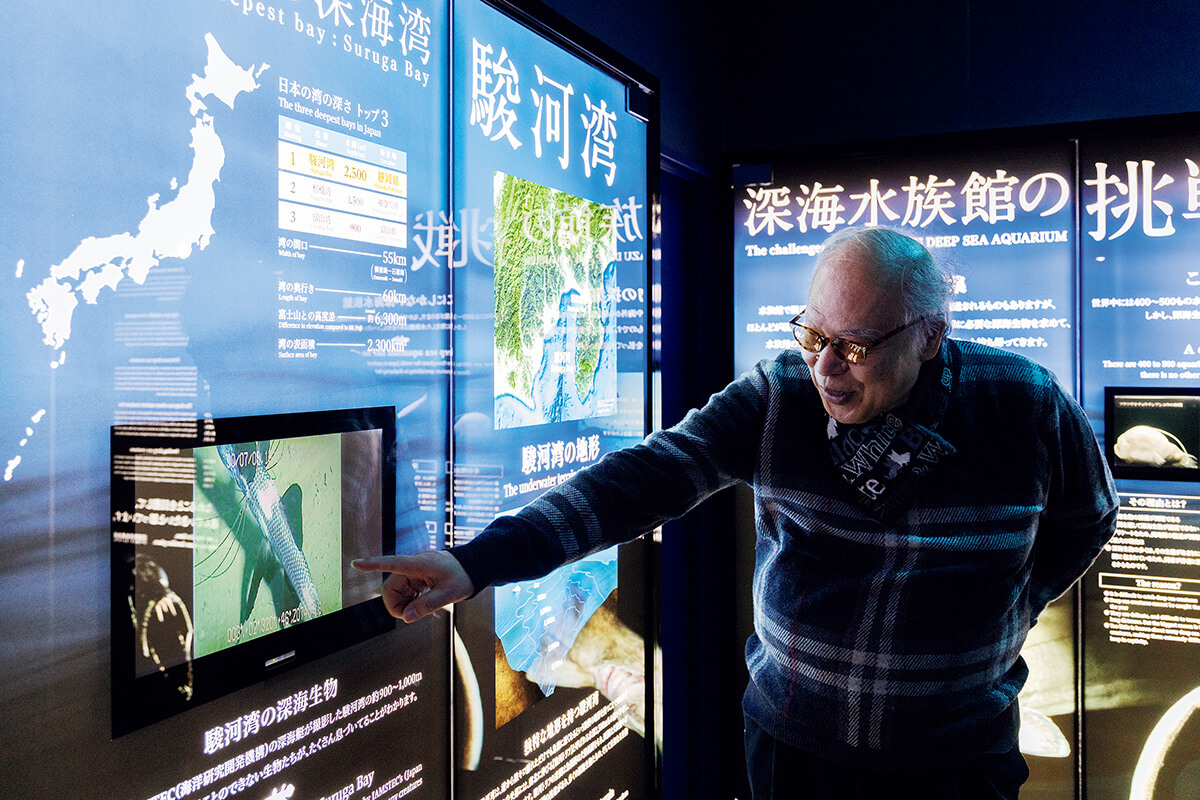
Deep-sea footage taken by the Japan Agency for Marine-Earth Science and Technology (JAMSTEC) shows a wide variety of deep-sea fish swimming in the depths of Suruga Bay. 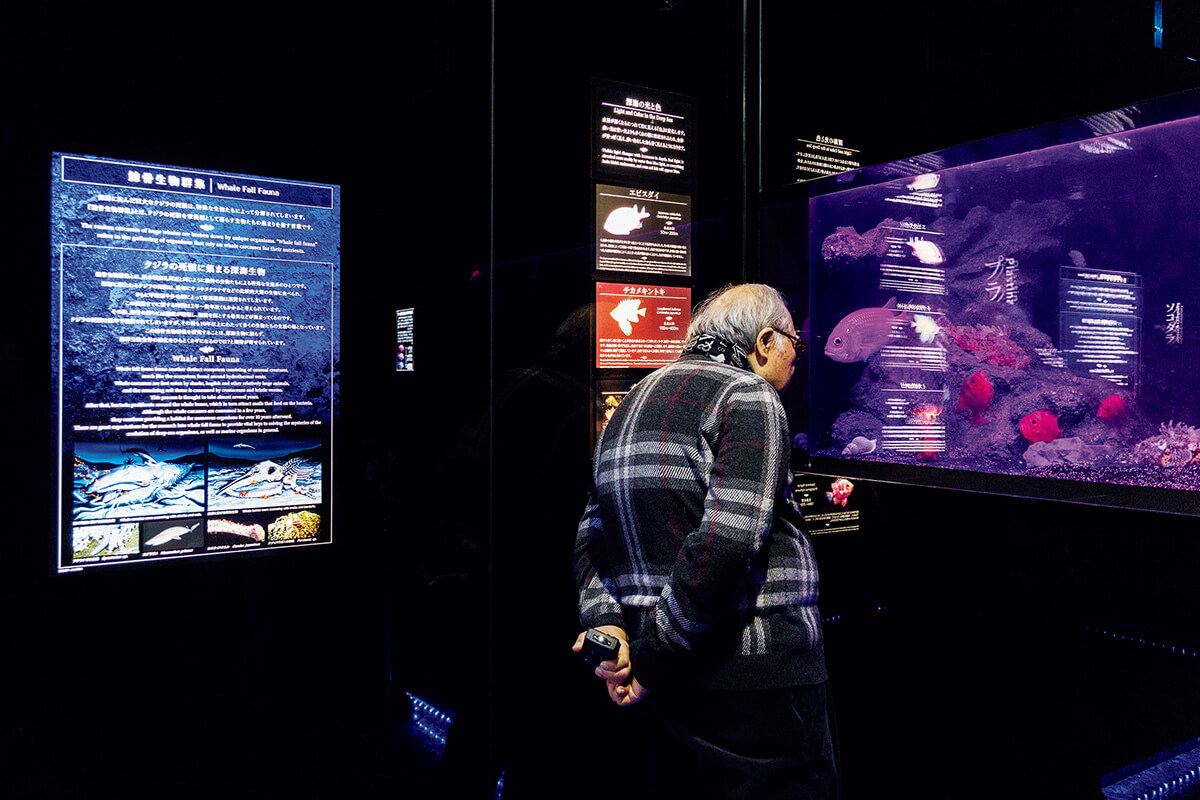
The "Deep Sea World" tank gradually changes the lighting from red to blue, showing the red Elvis wrasse as the complementary color of the dark ocean.
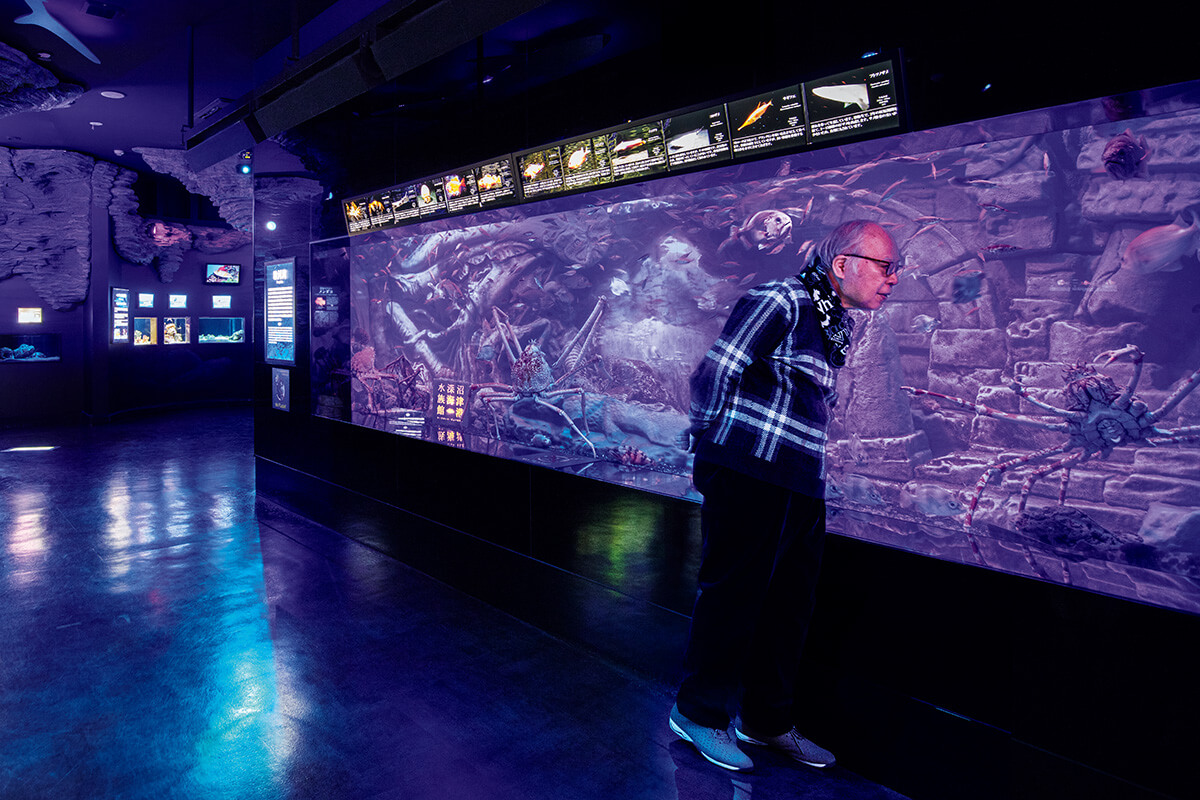
Their excitement is palpable as they spot a potfish in the welcome tank at the entrance and take pictures of it with their digital cameras. They take their time observing the creatures, reaffirming the cuteness of the common octopus, the second in the world to be successfully hatched in captivity, and marveling at the size of the spider crab, which is over 2m in length.
"Displaying swimming deep-sea fish in tanks alongside shallow-sea creatures is a major advancement not seen in modern times. They are displayed in individual small tanks to suit the different temperatures and environments in which they live, making them easy to observe. The space, which makes you feel as if you've stepped into a cave, is well designed. Aquariums in the 19th century had this image of an 'other world.' This is reminiscent of aquariums from the time when the deep sea was truly a wonder."
The unexplored deep sea world is full of new discoveries
One of the attractions of this aquarium, also known as the Coelacanth Museum, is the display of the "living fossil" coelacanth, which is said to have changed little in the last 350 million years. In addition to three taxidermied specimens measuring nearly two meters in length, the museum also displays two of the world's only frozen specimens, along with rare footage of them swimming. Much of the creature's ecology remains shrouded in mystery, stirring up the romanticism of this last unexplored region.
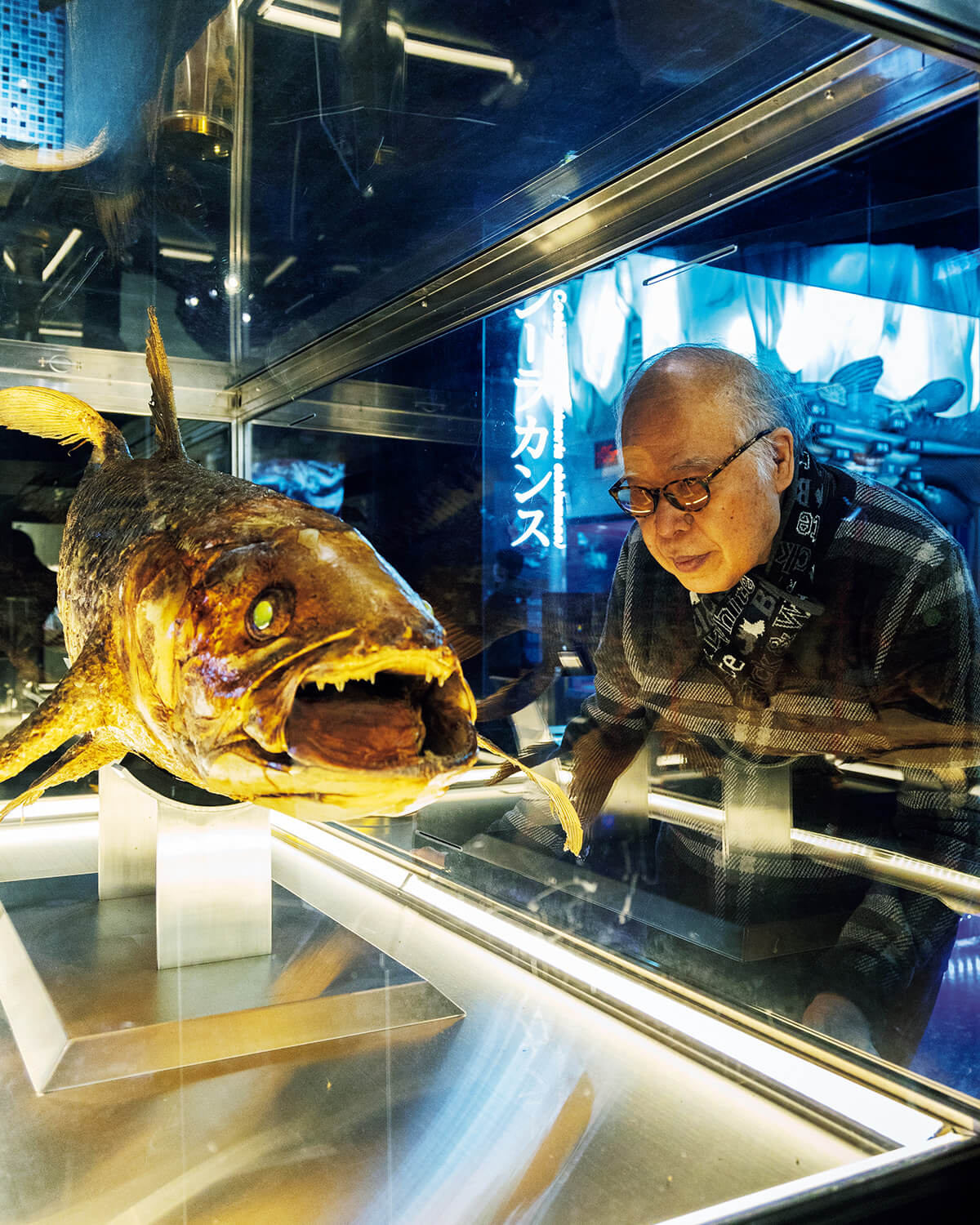
Aramata gazes at a stuffed coelacanth, reconsidering the role of the eyes, which are believed to degenerate in the deep sea. 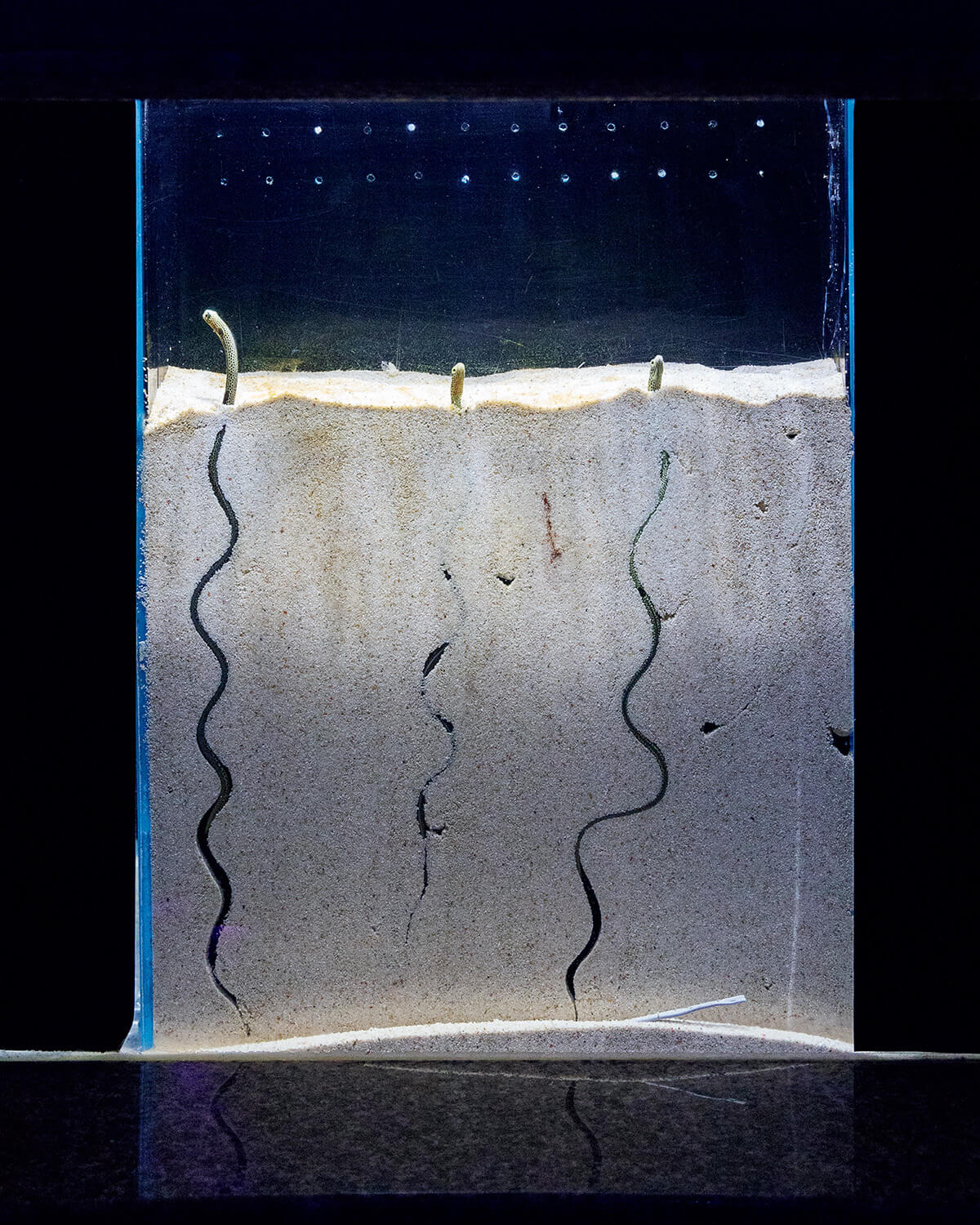
Near the entrance, there are other fish besides deep-sea creatures, including a behavioral exhibit showing how garden eels twist and turn their long bodies to dig serpentine holes underground.
"Looking at their tetrapod-like appearance, we can clearly see the structure of ancient fish when they evolved. The second dorsal fin, which they use for swimming, has a firm layer of flesh attached to the base, and it's amazing how dexterously they can move it, just like our hands and feet. If you look closely at the stuffed specimen, you can see that they have oily eyelids around their eyes to protect them. I thought eyes wouldn't be necessary in the dark deep sea, but perhaps it's precisely because they can't see very well that they take such good care of them to protect them from injury. I didn't know that. Today's big discovery was that eyes are important for deep-sea fish as well."
Afterwards, he toured the exhibits, observing and taking photos of various deep-sea creatures. At one point, he happened to witness a red-spotted sea bass breathing through its gills, and waited in front of the tank for over seven minutes, asking, "One more time, please!", in an attempt to capture the moment on camera.
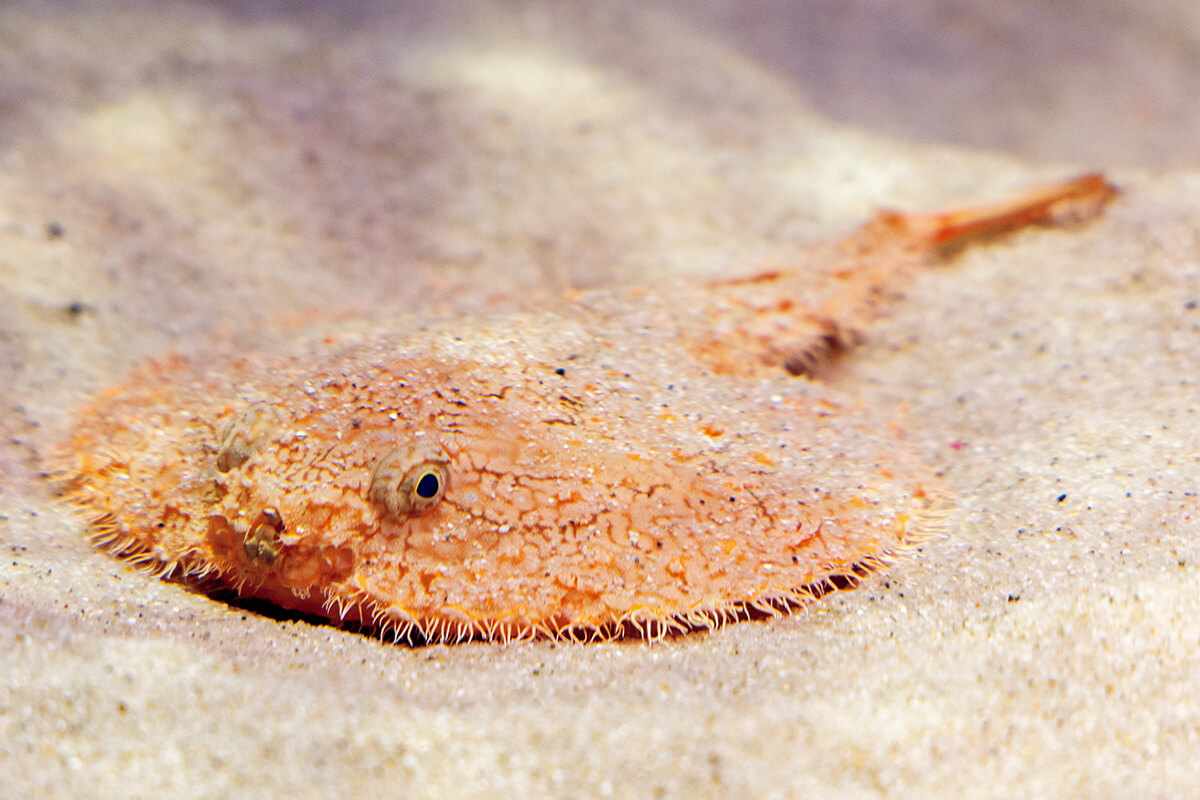
Aramata observed the red-spotted smelt for about seven minutes. It has gill openings near the base of its tail. 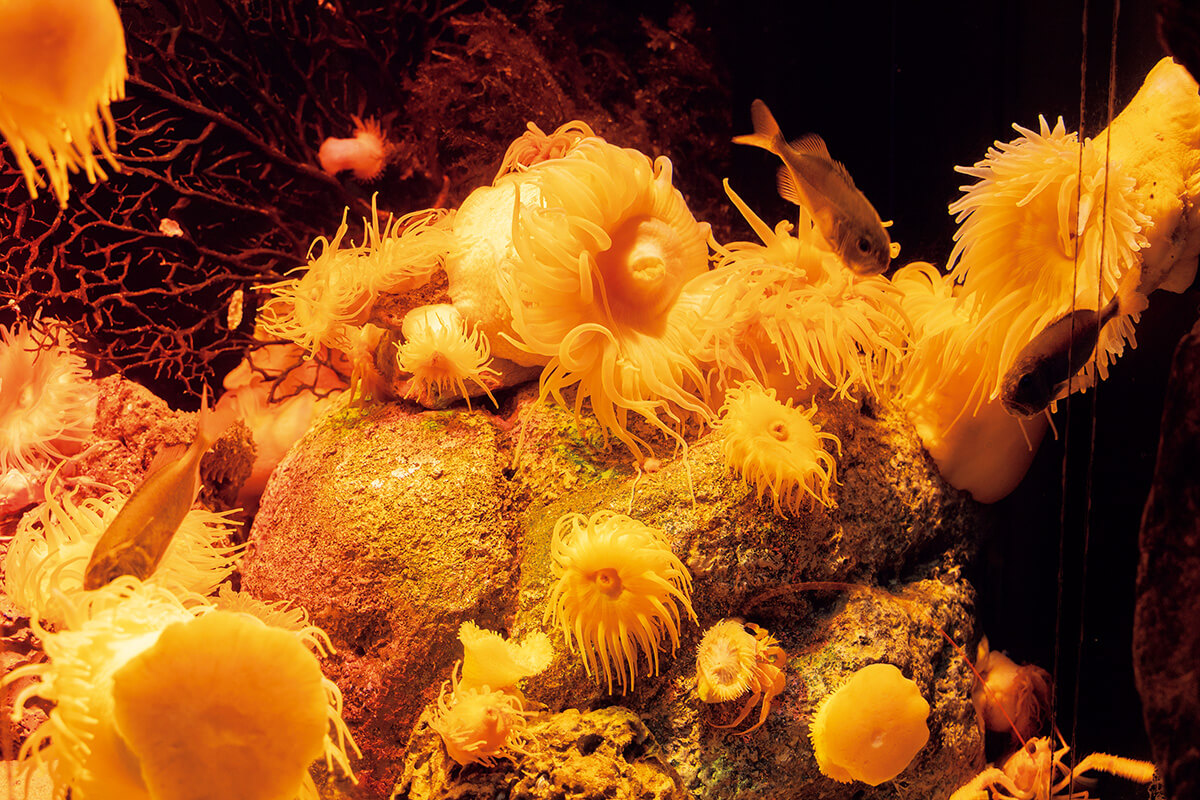
The sea anemones grow in groups like monsters, giving a sense of the strangeness of the deep sea. 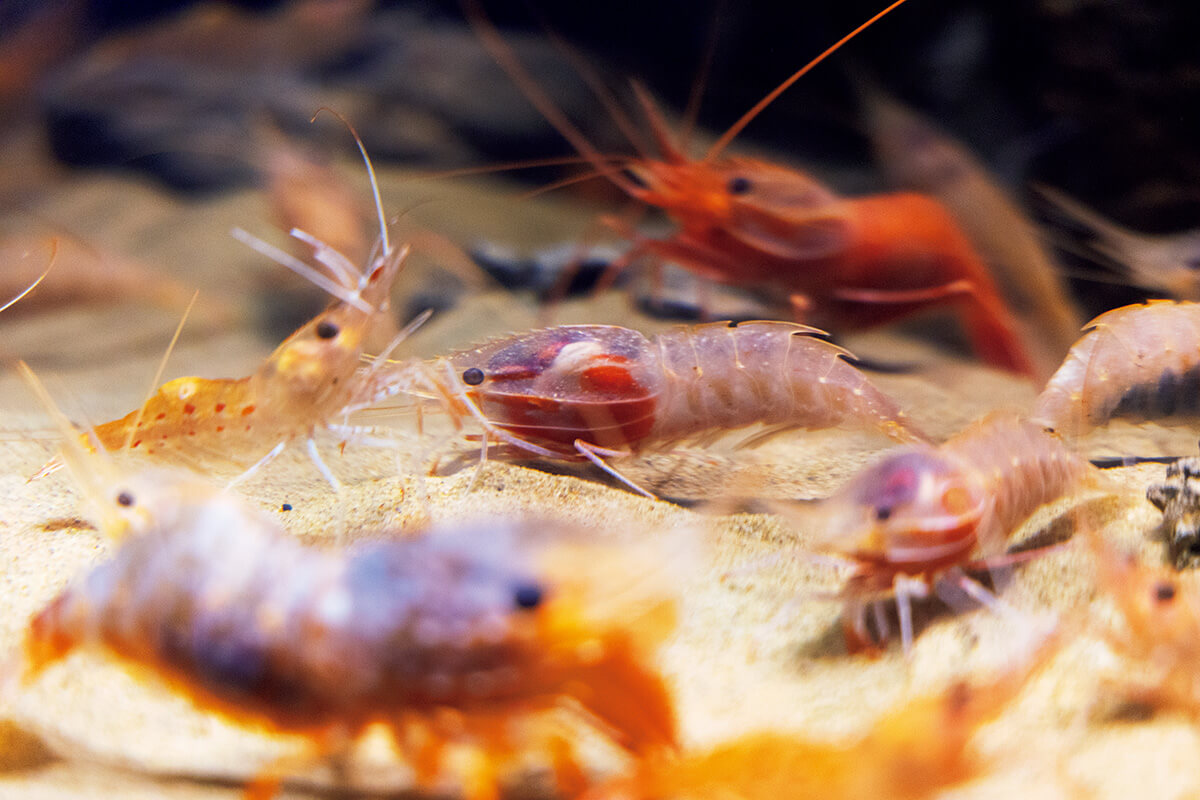
This is a large family of shrimp, with about 50 of each size. 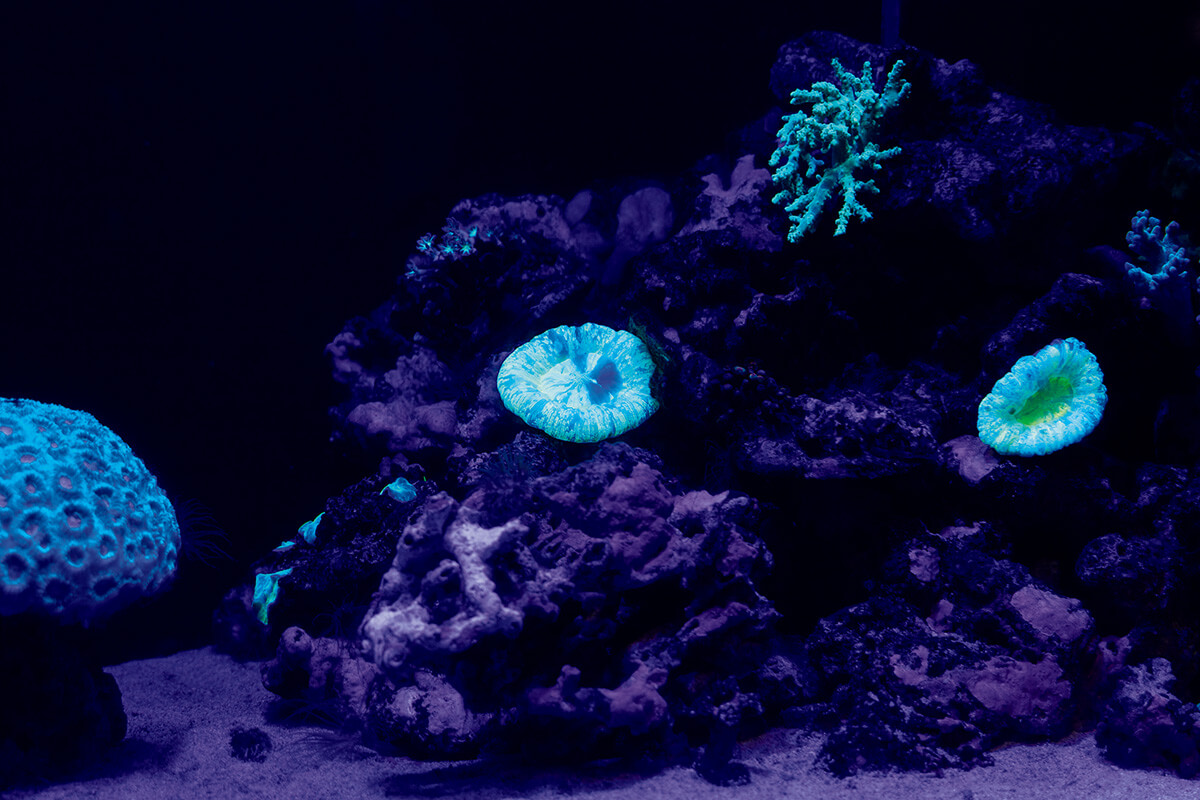
Fluorescent coral emits dazzling colors. It appears to glow, but it has pigments that reduce damage from strong ultraviolet rays, which makes the coral appear fluorescent.
"Today, I learned for the first time that red-legged dung beetles don't breathe very much. I've been here many times since the museum opened, and each time I discover something new. No matter how many times I come, my interest never fades."
Thanks to these efforts, the red sea bass is one of the creatures that the aquarium has finally been able to keep for a long period of time. Because deep-sea creatures can only be collected for a few months in winter, it is the mission of an aquarium with a deep-sea theme to be able to keep other difficult-to-keep creatures alive and on display year-round.
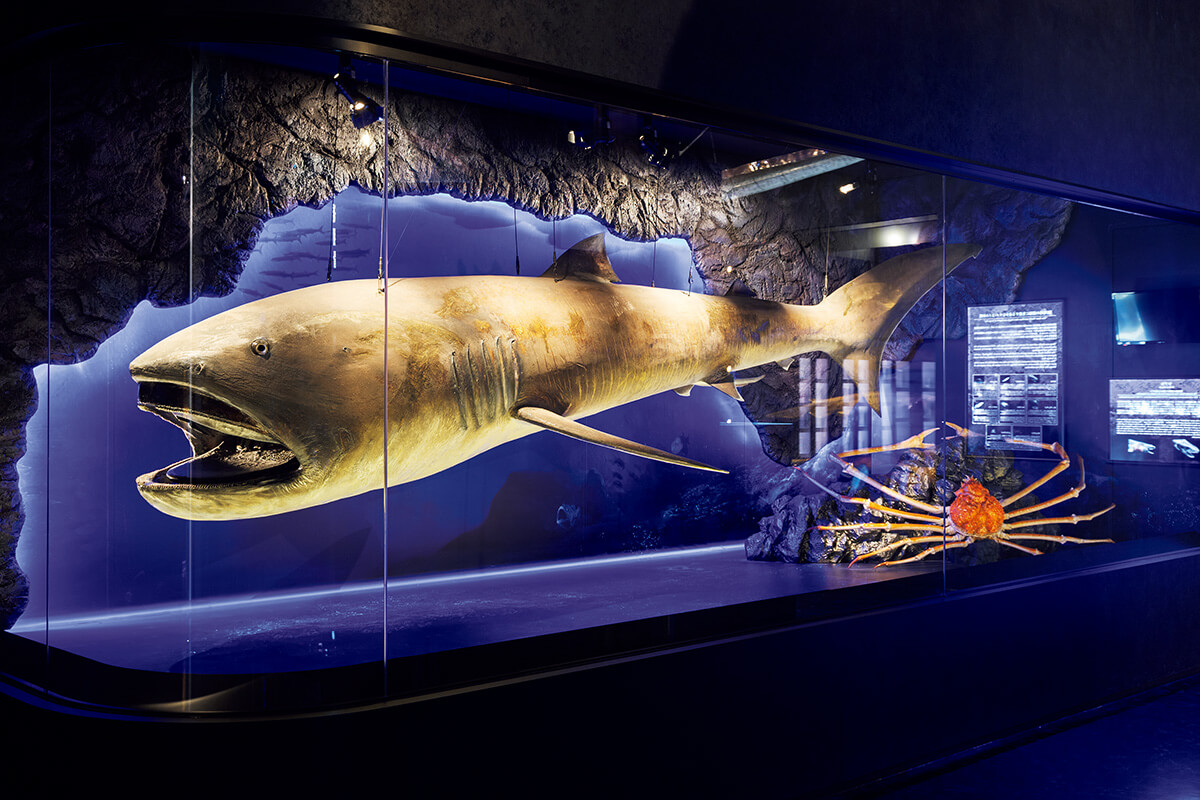
The impressive megamouth shark, measuring approximately 5m in length, was washed up on Suruga Bay and took two years to be stuffed. 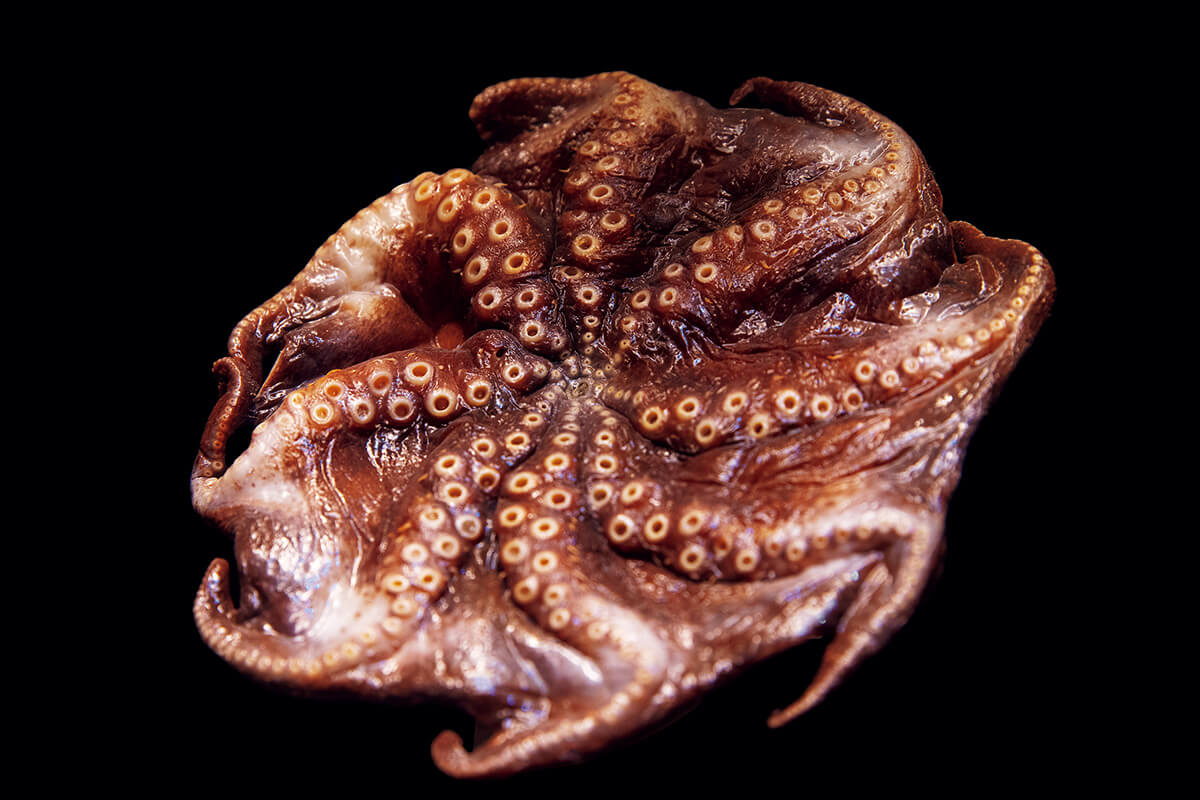
A specimen of the common octopus. Like common octopuses, the males and females can be distinguished by their suckers. The photo shows a male. 
Live hagfish and fried hagfish are on display at the same time.
"There are still many deep-sea creatures that are difficult to exhibit or raise. I would like to see the transparent-headed Demenigisu and deep-sea jellyfish swimming in an aquarium. Deep-sea fish are creatures that undergo major changes after they are born, so I would like to be able to exhibit juvenile fish and have an exhibit that shows their life cycle throughout their life.
However, now in its 13th year since opening, it's fair to say that the aquarium is entering its second phase. In the shrimp tank, there are a variety of individuals, large and small, from females carrying eggs to small juveniles, and we can now see an entire generation. This makes us very happy. The deep sea, like space, is only going to get more interesting from here on out."
As marine science and technology advance, new discoveries continue to be made about the world of deep-sea creatures. Dive into a different world at this aquarium, where you can experience the cutting edge of this world.