











How did the master architect design his bedroom?
Text by Jun Kato
When I visit a home for an interview, the client or architect first gives me a tour of the entire house. I enter through the entrance, then the living room and dining room, then the kitchen and bathroom. Finally, there is the bedroom, but in most cases I don't stay there for long.
This is because bedrooms are less explained than other living rooms and are perceived as spaces with a high degree of privacy. People tend to be considerate of each other when leaving the bedroom and quietly closing the door.
The most prominent areas in modern homes are the living room and dining room. These are semi-public spaces where guests stay when they visit. For example, imagine a room with high ceilings and large glass windows from which you can look outside. On the other hand, bedrooms, which are usually only used by the family, are rarely the main attraction.
The relationship between the living room, which faces outward, and the bedroom, which faces inward, can be said to have been carried over from the era of modernist architecture. Let's take a look at the bedrooms designed by great architects, taking into account the background of their activities.
Modernist architecture brings innovative simplicity to the bedroom
Modernist architecture flourished in the 20th century. Great architects produced one masterpiece after another in the residential realm, leading the era and style. However, if we focus on bedrooms alone, most are not very spacious, with simple fixtures and finishes. It seems appropriate to describe them as "beds" simply for lying down and resting.
If we think of a bedroom as an animal's nest, then a person sleeps with their eyes closed and barely moving, so they don't need a large space, and there's no need to create a unique space like an open ceiling. All that's needed is a quiet space that maintains the right temperature and humidity, allowing for a comfortable sleep. Nevertheless, each of the bedrooms that great architects have worked on can be considered innovative.
Roughly speaking, the defining characteristics of modernist architecture are that it is bright, clean, and uncluttered. In pre-modern stone and brick buildings, rooms tended to be dark and stagnant, and movement between rooms was cluttered and inefficient. New materials and technologies, such as concrete, steel, and glass, made it possible to create spaces that were light-filled, ventilated, hygienic, highly functional, and rational. The same is true for bedrooms.
The bright and simple bedroom designed by the architects was not the main space in the entire house, but it must have seemed very fresh to the eyes of people at the time.
The origins and evolution of bedrooms sought by master architects
When modernist architects designed bedrooms, they likely had in mind the prototype of a monastic cell rather than a royal bedroom like that of the Palace of Versailles: a minimalist, ascetic space for meditation, prayer, and physical rest.
Le Corbusier, one of the most influential architects in the world of architecture, had the opportunity to actually design a monastery in France, and created a series of cells with the same plan. The large windows facing the balcony let in plenty of sunlight, and the lush surrounding greenery spreads out beyond the windows. The width is the length of an adult man's outstretched arms, and the ceiling height is the height of one raised hand, creating an intimate atmosphere that matches the scale of the body.
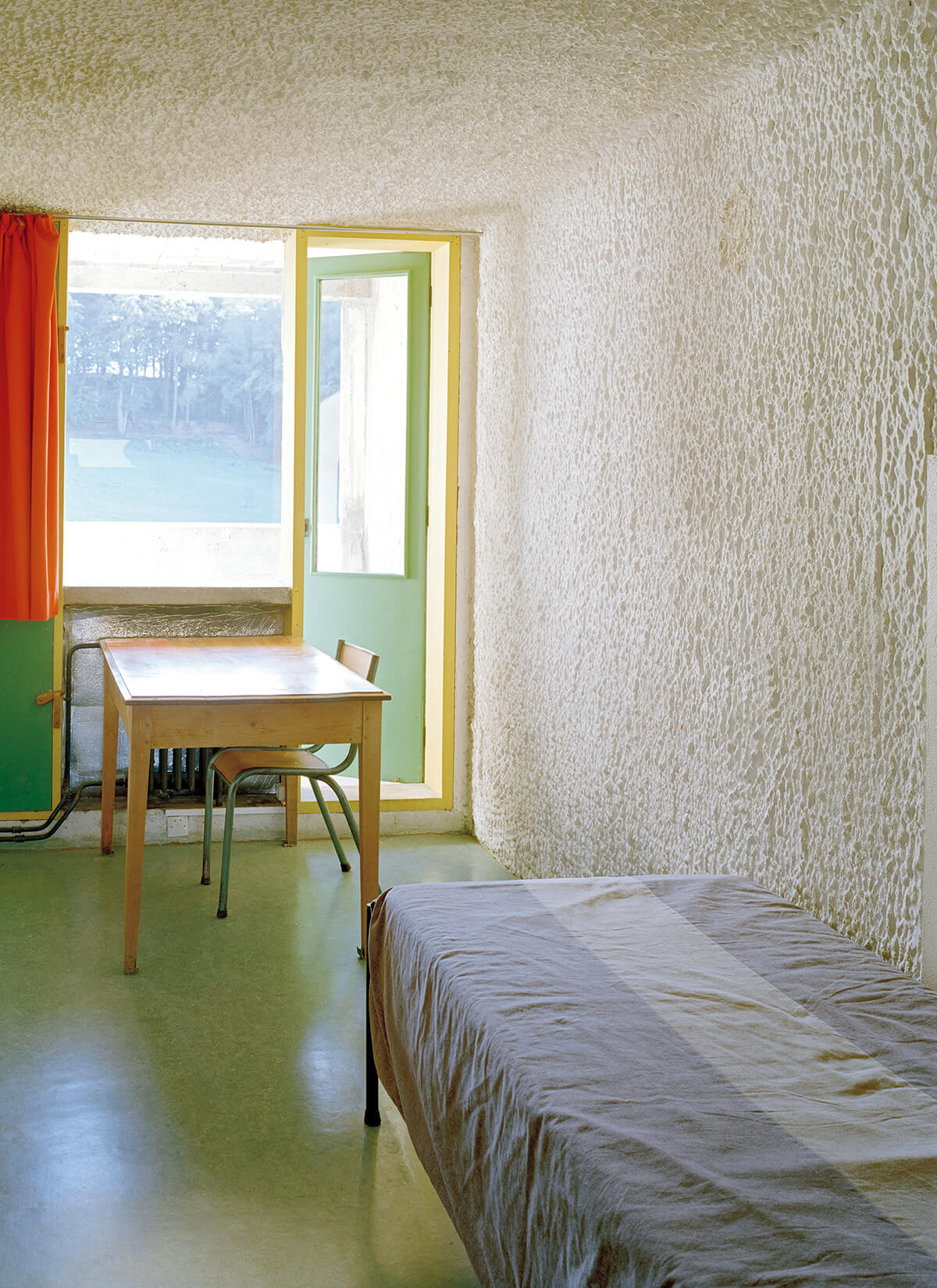
Completed in 1960, this Catholic Dominican monastery was designed as a place of meditation, study, and prayer for the monks. The concrete building is supported by columns and pilotis on a steep slope, and the 100 cells on the top floor and the chapel and dining hall on the lower floors are connected by cloisters surrounding an atrium and courtyard.
The size of the cell is 1.83m wide, 5.92m deep, and 2.26m high, in accordance with Le Corbusier's Modulor system of measurements based on the human body. It is equipped with a washbasin, bed, and desk.
Photo: VIEW Pictures / Aflo
Similarly, in the vacation cabin that Corbusier designed for himself and his wife, he placed great importance on the way light and scenery are incorporated, as well as on the scale of the body. Corbusier is said to have said, "I live there like a happy monk," and "This vacation cabin is extremely comfortable, and I will probably spend the rest of my life here." Le Corbusier achieved a bedroom space that is minimalist yet infinitely expansive, based on a monk's cell.
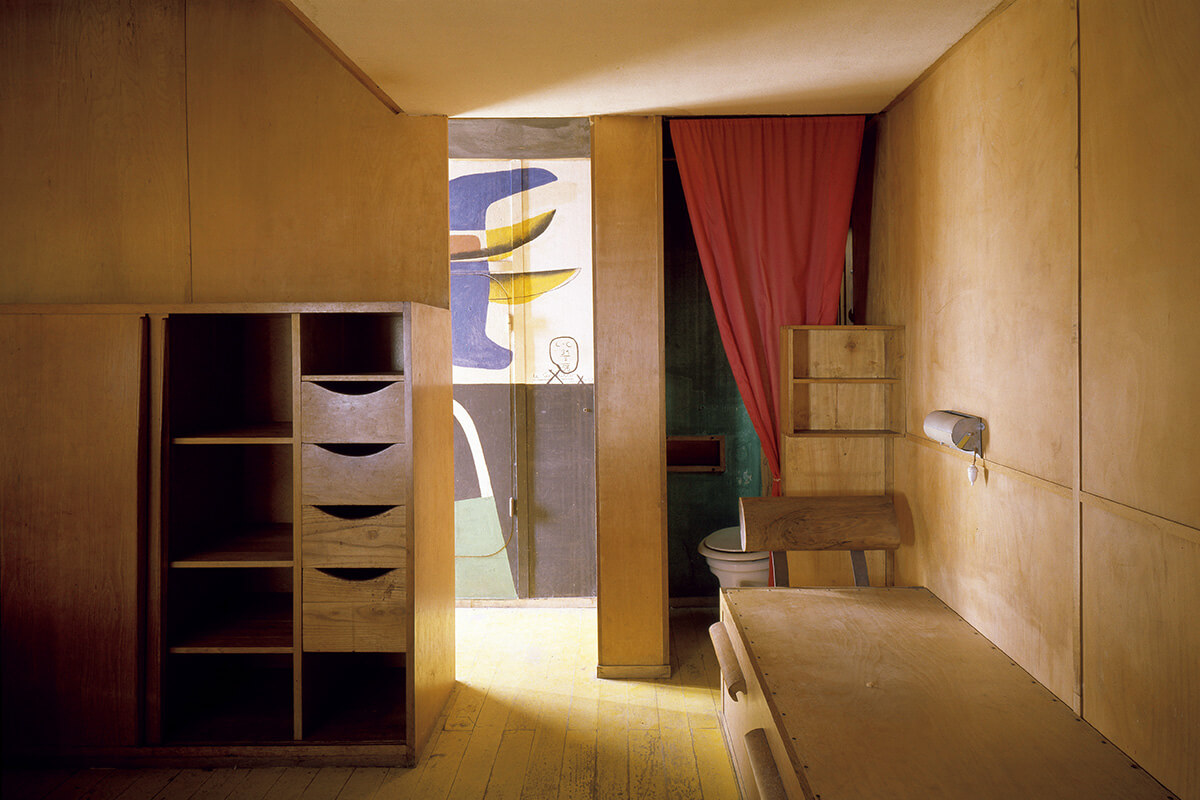
Le Corbusier's Cap Martin holiday cabin (Cap Martin, France)
Completed in 1952, this holiday cabin stands on the cliffs of Cap Martin, a small cape jutting out into the Mediterranean Sea in southern France. It was designed by Le Corbusier as a birthday present for his wife, Yvonne Galli.
Based on the dimensional system he proposed, "Modulor," he created a tiny space with an area of approximately 8 tatami mats and a ceiling height of 2.26 meters, and designed a bed with storage, a counter table and box-shaped stool, a shelf with a washbasin attached, and storage shelves.
Photo: VIEW Pictures / Aflo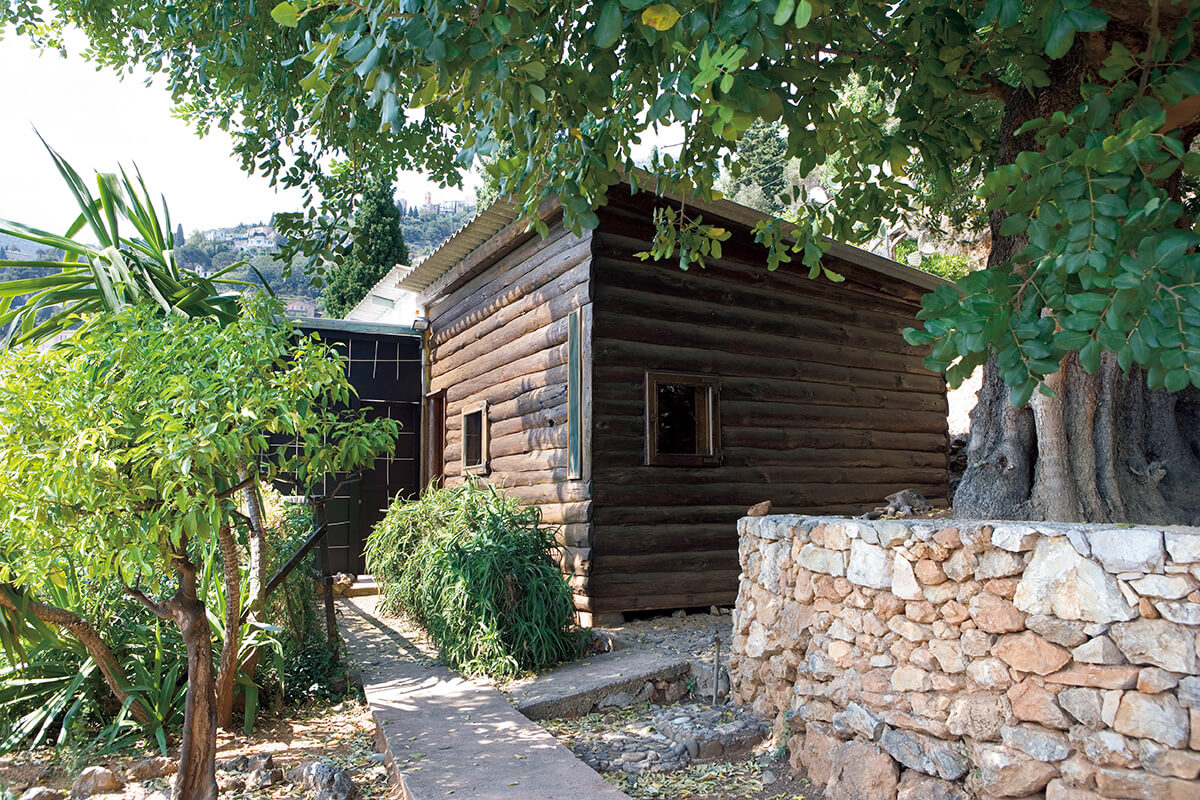
The exterior walls are made of logs, and the interior is clad in plywood, creating a simple finish. Le Corbusier said he spent time here like a monk, but he was caught in the sea and died while swimming at Cabet Beach below.
Photo: VIEW Pictures / Aflo
The unique space of the bedroom, where instinct and reason oscillate
It was Frank Lloyd Wright who pursued rationality while also seeking a sense of unity with nature and a sense of security rooted in the land. The concrete walls that appear in the bedrooms at Taliesin West are made from rocks found on the desert site, with round and angular stones embedded in them. The exposed, sturdy beams also have a presence that echoes the landscape, providing a spiritual anchor in the wilderness.
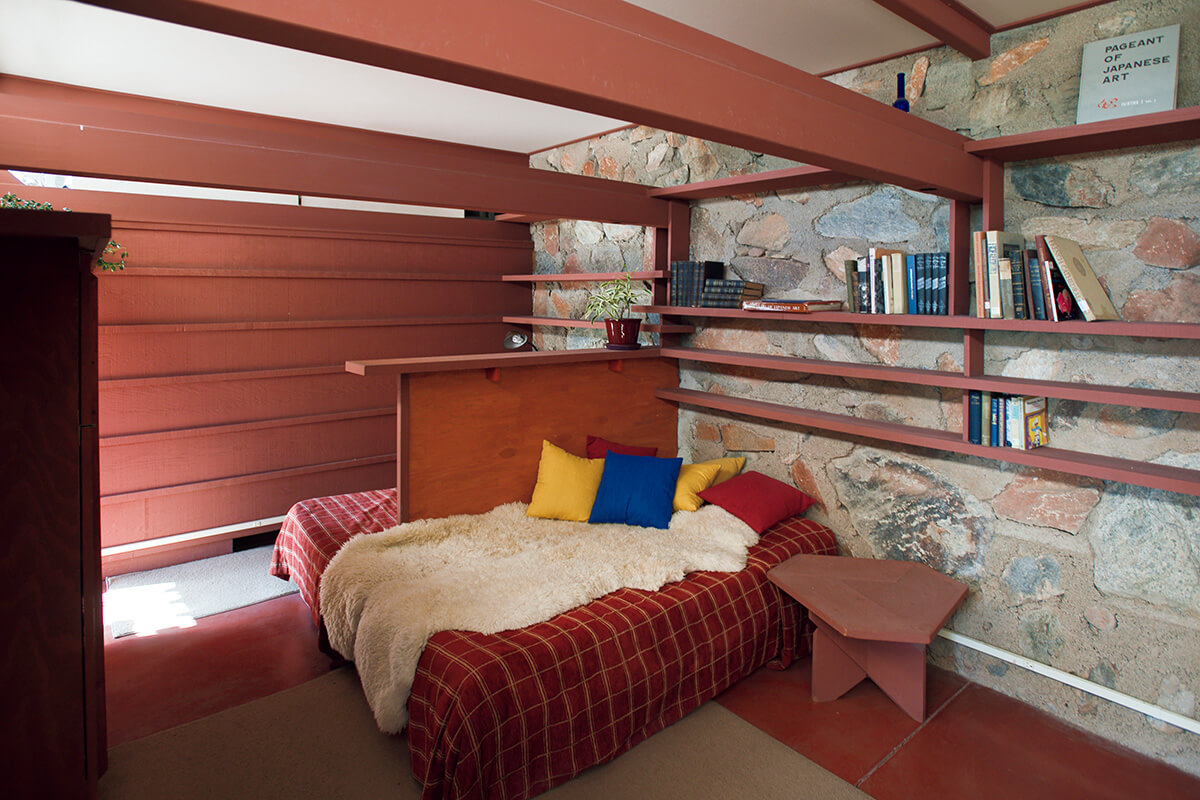
Completed in 1937, the house has been repeatedly expanded and renovated. It served as Frank Lloyd Wright's personal home and studio, where he shared living space with his family, apprentices, and architecture students. The house was designed to incorporate the vast natural scenery, with walls made of stone mined from the desert site placed in redwood frames and then hardened with concrete. The redwood beams create a wild, earthy feel, and the same can be said for the bedrooms.
Photo: Alamy / Afro
The Farnsworth House, designed by Mies van der Rohe, is a large, glass-walled one-room space, and even the bedroom is undivided, being continuous with the living room, dining room, and kitchen. Only movable furniture is placed between the bedroom and living room. Mies pursued the idea of eliminating the boundaries of the home to the extreme, and as a result, he ended up pulling the bed out of the room and eliminating the bedroom.
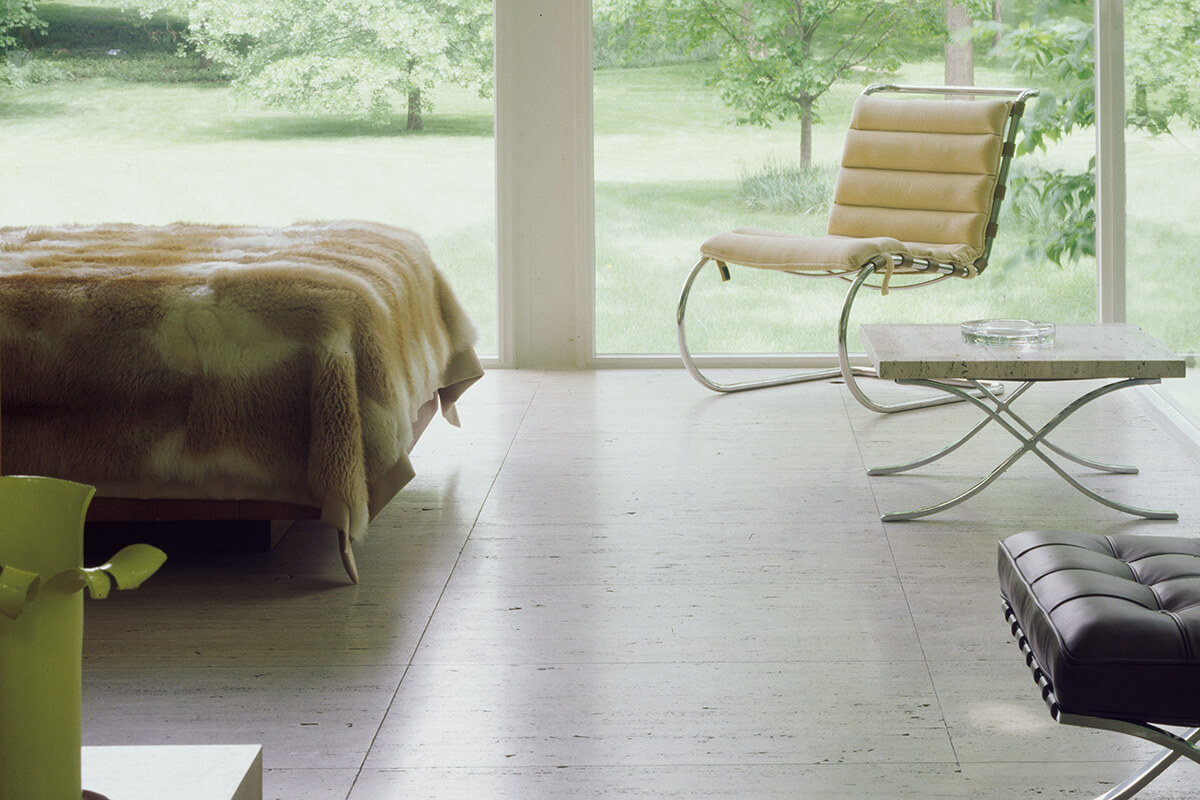
Completed in 1951, this weekend home was planned for the lush riverside of Plano, a town west of Chicago. The floor is raised off the ground, and the interior space, surrounded by glass on all sides, gives the impression of floating in the air. The one-room space has no walls or partitions apart from a central "core" that houses the kitchen, bathroom, and toilet. The blueprints do not include any room names, and the bed is located on the east side.
Photo: VIEW Pictures / Aflo
Mexican architect Luis Barragán saw his home and rooms as places for prayer and meditation, and so religious paintings and sculptures of Christ and the Virgin and Child are displayed throughout his home. The tranquil bedroom is a space that strongly reflects spirituality and religious sentiment.
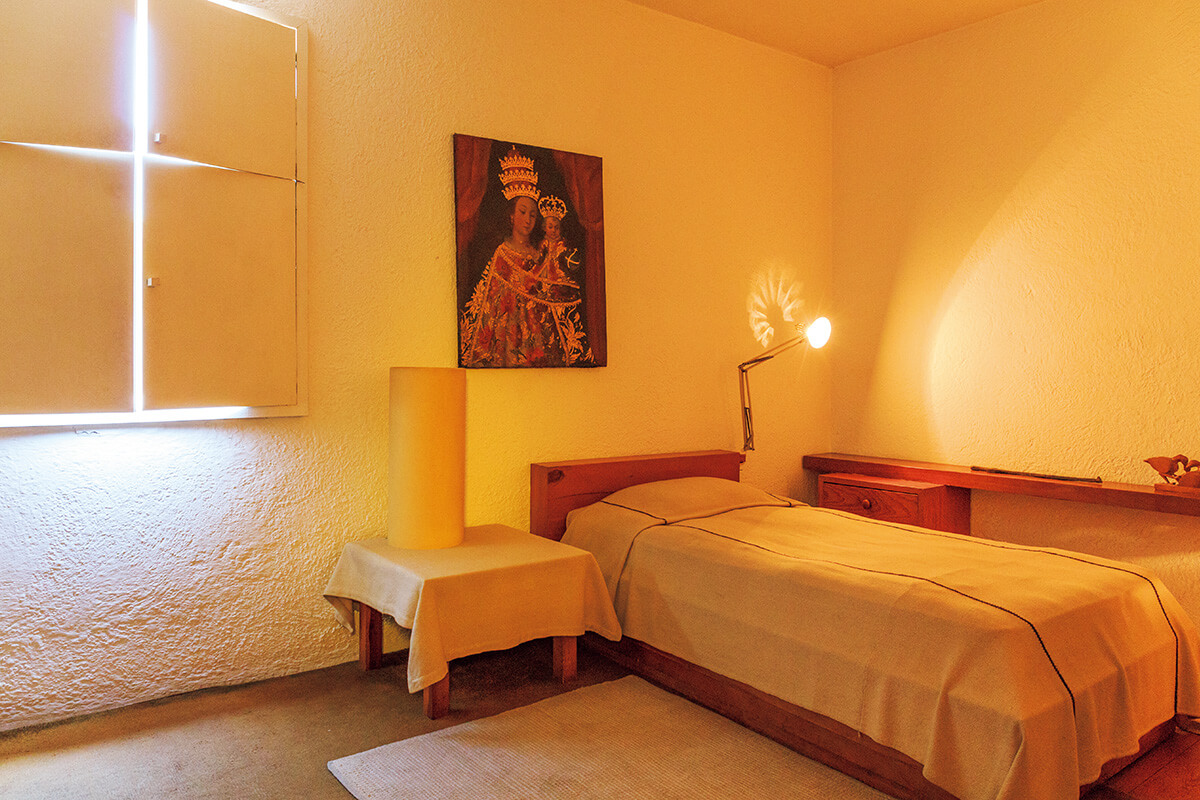
Completed in 1948, Barragán's home and studio stands on the outskirts of Mexico City. While it is inconspicuous from the street, its interior uses colorful colors such as pink and yellow, and incorporates natural light, shadows, an atrium, and a courtyard to create a unique worldview. The guest rooms on the second floor have two sets of double doors, one above the other, which, when opened slightly, allow a cross-shaped light to stream into the room.
Photo: Yoshio Tomii / Aflo
The home designed by Scandinavian master Alvar Aalto is popular worldwide for its harmony with the surrounding natural environment and its use of natural materials that create a soft feeling. The private second floor is a model for modern housing, including the functionality of connecting the family's living room and bedroom. Surrounded by furniture, built-ins, and lighting fixtures designed by the Aaltos, it creates a relaxing space.
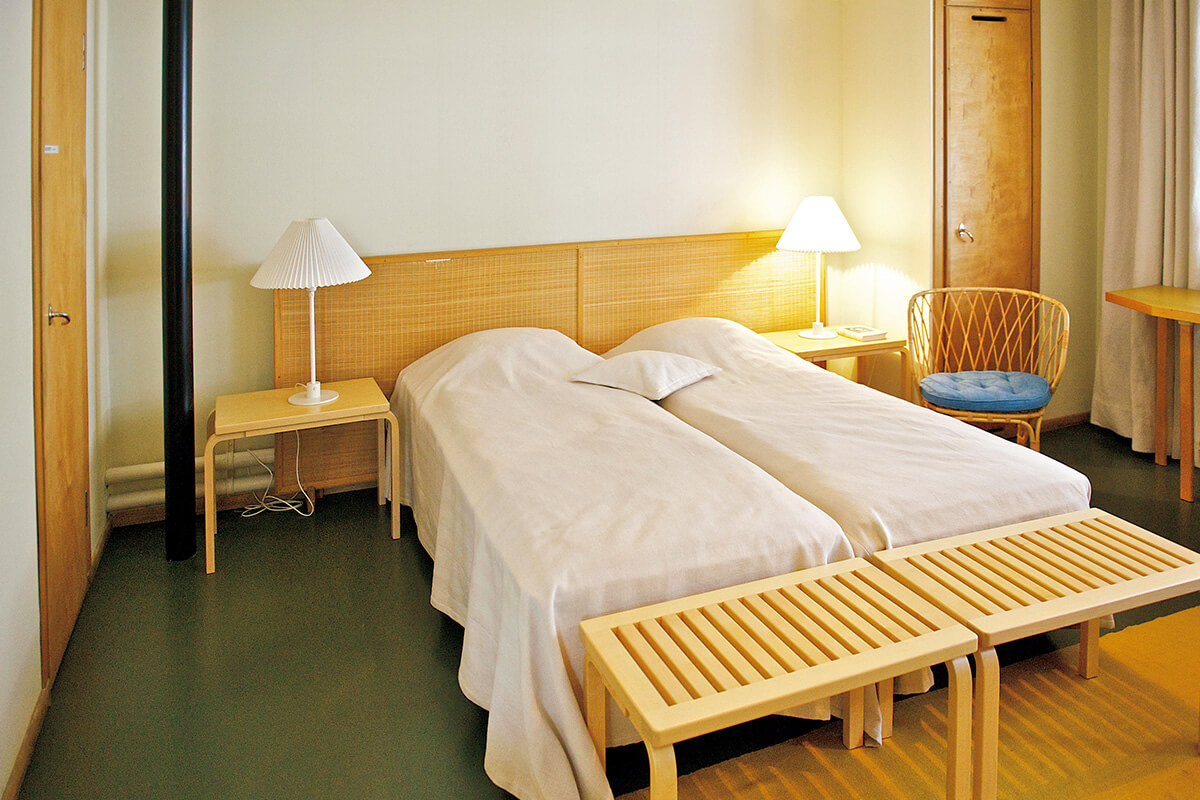
Alvar Aalto's House (Helsinki, Finland)
Completed in 1936. This is the home and office built by Alvar and Aino Aalto on the outskirts of Helsinki.
Photo: Alamy / Afro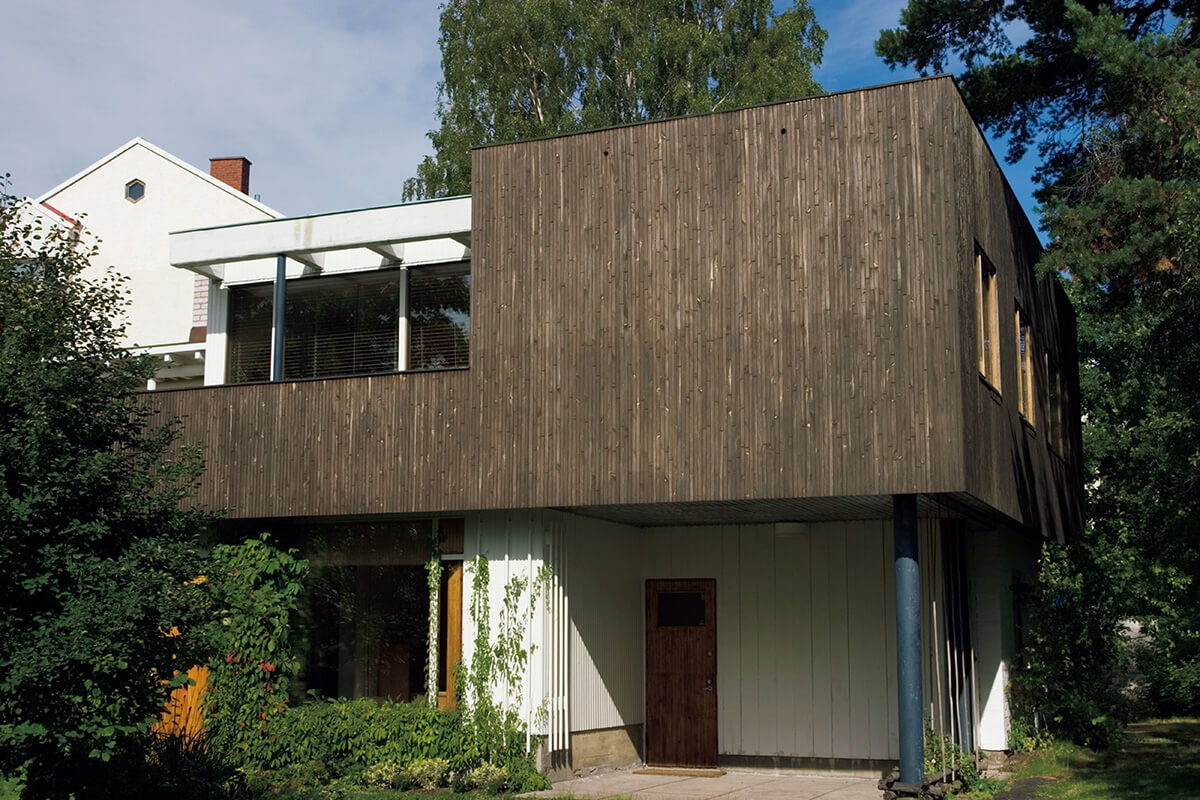
The L-shaped building surrounding the garden is made up of three floors, with the living/dining/kitchen area on the first floor, the work space and library on the 1.5th floor, and three bedrooms and a private guest room on the second floor. The areas on the exterior with vertical dark brown paneling are the bedrooms. The living and dining areas, where people spend their daytime time, are located on the bright, sunny south side, while the three bedrooms are located on the east side, where the morning sun shines. A hall with a fireplace connects the bedrooms in the center and is also used as the family's breakfast room. The hall leads to a rooftop terrace that is larger than any of the rooms on the second floor.
Photo: Alamy / Afro
While pursuing the ideals of modernism, architects developed bedrooms with an understanding that they are closely related to the body. Furthermore, bedrooms are closely linked to the ideals and spirituality of each individual, resulting in the emergence of a unique space. If you open the bedroom door of a master architect's home and closely observe its "inward-facing face," you are sure to see a different side to its outward-facing, conspicuous expression.
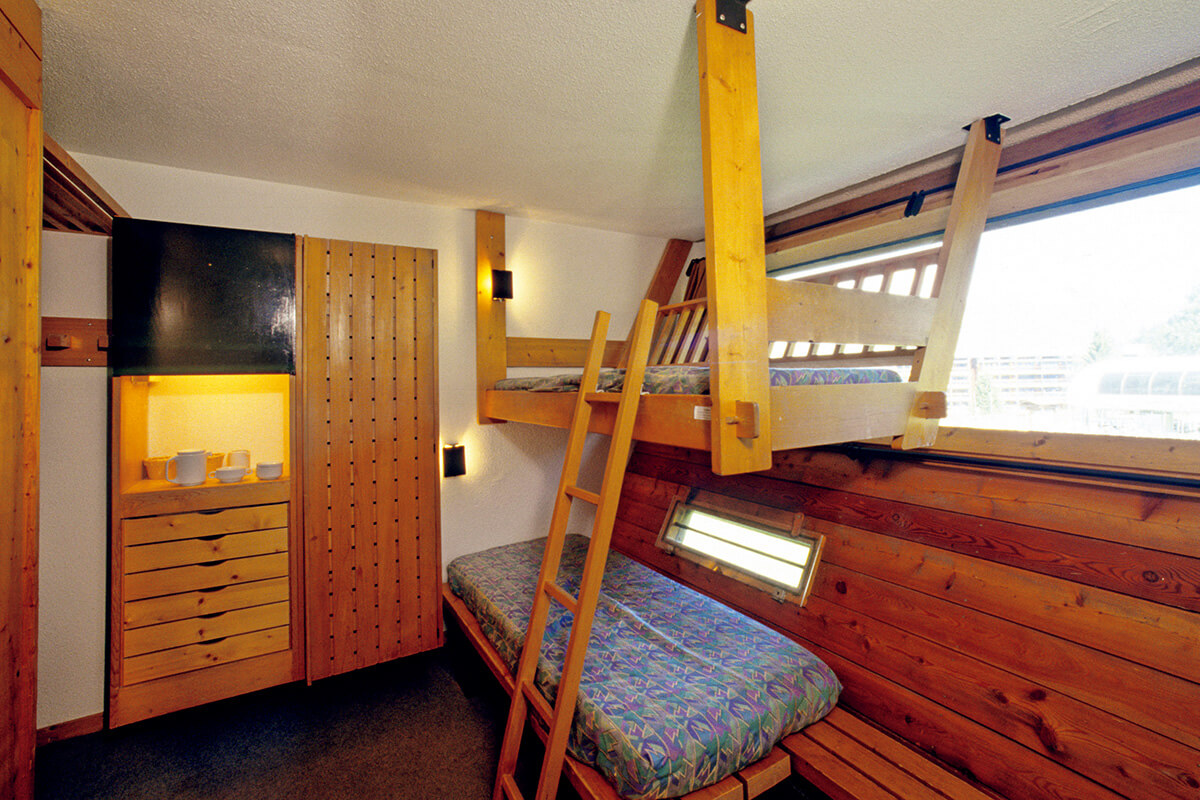
Built in 1967 as a ski resort with a vast slope facing Mont Blanc, the first residence was completed in 1969. Charlotte Perriand oversaw the entire project for around 20 years, producing everything from the spatial composition and facilities to the interior and fixtures. The salon and bedroom, connected to the unitized bathroom and kitchen, were designed to make the most of the views outside.
©Bridgeman Images / amanaimages ©ADAGP, Paris & JASPAR, Tokyo, 2024 E5474