








Lecture summary
This lecture covers all the basics about the human brain, from basic knowledge to the latest research. It covers a wide range of topics, from the size and shape of the brain to how humans have come to know about the brain, human perceptions such as sight, hearing, taste, and smell, the relationship between the brain and memory and sleep, and recent research results. It is a popular lecture held in the large auditorium and attended by several hundred people every year.
Point 1: Leonardo da Vinci didn't know the shape of the brain either.
A major feature of cognitive neuroscience is that there is no corresponding subject in high school education, so for many students, this is their first systematic study of the brain.
"The first thing I ask is, 'How big do you think the brain is, from the forehead to the back of the head?' Some people point to about 25cm, but in reality it's only about 15cm. It's smaller than you might think. For your information, if you unfolded the folded brain, it would be about the size of three A4 sheets of paper."
The history of neuroscience is also a topic that is covered early in the lecture. It wasn't until the 20th century that research on the brain made significant progress. Even in the anatomical drawings of the human body drawn by the century's genius, Leonardo da Vinci, the shape of the brain was completely different from the actual shape. "That's how complex the brain is."
Point 2: There is no part of the brain that specializes in perceiving the flow of time
The lectures focused on the five human senses, such as sight and hearing, because this is the easiest to understand. For example, in the case of sight, light enters the eye, which is converted into electrical signals by the function of cells, and these electrical signals are transmitted between nerve cells, giving rise to the sensation of "seeing."
The brain has a visual cortex that processes information seen by the eyes, an auditory cortex that processes information heard by the ears, etc. However, there is no area of the brain that specializes in processing the flow of time. It is processed using multiple areas.
"Time can be measured in extremely short units, such as a few hundred milliseconds, or in units of one second, one minute, one hour, one day, or one year. The brain mechanisms involved are different depending on the unit. Time is truly a mysterious sensation."
Point 3: Today I'll show you my alpha waves.
The technology for measuring brain function is evolving every year. "In the past, measurements were taken using extremely large machines, but now there are portable devices and even simple ones that can transmit data wirelessly. I sometimes bring in such a measuring device and say, 'Today I'll show you my brain waves,' and project my brain waves on a screen in real time.
For example, alpha waves, which are said to appear when you are relaxed, actually appear more when you close your eyes and disappear when you open them. You can see alpha waves decrease or increase just by opening and closing your eyes." A simple measuring device apparently connects to a PC via the earphone jack and inputs brain waves as a WAV file.
Point 4: The brain is not as simple as people believe
"I hope that students who take this class in their liberal arts courses and become interested in cognitive neuroscience will eventually come to my lab and conduct research together," says the professor. However, there is something he also wants to say to students who plan to pursue careers unrelated to neuroscience in the future.
That is... "How wrong the fake neuroscience that people have out there is (laughs). I want students to realize that. If we have a serious scientific discussion, it's not so simple. This isn't just about the brain; in this world, we tend to want to divide everything into black and white, but the truth is that it's much more multidimensional. How irresponsible it can be to simplify things so roughly. I always want students to be able to understand the multidimensionality of the world."
Lecture reference book
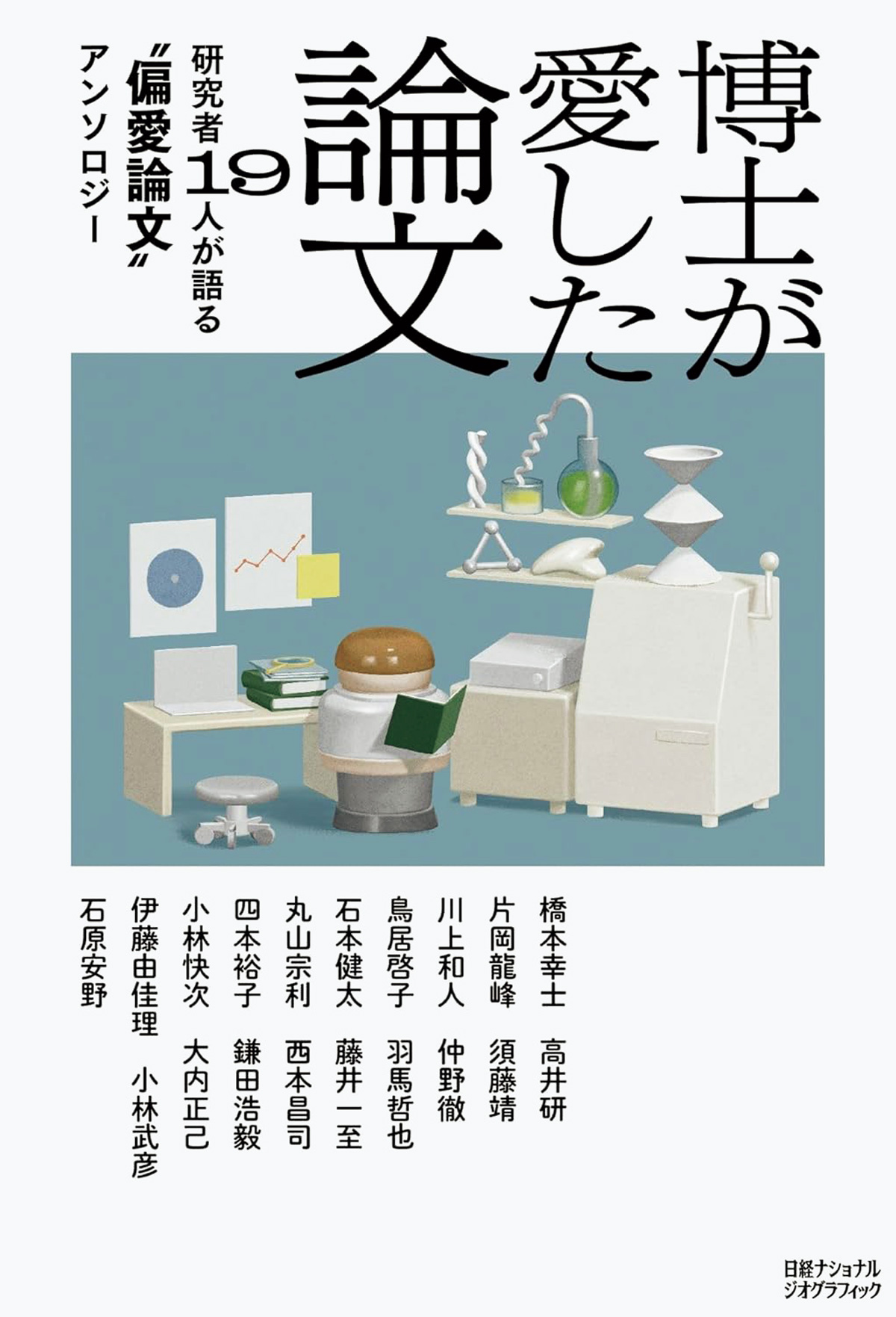
"If I had time to write a book, I'd like to write a paper." This is the only anthology to which Professor Yotsumoto, who has never published a general book, has contributed. Researchers from various fields, such as the universe, the human body, plants, and dinosaurs, passionately discuss their favorite paper. Professor Yotsumoto contributed a paper on time perception and a story about its author. Nikkei National Geographic / 2,420 yen.