










Mizuno Shizu deciphers the epic detours disguised as answers to questions
Igarashi-san's previous book, "Creating IMON" (reissue), was an incredibly interesting book. It was written about very complex things, but it was densely packed with the essence of intelligence. It was such a rich read. This book is in a question-and-answer format, and the questions are open-ended, so I think it's even easier to read.
As I read "The Answers of the Questioned Old Man," I thought of Igarashi-san's great ability not to give an immediate answer to any question.
Rather than giving an immediate answer, they are ultimately able to postpone their response to a question. Moreover, in response to a question such as "Is studying useful?", they simultaneously possess the ability to continue to ask new questions at an incredible speed, which leads to an explosion of questions within themselves.
Modern people are driven by an obsession to quickly solve the problems they are presented with and create value. In such a society, I think many people become stressed because they feel that it is pointless to continue to hold on to questions and worries that have no easy answers.
When you're in front of people, there's pressure to look good, so it's hard to remain a "slow processor." But in this day and age, AI can do the fast processing for you.
On the other hand, I think that only people with slow processing abilities who don't immediately come up with answers can come up with new questions. It made perfect sense to me that someone with an intellect that can tolerate being removed from rationality would draw a manga like "Bonobono."
As with "Creating IMON," I think the extraordinary density of Igarashi's inner world is reflected in his works.
Is it possible to not give an answer to a question right away?
Something I've been thinking about a lot lately is that perhaps because we live in a society where we have to present ourselves in a good light, there are an increasing number of people who subconsciously harbor the exact opposite desire: to be disillusioned by others.
I feel this in Igarashi's "Bonobono," Sakura Momoko's "Coji-Coji," and more recently in "Chiikawa," and I feel that these characters are proxy depictions of people who are "properly disappointed."
The reason we find it soothing is that somewhere deep down we want to stop the fast process of constantly answering questions. We want to escape from a world where we have to keep producing value in order to be recognized.
When I come up with an immediate answer to a question, I sometimes feel dissatisfied because I feel it is just a simplification, so while reading this book, I felt a refreshing sense of joy, like "I'm happy, I've done it, hurrah!" when Igarashi doesn't give me an answer.
What I particularly like is the "Questions from Adults" section in the second half. The answers to each question are shorter, but the complexity is incredibly high. The number of questions that arise as the answers are given is exponentially higher. But because they're all told in the author's own words, you won't be left behind while reading.
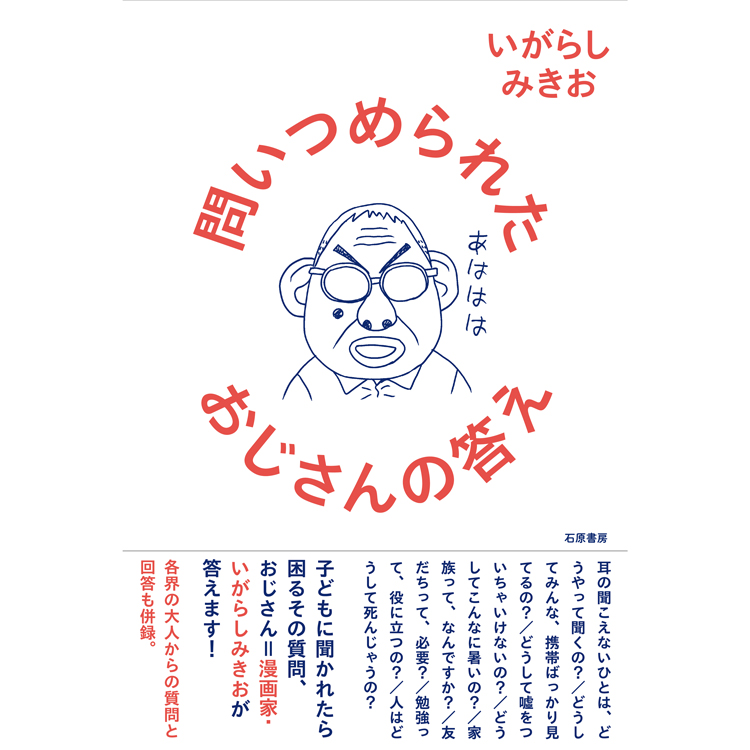
Igarashi Mikio, the manga artist behind "Bonobono," writes straightforward and humorous answers to the simple, essential questions that children often have. It addresses "the first questions in life" and helps adults reflect on the wonder and joy of being born and living. Ishihara Shobo / 2,420 yen.
I asked a question myself, but I made it too concise, which resulted in a major miscommunication. The meaning behind the phrase "the truth of the heart" would have taken about 8,000 characters to convey. Like Igarashi-san, I continue to have unresolved questions, which creates a huge amount of context within myself, and I sometimes forget that this context is not shared with others. Igarashi-san's writing is more objective, but if you read it carefully, there are parts where you can read another 8,000 characters of context, which is incredibly interesting.