









"If you want to write a love song, you have to be in love."
I think I started to like music when I was in fifth grade. Meanwhile, I first experienced love when I was in second grade of junior high school. What I remember well is that after I fell in love, I heard Megumi Asaoka's debut song "Mebae," and even though I'd heard it several times before, I thought, "This song is about me."
Those lyrics are written by a girl. I guess that's when I started thinking about writing a love song. I thought you can't really understand unless you've fallen in love.
When you write a song, if it's a love song it's easier to create a world and get it across to the listeners. Love songs are easier to relate to than songs that express your feelings or songs that sing about society. People will think of it as just plain pop music. When you watch a movie, don't you think it's easier to get into if there's a star in it?
Even if the story is difficult to understand or silly, it will still draw you in until the end. In music, the star of that story might be a love song. Or a song by a talented singer, or a song with a pleasant chord progression.
Love ends somehow. That's cruel.
In addition to direct love songs like "I love you," there are also songs that make you think about love. If I think about the love songs I've written, there are probably quite a lot of those. To me, songs about girls are also love songs. I don't want to write a song about a girl I don't like.
It's true that many of my love songs are sad. When you fall in love, you feel excited and your heart pounds, but even if it is fulfilled, for some reason that love ends before you know it. Even though nothing in particular has happened. I've always thought that this is a strange thing, or even cruel. Maybe that's why my songs about love are so pessimistic.
I started writing songs after I started Pizzicato Five, but ever since then I've only had pessimistic feelings about love. However, even with pessimistic lyrics, I haven't liked minor key songs for a long time - although that's changed recently - so I often put them to bright melodies.
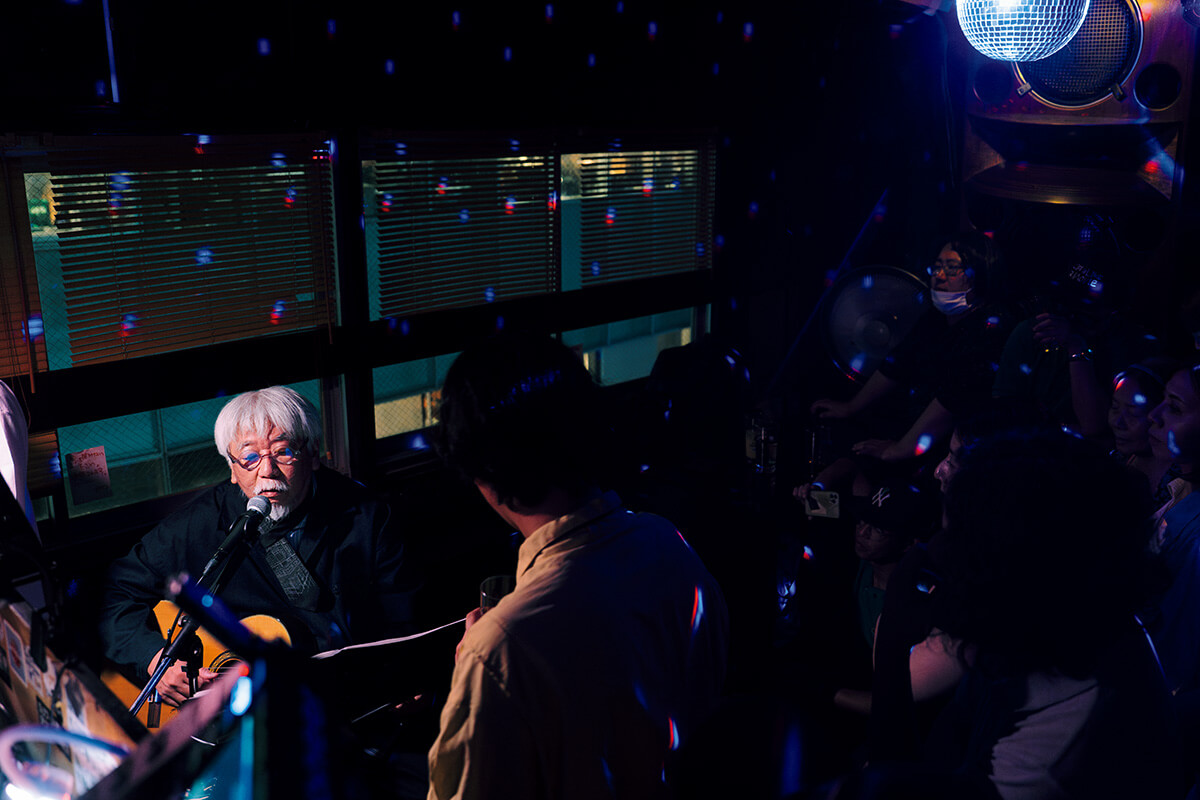
For example, "My Life, Summer of My Life," which I wrote for Kahimi Karie's album, was a song that captured the image many listeners have of her. However, when I sang it live a few years ago, I realized that the lyrics were written for me to sing. It was a song about an old man my age, with a body shape like mine, wearing big pants and no shirt (laughs).
I recently found a demo tape of "Onna no Miyako" (Women's City) that I wrote for Arichika Masumi, where I played and sang it myself, and when I listened to it, it perfectly matched how I feel now. I was surprised to learn that I had written lyrics like that when I was young. I think the reason I've been doing this more is because I'm getting older, rather than because I'm now in a position to sing.
In the end, I think love songs written by people who have never fallen in love or been rejected by a girl are shallow. They're just a formality, or just a pile of words. After all, you have to be in love to write a love song.
However, it's not true that you can write songs just because you're in love; you have to be in love and always thinking about music.
In the kitchen at midnight
Pizzicato Five "Television Age of Love"
Do you remember the big fight?
It's really sad though
Pizzicato Five "Sad Song"
Our love is over
I'll never fall in love again
Masumi Arichika "City of Women"
I met you at the end of my life
In the city of women