











They poured their artistic talents into a commercial idol film
In December 1985, Toho screened two films simultaneously as New Year's films: "Sister Hill" and "Fragments of Snow: Passion." Typically, film companies compete to produce entertainment films that will be box office hits during the New Year's holidays. However, these two films were a little too bold to be called entertainment films.
"Sister Hill" opens with a lyrical title of cherry blossom petals dancing, along with the words, "A film. It is always excessive with feelings of love, disturbing people's hearts." At the beginning, a crane moves freely across the set, and "Fragments of Snow - Passion" depicts the protagonist's childhood in a single long take of about 14 minutes.
Although the two films were defeated at the box office by Toei's New Year's film "Be-Bop High School" and Shochiku's "It's Tough Being a Man: From Shibamata with Love," they must have made a strong impression on audiences who casually went to the theater. What is this unique world? "Sister Hill" was directed by Obayashi Nobuhiko, and "Fragments of Snow: Passion" by Shinji Somai.
Japanese cinema was undergoing a period of great change in the 1980s. The Japanese film industry had reached its peak in the 1950s, but with the spread of television and the decline of the studio system, it began to shrink and sought new ways to survive. Amid this, Kadokawa Shoten rose to power. Its media mix approach, in which it adapted its own books into films and promoted them with a large number of television commercials, quickly made Kadokawa a central figure in the film industry.
Kadokawa, who began making films in the mid-1970s, established his own line of idol films in the 1980s. It was Obayashi and Somai, who emerged from the collapse of the studio system, who created masterpieces that combined commercial appeal with auteurism.
Shinji Somai
Born in 1948, Somai worked as an assistant director at Nikkatsu before going freelance and making his directorial debut in 1980. His first film was "The Flying Couple," the first starring role for Yakushimaru Hiroko, a protégé of Kadokawa Pictures who had made her film debut in "Proof of the Wild."
In this bittersweet coming-of-age drama, Somai already used the long take technique that would become his trademark. Working with actors in their mid-teens, including Yakushimaru and Tsurumi Shingo, he rehearsed repeatedly, took multiple takes, and carefully captured each scene in a single take. The film's success led to Somai's return the following year, in 1981, to work on another film starring Yakushimaru, the Kadokawa Pictures production Sailor Suit and Machine Gun.
A high school girl suddenly becomes the boss of a small gang. A unique coming-of-age drama, this extraordinary story is imbued with the raw emotions of the protagonist and the gang members surrounding her.
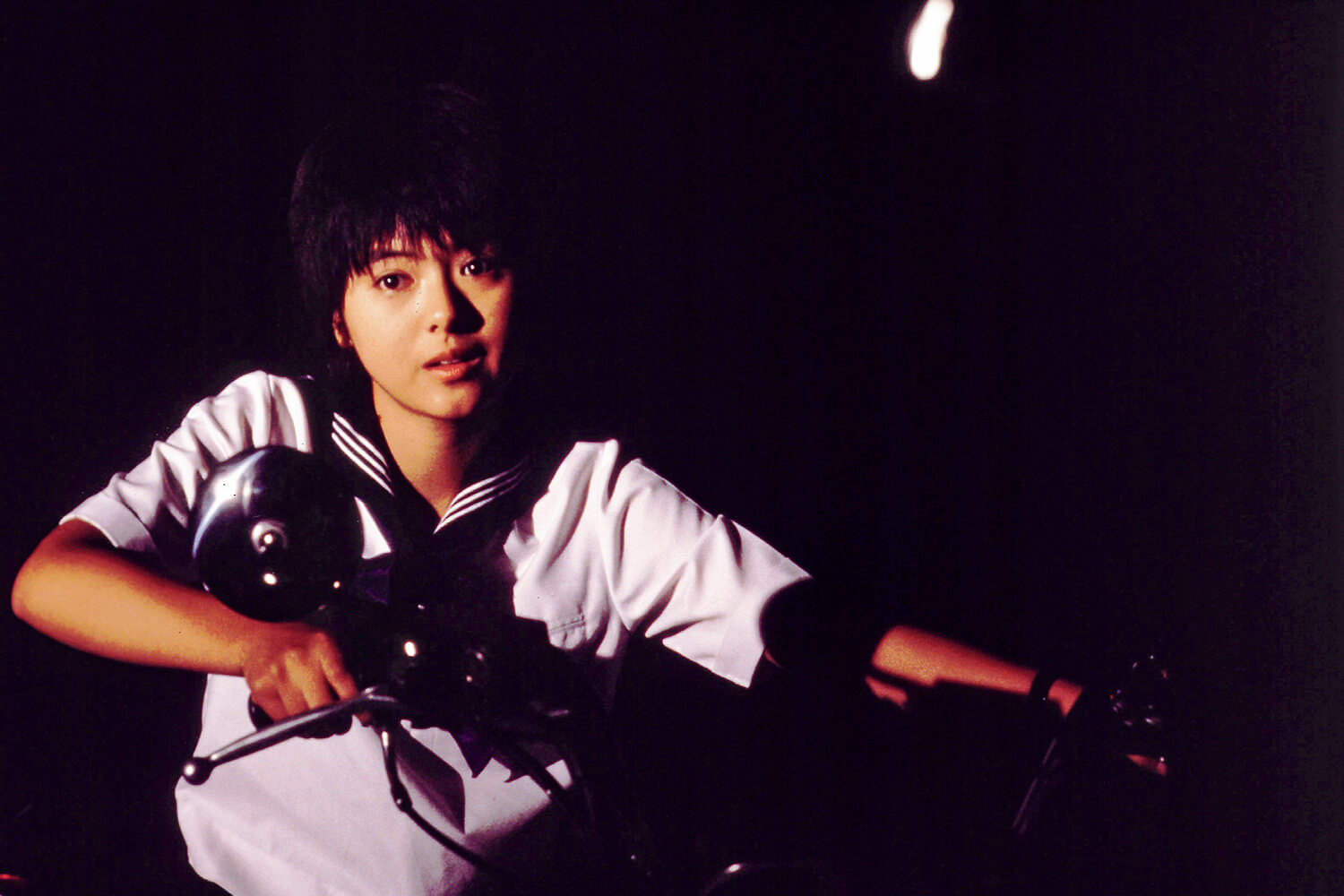
©︎KADOKAWA 1981
"In Somai's case, rehearsals continue from 9am until midnight, and he is told not to do the same thing twice during that time. (Omitted) He is told to concentrate until he can't think of anything else." (From "Cineaste Shinji Somai")
Yakushimaru reflected on his direction: "(Note: Somai's direction) was not to have the actors just say their lines superficially, but to have them perform the lines to the point where they could no longer be separated from their own bodies, pushing them to the point where they could actually experience the extraordinary, or at least see it that way" (ibid.).
Somai pushed his actors to the limit, waiting for something to emerge spontaneously from them, and once it did, he would capture it in one long take. He says, "At such times, the actors themselves, their physiology and time, appear, rather than as characters in a story." (ibid.)
When "Sailor Suit and Machine Gun" was released in December 1981, it earned 2.3 billion yen in distribution revenue and became the number one hit Japanese film of the following year, 1982. On the surface, it was an idol movie starring an actress at the height of her popularity, but in reality it was a film that allowed no compromise and adhered to strict auteurism.
The original story was written by Akagawa Jiro. This absurd story was brought to the screen with humor to the very end, yet with a touch of serious emotion. The scene in which Yakushimaru Hiroko infiltrates a rival organization and fires a machine gun is so famous, it's surprising how fresh it still feels today and how it hasn't aged at all. Kurosawa Kiyoshi was involved as an assistant director. '81 Days.
A masterpiece that represents the pinnacle of Somai's work. Set on a typhoon night, the director captures the frustration, fatigue, confusion, and anger felt by junior high school boys and girls through a flexible and hard-hitting direction. One of his techniques is to make impressive use of popular songs, and this film features a song by BARBEE BOYS, with girls and boys stripping off in the rain and singing Warabe's "Moshimo Ashita ga...". A striking film. '85.
Nobuhiko Obayashi
Similarly, Obayashi's 1983 film The Girl Who Leapt Through Time boldly injects experimental, lyrical artistic style into the guise of an idol film.
Born in 1938, Obayashi began making experimental independent films as a student, and from the 1960s onwards, he became a pioneer in commercial direction, creating commercials that appealed to the viewer's sensibilities. His first theatrical film, "House," which he directed in 1977, is a groundbreaking horror film that brings to the forefront his avant-garde and visual sensibility. Kadokawa's 1981 film, "The Targeted School," starring Yakushimaru, is also a sci-fi coming-of-age drama that follows the fantastical worldview of "House."
However, while these films generated enthusiasm from some quarters, others panned them, saying, "This isn't cinema." It was under these circumstances that Obayashi began working on a coming-of-age film set in his hometown of Onomichi, Hiroshima, and earned high praise for his 1982 film, "Transfer Student," which was imbued with nostalgia and a touch of lyricism. He gained a great deal from the success of this work.
"The film that I made was supposed to be the most personal, but it was loved by so many fans. I think that when it comes to films, you make them with care and cherishment, focusing on the things that are most dear to you, and ultimately they become great products." (From "My Movie Life" by Nobuhiko Obayashi)
This desire led to his next film, "The Girl Who Leapt Through Time." Kadokawa Pictures asked him to make a film in Onomichi for Harada Tomoyo, one of the three Kadokawa girls. Obayashi set out to make an extremely personal film, as if he had fallen in love with her when she was 15 years old.
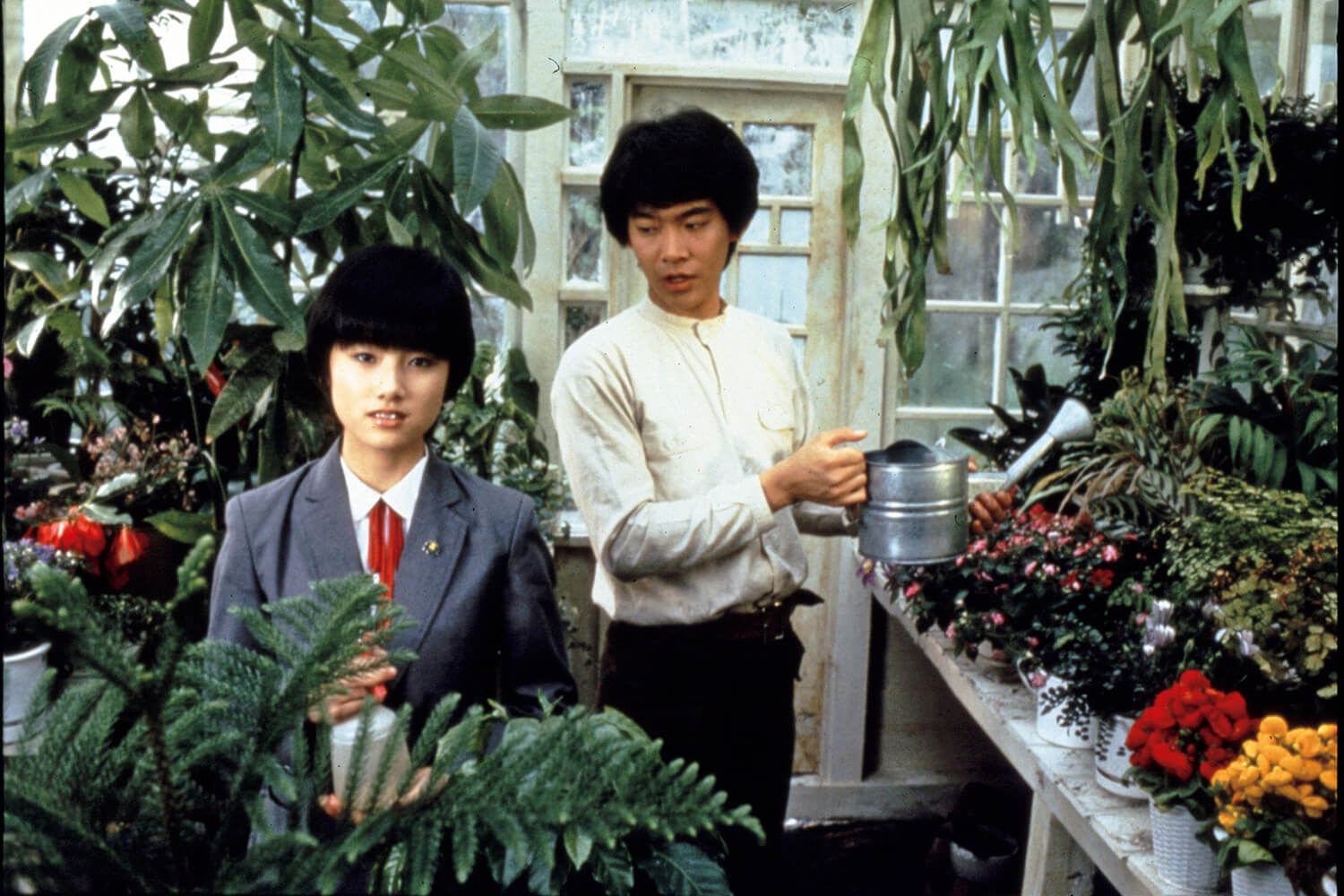
©KADOKAWA 1983
"The Girl Who Leapt Through Time," which depicts the romantic adventures of a high school girl with the ability to jump through time, encapsulates Harada's girlishness, which she likely possessed only for a moment at that age, along with a sense of intense sadness and loneliness, while incorporating a variety of experimental techniques.
The Girl Who Leapt Through Time was released in July 1983 and earned 2.8 billion yen in distribution revenue, ranking it second among Japanese films in the box office rankings for 1983. Obayashi and Sōmai were also active throughout the 1980s, producing many excellent works, leading some to refer to the 1980s as the era of Obayashi and Sōmai.
Now that we're in the 2020s, it's difficult to find such artistic merit in blockbuster entertainment works, but the influence of Obayashi and Somai remains strong in many directors and actors still active today.
Somai passed away in 2001. Obayashi passed away in April 2020, but as long as there are people who carry on their will in some form, their spirits will surely never die.
Along with 1982's "Transfer Student" and 1985's "Sabishinbo," this film is known as the "Onomichi Trilogy," but only a few scenes were actually filmed in Onomichi. The end credits, featuring Harada Tomoyo singing the theme song "The Girl Who Leapt Through Time," capture Harada's natural charm, which is different from her appearance in the film, and some people love this more than the main story. It is a skillfully adapted film from Yasutaka Tsutsui's original work. '83 Days.
A screenwriter living alone, separated from his wife and children, one day meets a man and woman who look exactly like his parents, who died when he was a child. The film is structured around a "downtown part" that strongly evokes nostalgia and brings tears to the viewer's eyes, and an "urban part" that depicts a strange rendezvous with a woman who lives in the same apartment building. Each ghost story unfolds in this way. This lyricism and experimentalism are typical of Obayashi. Based on a novel by Yamada Taichi. '88 Days.