








Approaching the work in your own style

Natsuko Shoji (hereinafter referred to as Shoji)
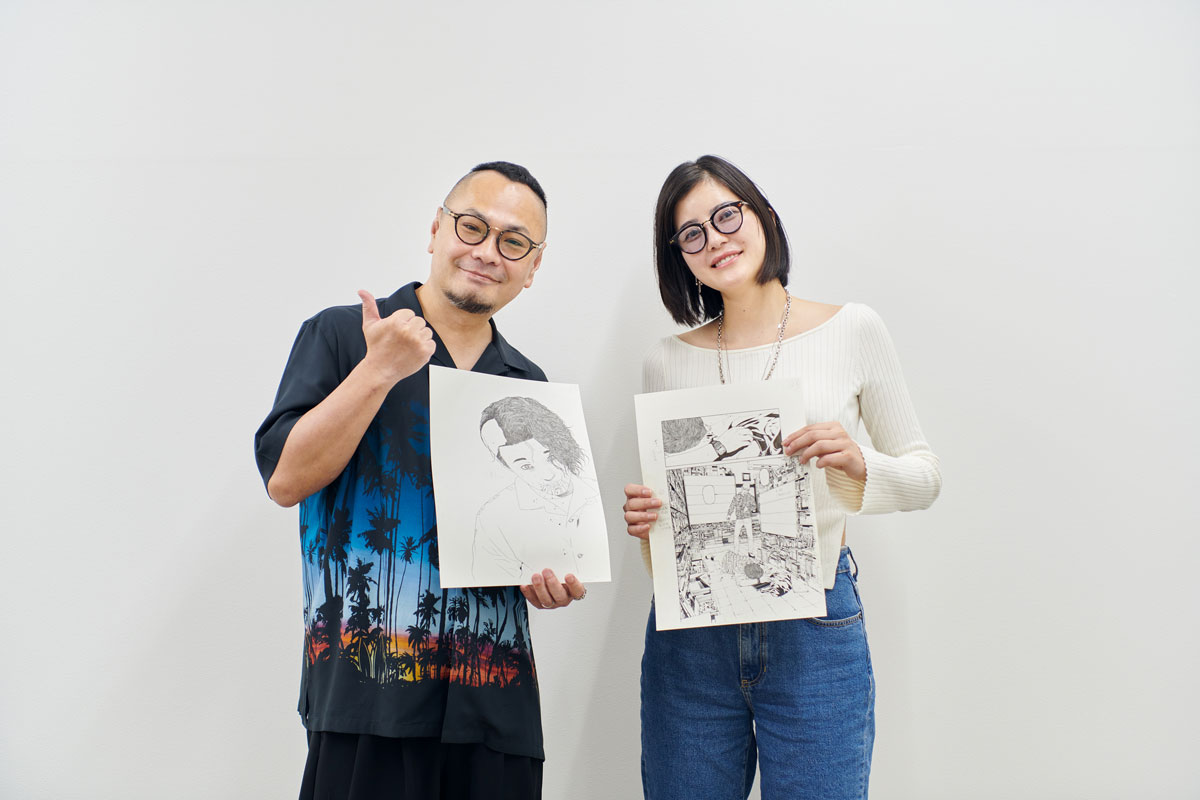
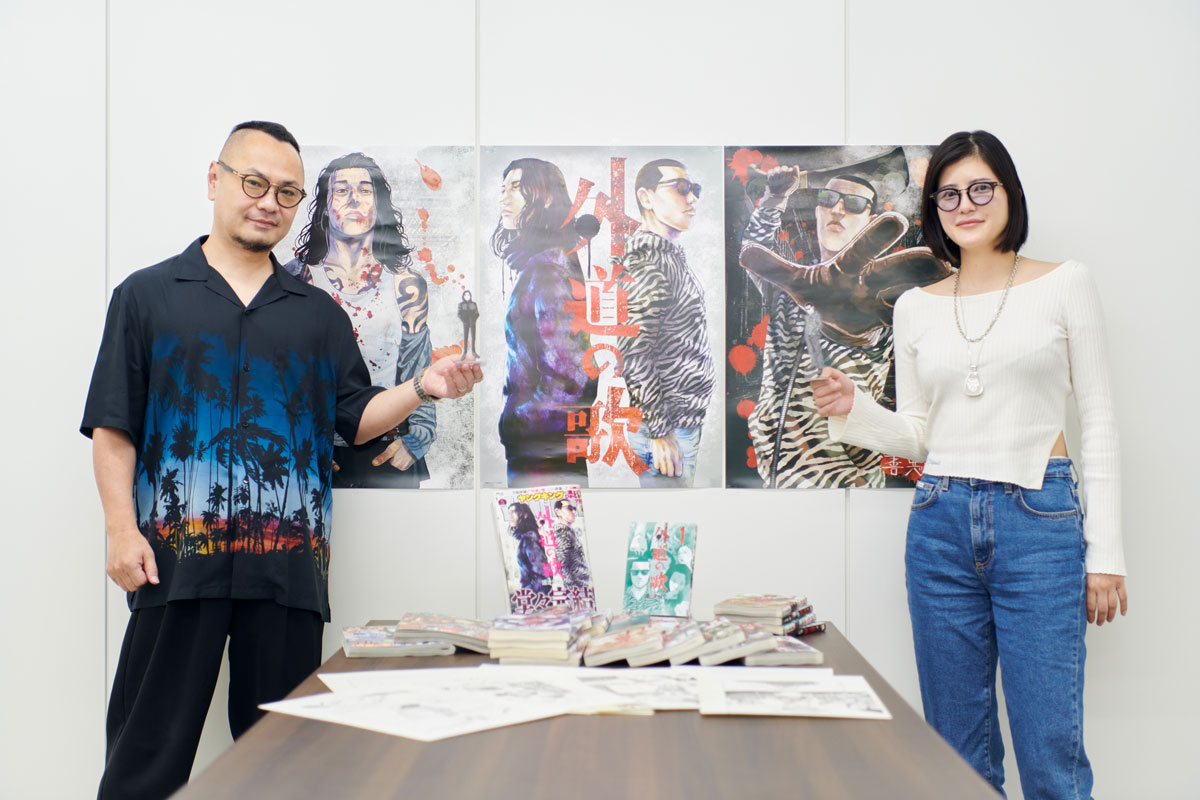
I have a close group of friends who love manga, and one of them recommended Watanabe's "Gedō no Uta" (Shonen Gahosha) to me, so I read it. I got totally hooked. When I met Watanabe for the first time, I thought he looked like someone who could appear in a manga.
Daisuke Watanabe (hereinafter referred to as Watanabe)
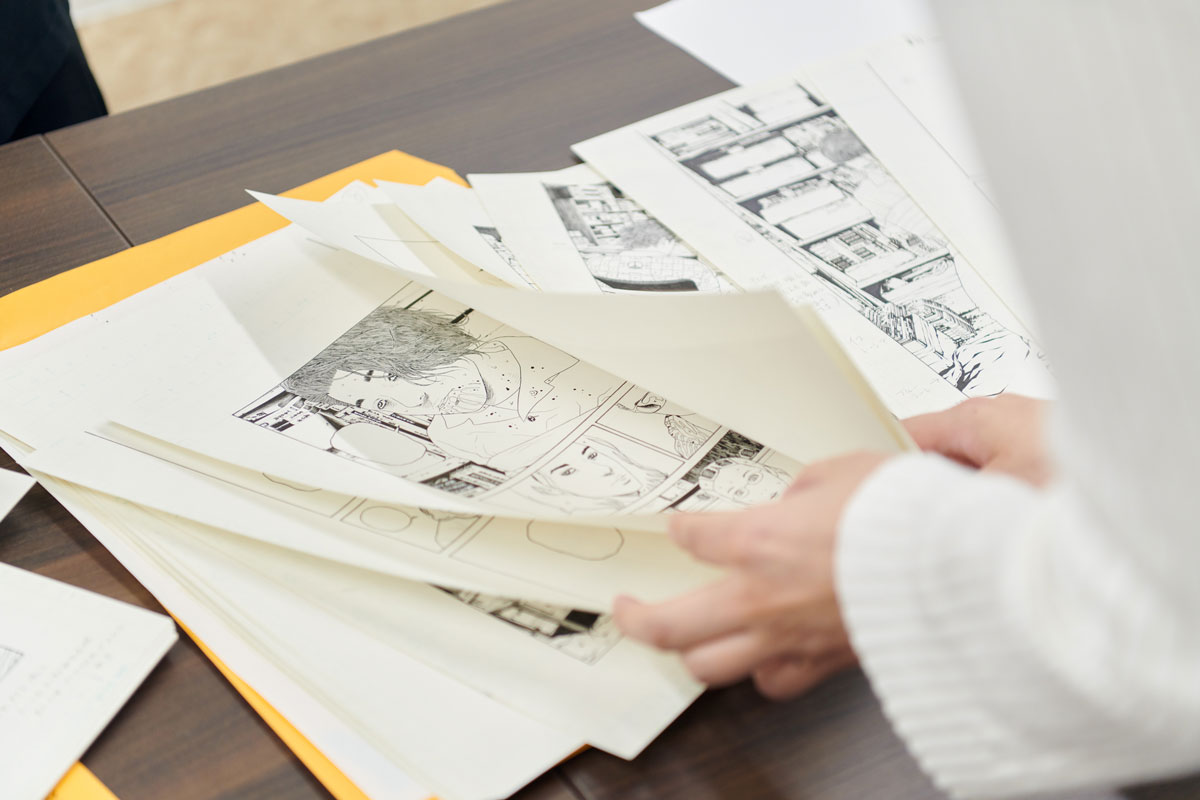
I get that a lot (laughs). Sometimes I model for characters from manga and recreate actual scenes.

Shoji
So you don't draw from your imagination. Have you always used your own model or recreated actual scenes as you draw?
Watanabe
I guess it started around the time I started drawing "Zankoku no Kusai," which was serialized in Shonen Gahosha's Young King magazine from 2014. Also, I don't like being pressed for time, so I think it's unique to me to always think ahead when I draw. When I'm working on a weekly serialized work, I sometimes end up drawing episodes up to 10 weeks into the deadline.
Shoji
I can't come up with good ideas unless I'm under pressure, so I think I'm the complete opposite of the type of person who draws with plenty of time to spare. I sometimes get an idea at the last minute, right before the deadline, and think, "It would be amazing if we could make this a reality!", so it's tough after that, but the staff I work with help me out. I wish they would just come to me in an instant.
Watanabe
That's better, isn't it? I'm a genius (laughs). When I first started drawing a weekly serialized manga, I was really busy, and I felt that if I wanted to continue doing it as a job, I needed to prepare thoroughly in advance. The best thing is to do everything the way you want to. I think there are people who can't find a method that suits them, or who struggle because things don't mesh well, so I think that as a creator, I'm lucky just to have found my own method.
The struggles of leading a team

Watanabe
As we were talking about staff earlier, most assistants to manga artists join the company with the goal of becoming professionals. These people are highly motivated, so they manage to do even if I ask them to do unreasonable things, but there are also some who give up on becoming professionals mid-serialization. When this happens, their skills suddenly decline, which is surprising. They may have been drawing amazing pictures until recently, but now they're sloppy, or worse, they don't even reply.
Shoji
Do you yourself realize, "Maybe this person has lost interest?"
Watanabe
I realized this when I saw the finished background art. There is actually someone like that, and we talked about it, but he said, "I don't care anymore." Each of us entered the world of manga artists with hopes, like "I want to draw manga that everyone will read," so I thought it might be a bit difficult to get someone who has lost that hope to work hard again for my manga.
Mr. Shoji, you are the owner of a shop, but have you had a similar experience?
Shoji
At our restaurant, we hire graduates from the culinary school I attended. Some of the staff actually work there with a clear goal of making it in the culinary world, while others have to take over their family's restaurant. Each staff member also has their own things that they value, such as time alone or their favorite idols.
It may seem obvious, but each person has a different way of thinking about work and what they value. As an employer, I want to help my staff "balance their work with what is important to them."
The healing time needed to continue creating
Watanabe
I set aside one day a week to take a break from manga. On that day, I go to the gym, get a chiropractor, or go to the sauna. I also often go to the local public bath, and I find it fascinating to listen to the casual conversations of the people there. Hearing exclusive stories that you can't hear anywhere else is my weekly respite.
Mr. Shoji, is there ever a day when you don't think about cooking?
Shoji
When I read Watanabe's manga, I don't think about cooking. When she opened her own restaurant and won awards overseas, I sometimes felt uncomfortable, perhaps because she was a female chef.
In Watanabe's works, the revenger relieves the "indescribable feelings" of the families of crime victims, and as I read them I feel as if my own vague feelings are being cleared up as well, which always soothes me.

Watanabe
I'm glad to hear you say that. When I first started drawing manga, I was unknown, so I used to draw shocking images to catch readers' attention. Once I had a certain number of readers, I started to pay more attention to the dialogue, while being conscious of creating images that leave room for readers to enjoy their own imagination.
And actually, the things the villains say in my works are things I want to say to the world. There is a manga editor named Sonoda Yumeji who appears in "Gedou no Uta" who aspires to be a writer, and although he does have a psychopathic side, I would like you to pay attention to his lines as well.
A new challenge begins for the next success
Shoji
As I spoke with people active in a variety of fields, I began to think about what "success" means to me. What does "success" mean to you, Watanabe?
Watanabe
I guess it would be to have many people know the titles of my manga. The manga I draw are mostly in the outlaw genre, so there aren't that many people who read them to begin with. That's why I think I'll have succeeded if I can create a work that is known by a wide range of ages, from children to the elderly, and that even people who aren't particularly interested in manga can say, "I know the title."
I feel hopeful because my seniors who draw manga in the same genre are paving the way for me.

Shoji
I think there are many people who feel just as refreshed after reading your manga as I do. What kind of manga do you plan to draw in the future?
Watanabe
I was happy when I received letters from readers saying things like, "It saved my soul" and "It made me feel more positive."
I feel like I've drawn all the outlaw manga I can. From now on, I'd like to draw works themed around horror and urban legends, which I've always loved. I'm at an age where I need to think about my future as an artist, so I'll start by drawing the things I really want to draw.
Shoji
It's a new challenge, and I'm looking forward to your future work.
In fact, I'm currently taking on a new challenge myself. I've been chosen to oversee the "Blue Box Cafe" that will be opening at "Tiffany & Co.". Until now, I've been running a small shop that only caters to one group per day, and I've been fortunate to have a good clientele, but the shop I'm opening this time is on a completely different scale. As I make preparations for the opening, including hiring staff, I'm constantly searching for the type of workplace that is in line with the times.
When I was training, I worked from early in the morning until late at night and prepared meals at home. Of course, it's important to work hard, but I can't force that on my staff, and I want to create an environment that suits the current era, where everyone can feel that cooking is wonderful and can work happily.
Also, even if the time allotted is the same, the work that each staff member can do varies depending on their skills. Rather than assigning each staff member only to the areas in which they excel, I would like to create a system in which everyone can acquire skills equally.
Watanabe
It would be great if such a system could be put in place. I once worked with someone who had been an assistant to another manga artist for five years, and when I asked him to actually draw something, it wasn't at the level I had expected.
As we talked, I found out that he had been working as an assistant to someone who draws sports manga, and that he had been drawing balls for five years straight. He is also to blame for not asking to be allowed to draw other things, but I also thought that there was a problem with the system in place.
When it comes to serialization, we tend to be pressed for time and each person tends to draw only the things they've been assigned, but that can be a problem if someone has to take a break, so I try to be conscious of making sure that everyone can draw equally.
Shoji
If your skills depend on someone else, you won't be able to take a break if something happens, and if that staff member ends up working somewhere else, you'll have a hard time. I've once again realized how important it is to "nurture" your staff in order to create good works. Thank you for today!