










Create a calming atmosphere in your studio with a book-based landscape
Nagaba says that he wanted to create a "bookshelf as a box" where the books are packaged together, rather than a bookshelf where each book stands out on its own.
"I think that book covers are like makeup that lets you express yourself, so I like to remove them in my living space and leave the books in their natural state. My ideal image is a box that neatly holds the books in their flat state."
The shelves are made by the British company Vitsœ, a masterpiece designed by German industrial designer Dieter Rams in 1960. Lined up neatly on the front are photobooks, catalogs, and drawing collections. The spines bear minimal information, in black or white lettering, or engraved with a pleasant feel to the touch. The lack of emphasis allows the beauty of the typeface and binding to jump out at you, which is refreshing.
"When you step back and look at the shelves and the view is beautiful, each book looks better and you feel more inclined to pick it up."
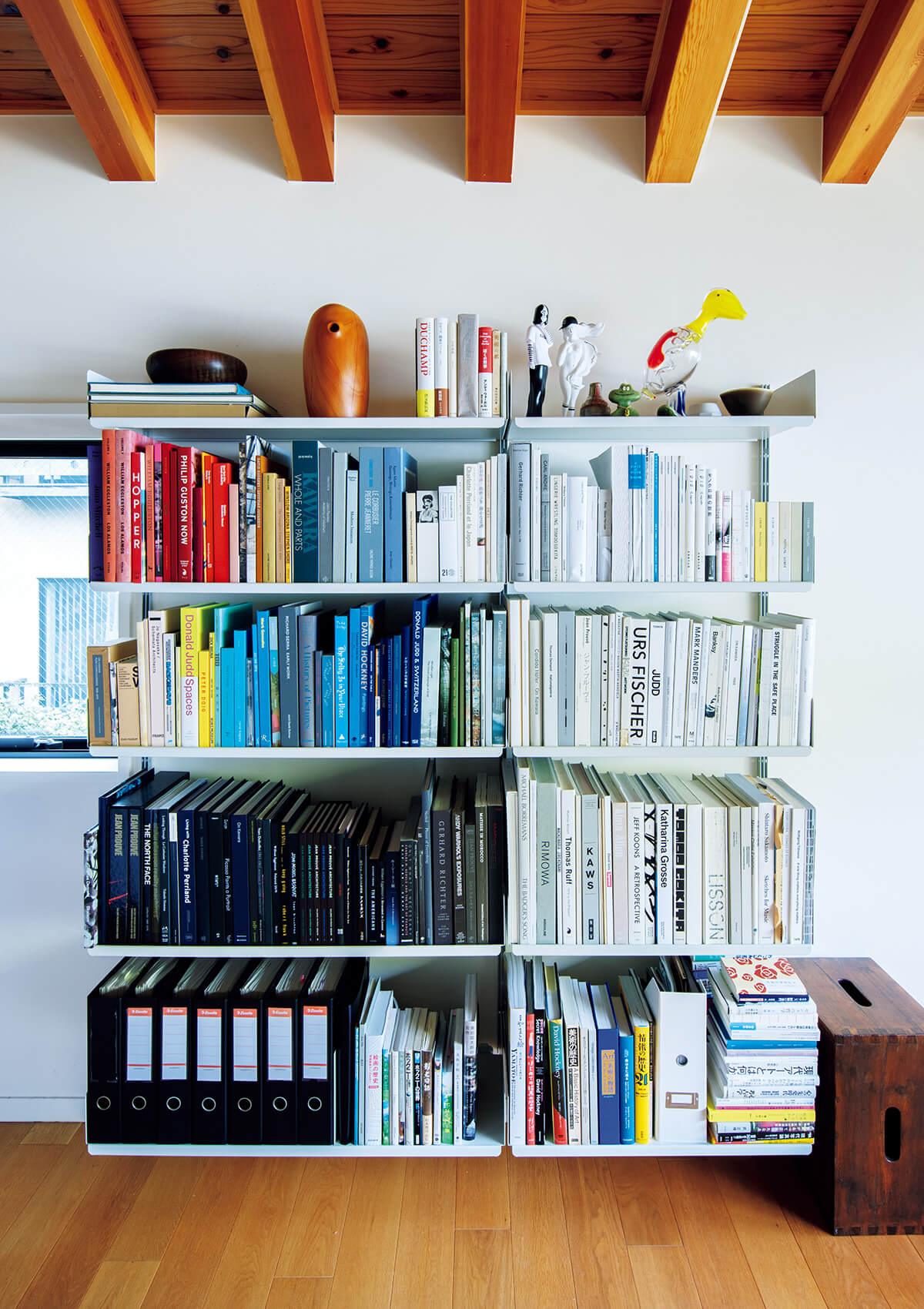
A bookshelf in an atelier located in a residential area of Tokyo. Photobooks and art books have had their covers removed and are arranged by color. The wall-mounted shelves are made by Vitsœ. The box-shaped stool in the bottom right is Le Corbusier's LC14. 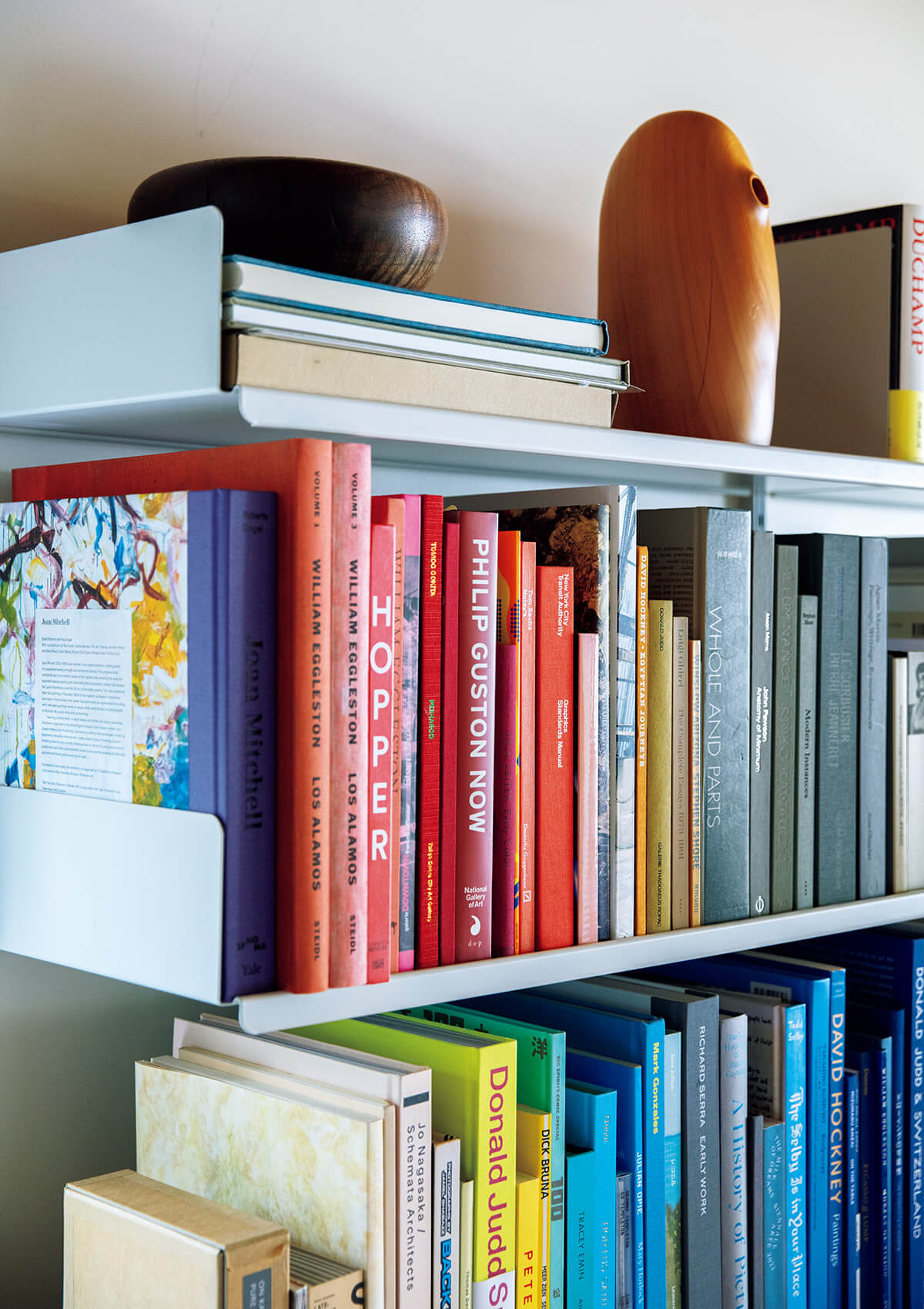
From Donald Judd and David Hockney to Taiyo Taiyo Matsumoto and Dick Bruna, "The colour tones on the Vitsœ shelves are outstanding, and even though all these different colours are lined up, they all blend together."
Rather than asserting individuality, he draws people in by suppressing it. By reducing the number of elements, he evokes the image of rich depth. Nagaba's bookshelves are very similar to the gravitational force of his paintings.
"Books are a source of inspiration and nourishment for creativity, so if I feel a book looks good, including its binding and feel, I buy it without much hesitation. But I'm not looking for an answer that will be useful right away. I choose books based on feelings like, "I feel calm when I see it," or "I might think, 'I'm glad I read this,' a dozen years from now." When it comes to buying books, I indulge myself."
Nagaba says that he wants to create a suitable place for the books he acquires and store them neatly, especially in his studio.
"What we see on a daily basis influences the pictures we draw. I want to create in a calm environment where my emotions don't fluctuate, so the view of the bookshelf is important. A bookshelf with books neatly lined up like a box is pleasing to the eye, and the fact that the books are kept in a box conveys that they are well-cared for."
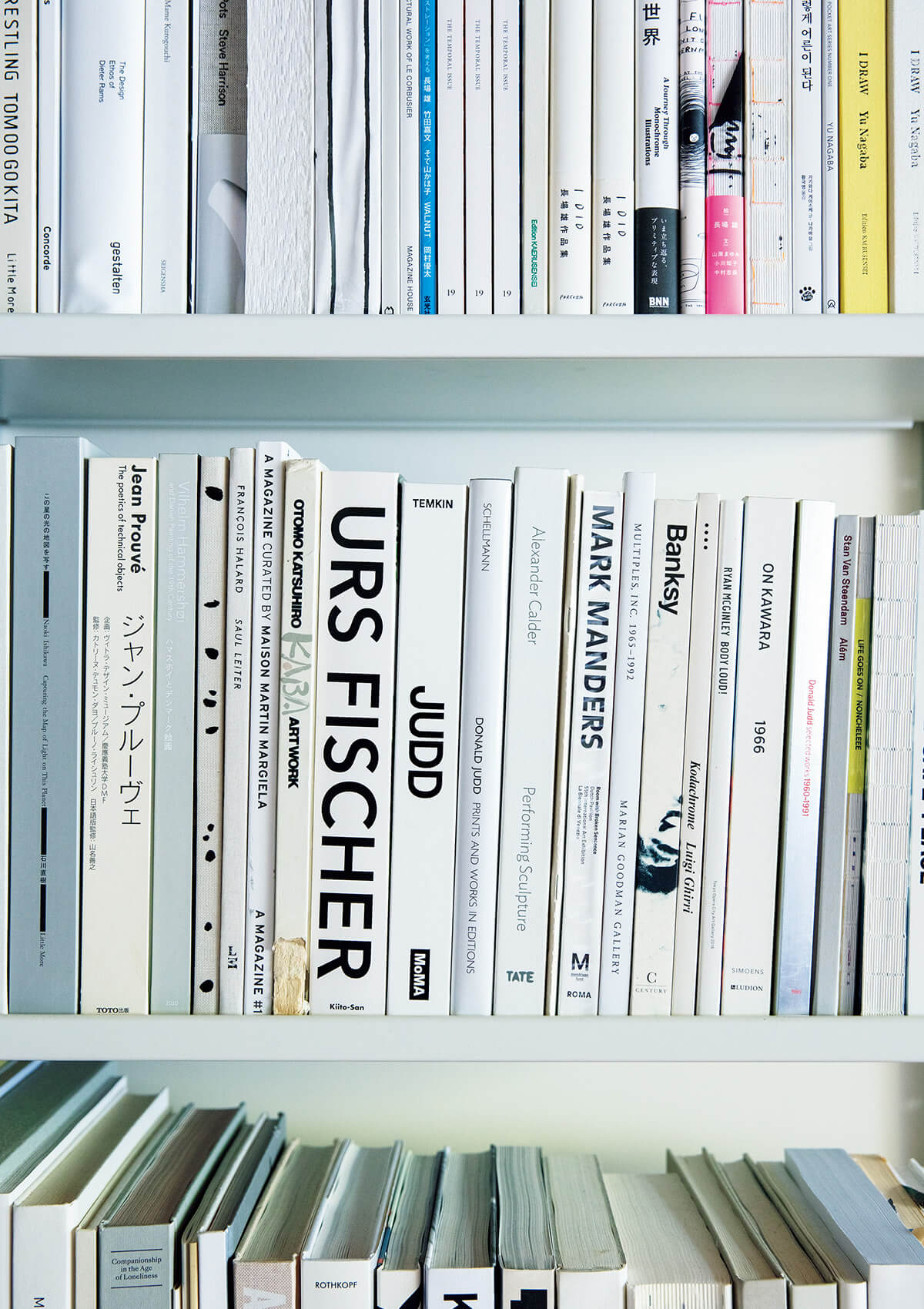
On the top shelf are seven books with their covers still on display: works by Duchamp, Matisse, Warhol, and Yomokichi Sawaki, a pioneer in Western art history who introduced the Venus de Milo to Japan. 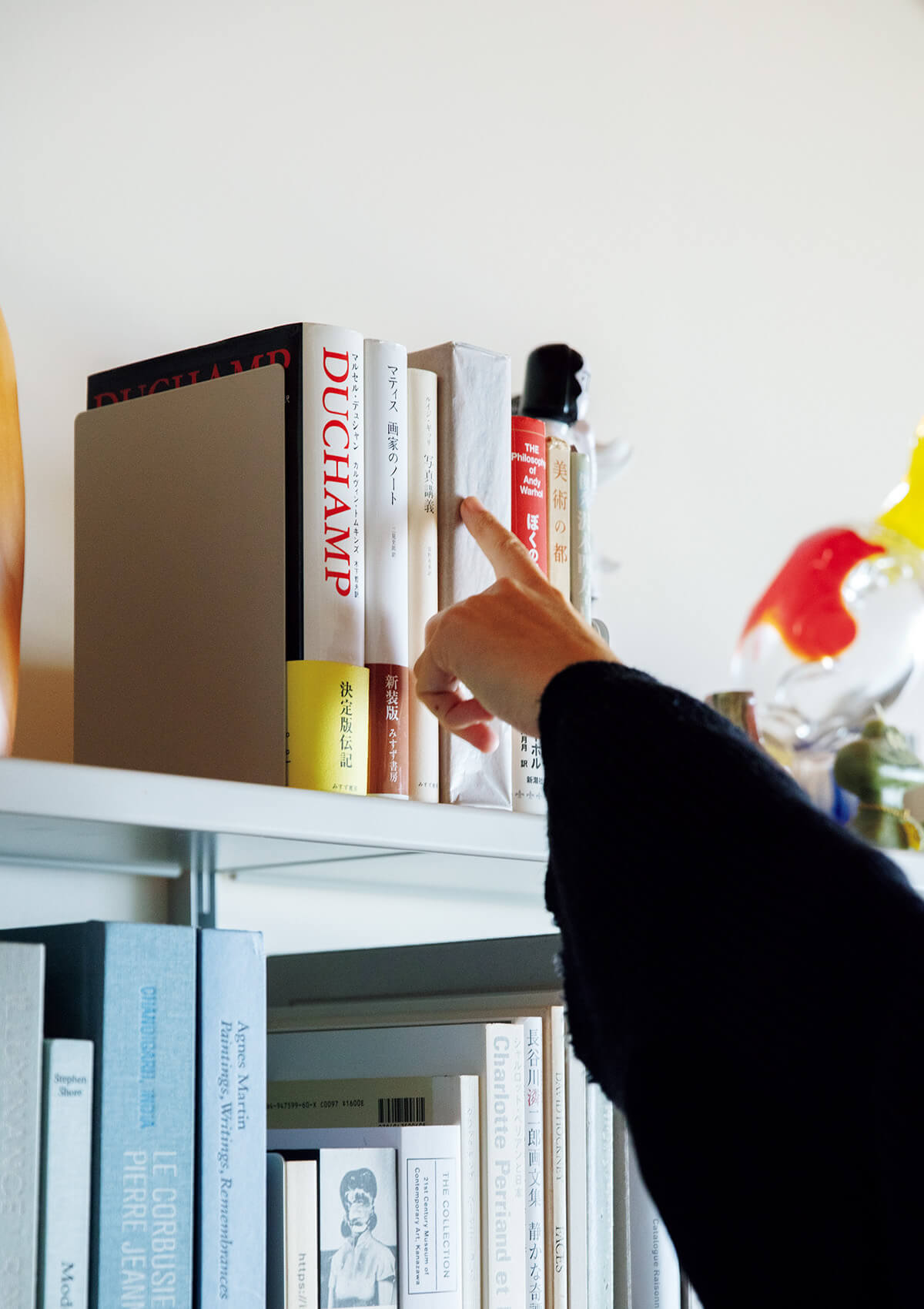
Removing the cover highlights the charm of the typography.
I look at the bookshelf and wait for the answer to come to me
I like books that bring comfort, not just to bookshelves as a space, but also to the books themselves. For example, the earliest photobooks by William Eggleston, a pioneer of "New Color," which attempted new expressions in color photography in the 1960s and 1970s.
"I also own the famous large-format photo collection, but I always reach for the slim reprint version, which is only 24 pages long. I'm really drawn to the atmosphere and composition of the images, which capture mundane everyday life, and each and every photograph really catches my eye. The collection of works by British architect John Pawson is also a book that will leave you entranced just by looking at it.
His architecture is like a collection of boxes, each meticulously honed to perfection. But in fact, there's something playful about it, like the oval handrails on the staircases. I went to hear a conversation with him when he came to Japan, and he was a very humorous and warm-hearted person. I felt a connection with him, as no matter how minimalist his work may be, his personality shines through."
On the other hand, the photo book featuring the "Today Series" by On Kawara, a leading figure in conceptual art, is interesting because it doesn't give you a clear answer. The "Today Series" is a series of works that feature only the date of creation painted in white numbers and letters on a single-color canvas. They are also known as date paintings.
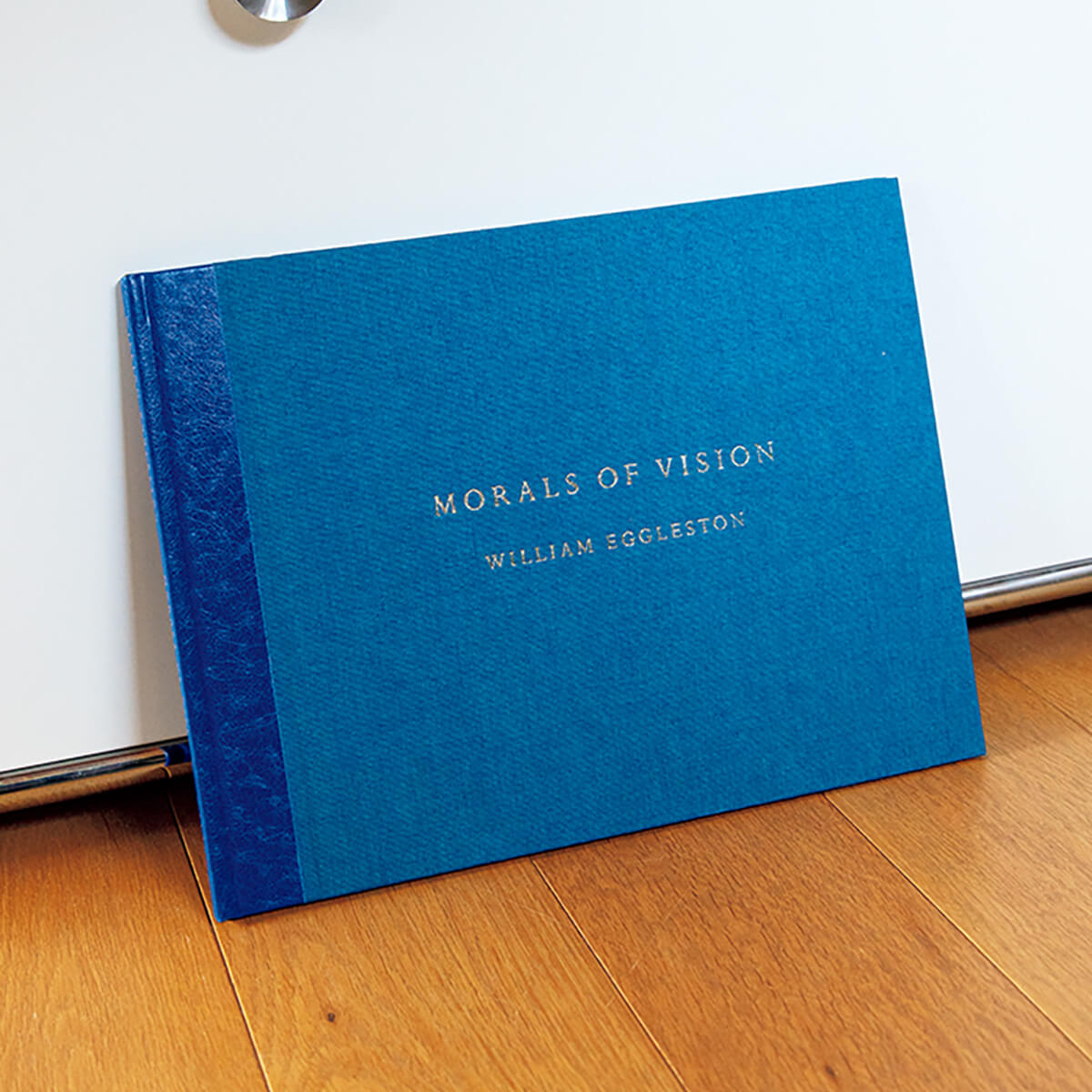
"Morals of Vision" by William Eggleston / Photography
William Eggleston, a pioneer of "New Color," is known for his works that elevate ordinary everyday life into poetic landscapes. This is a reprint of his artist book, one of only 15 he produced in 1978. The book contains nine colored coupler prints, including still lifes, landscapes, and portraits, some of which were not included in the original edition. The cover is cloth-covered. Steidl.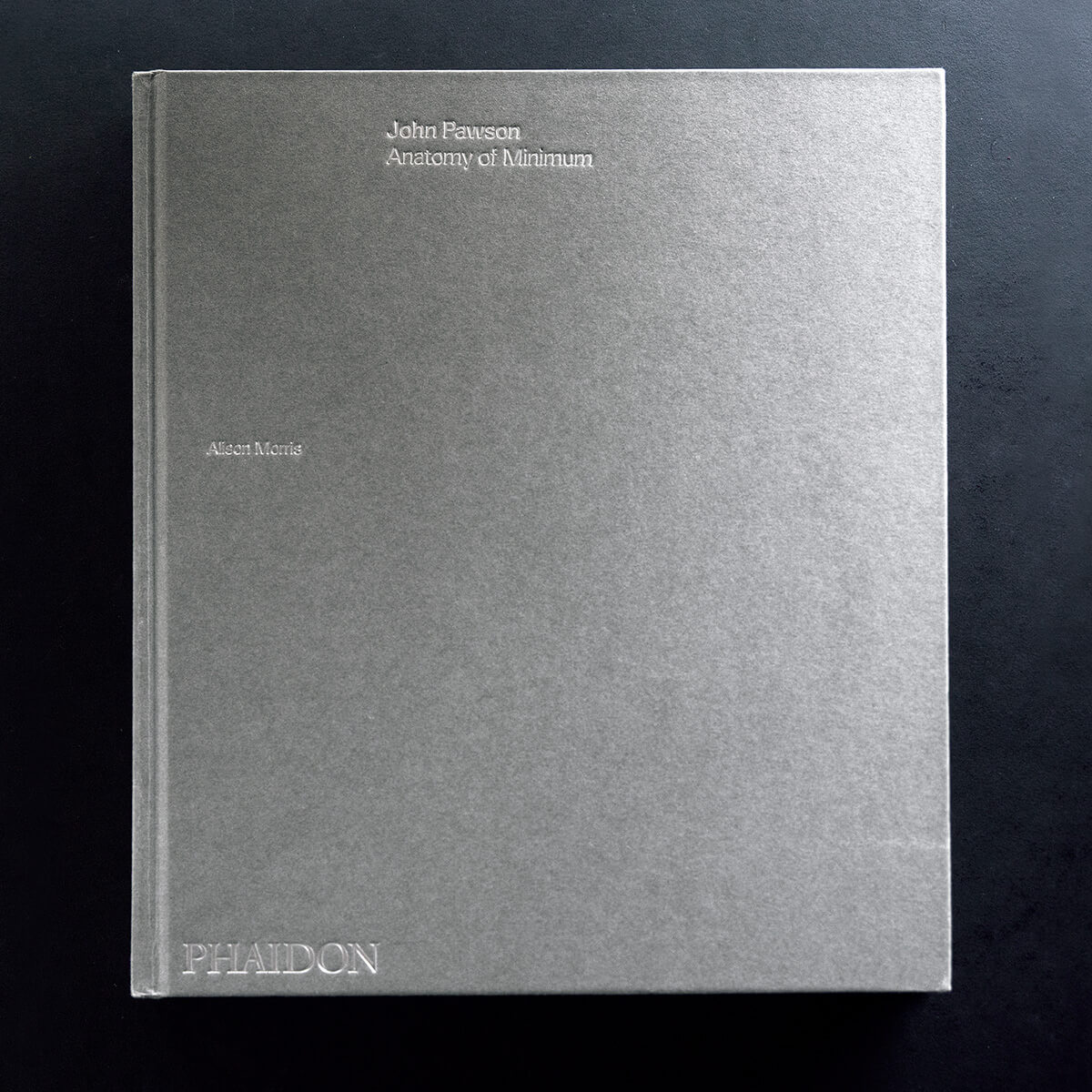
"John Pawson: Anatomy of Minimum" Photo by Alison Morris
This is a collection of works by architect John Pawson. In addition to his own home in the English countryside, it also features products he designed, such as doorknobs and tableware. "He came to Japan in his twenties and was influenced by temples and tea houses, and his history as a frequent visitor to Shiro Kuramata's studio is also intriguing." The photo shows the cover removed. PHAIDON.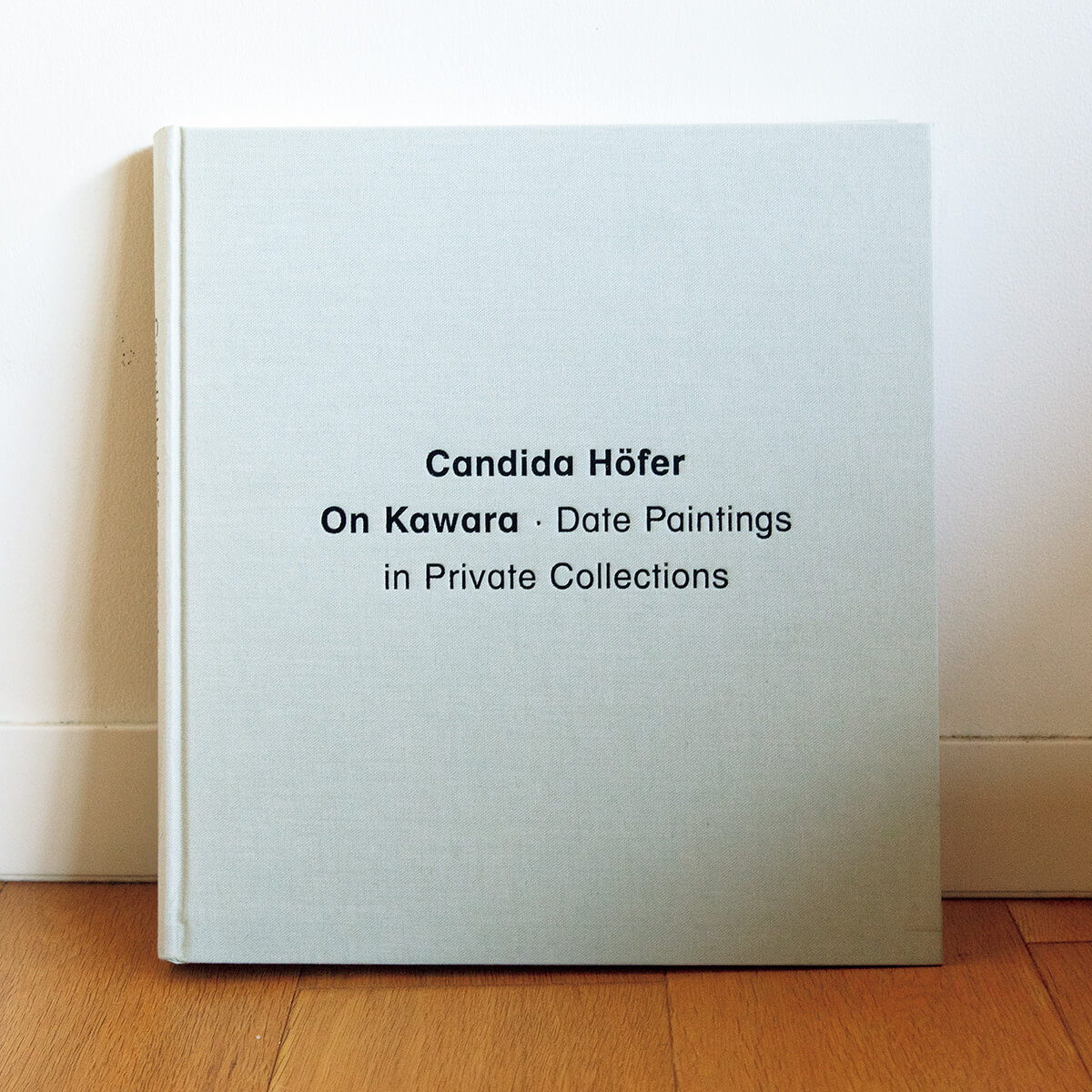
“On Kawara, Date Paintings in Private Collections” Candida Höfer/Photography
This exhibition captures the private spaces of collectors who own works from the "Today Series" by contemporary artist On Kawara. The photos were taken by German photographer Candida Höfer. The curator was Kasper König, a leading figure in the German contemporary art world who passed away this year. The photographs are taken with the cover removed. Walther König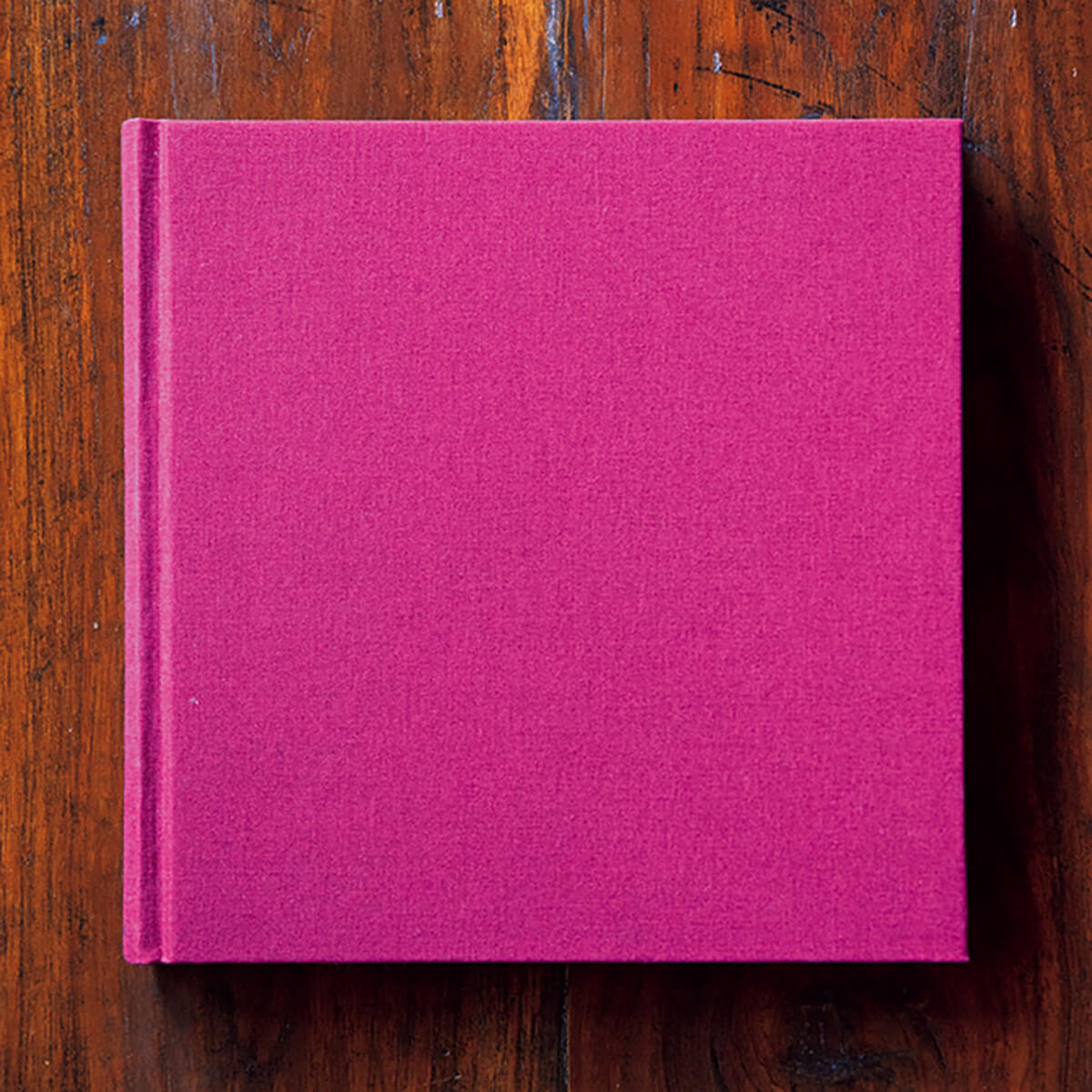
"Early Color" by Saul Leiter / Photo
This is the first photo book by Saul Leiter, who took photos and painted every day until just before his death in 2013, leaving behind a vast body of work. It contains color photographs taken in downtown New York from the late 1940s to the 1950s. "What's great is that the works he selected are not flashy, but have a sleek, reserved appearance." The photo shows the cover removed. Steidl.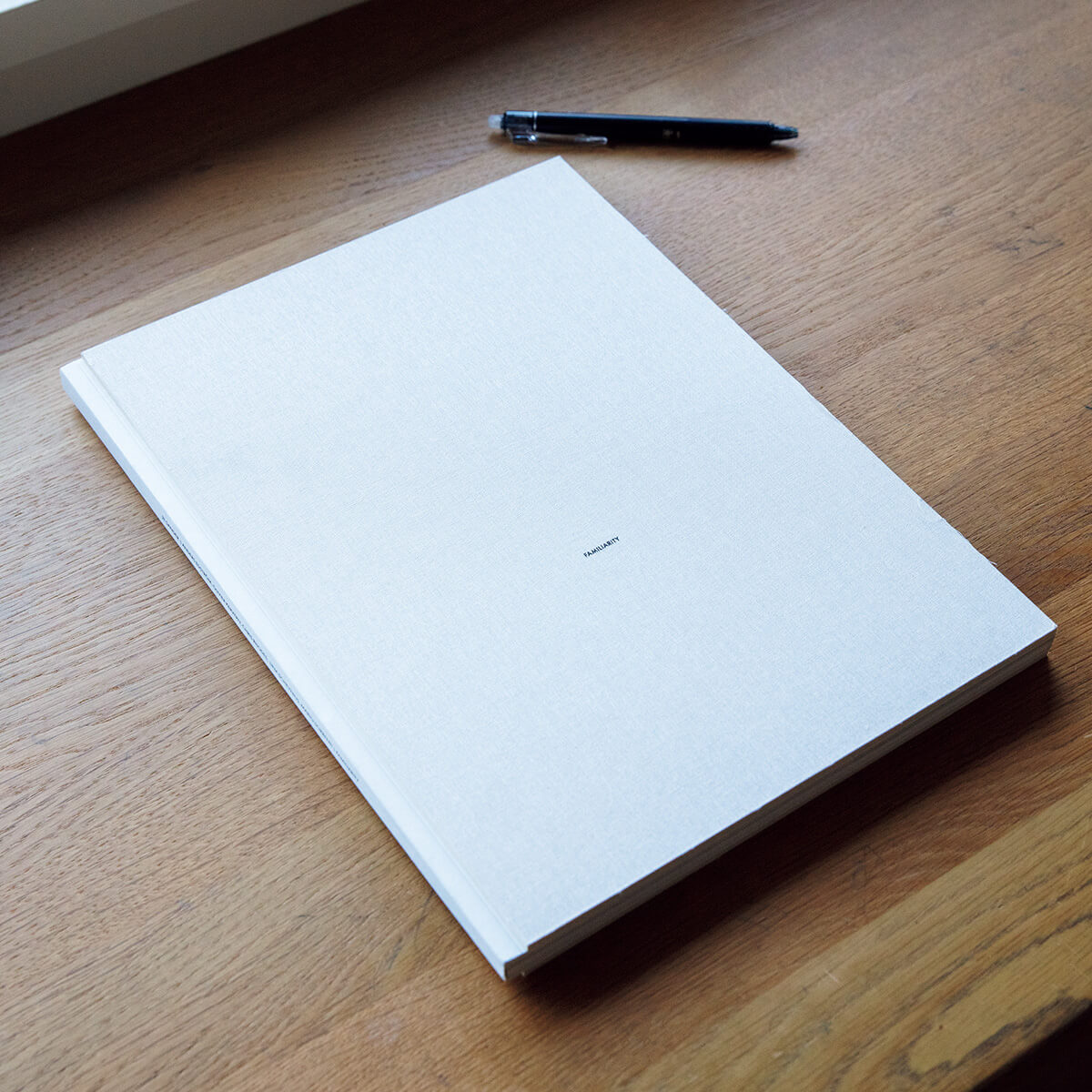
“FAMILIARITY” Curated by Lucie and Luke Meier
A photo book that conveys the world of Jil Sander. Five photographers, including Anders Edström and Mario Sorrenti, shot the brand's collections in their respective homes and gardens. "The luxurious binding, with its thick cover and machine-sewn binding, is irresistible. The visuals are also beautiful, and I feel happy every time I look at it." JIL SANDER PUBLISHING.
"It's a photo book that features photographs of the homes and offices of collectors who own the works, and while some are cool rooms decorated with pop art-like furniture, others are displayed in formal corporate reception rooms with black leather sofas. I think it's fascinating how people connect with artworks.
The intensity and timing of the encounter will influence the relationship that follows. Some encounters are by chance, others by fate, and if there is a piece in the "Today Series" that has your birthday on it, you will feel an incredibly strong connection.
What does it mean that a date alone can become art? I first encountered this work when I was 20 years old, and I've been pursuing it ever since, without knowing the answer. It's the exact opposite of something that gives you an immediate answer, so the images just keep piling up in my head, and maybe one day, at some point, they'll suddenly appear at the top of the layers. I feel like I'm waiting for that moment as I gaze upon the bookshelf."