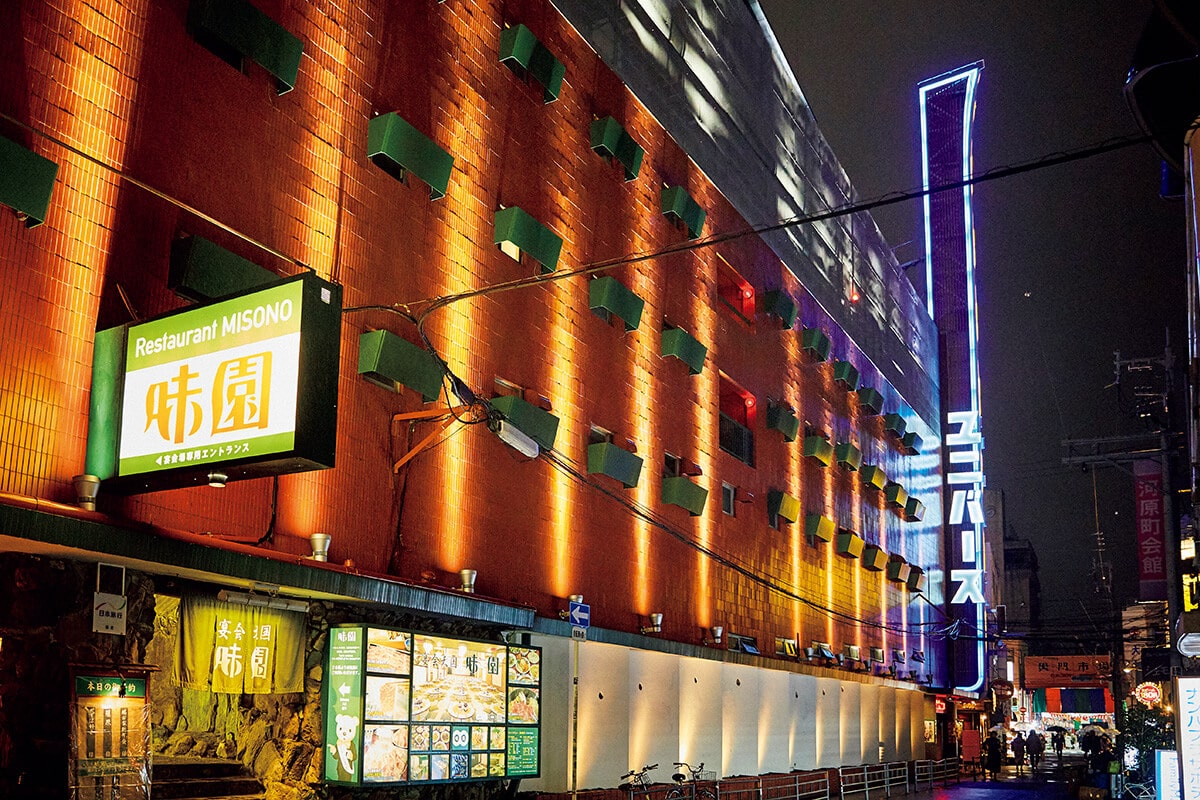











A huge cabaret that recreates the universe that the founder dreamed of
Without this space, the history of Osaka's nightlife would surely have been very different. The Misono Building was built in 1965. Universe, which opened there, reached the height of its glory, touting itself as "one of the world's largest cabarets."
Founder Ginjiro Shii, who came to Osaka from Taiwan with just one bag, aimed to create world-class entertainment in Sennichimae, and his ambition was no joke. It featured an aerial stage, a fountain, and an arc-shaped atrium spanning the first to fourth floors. In addition to this mind-blowing space, it's amazing to note that even the lighting, speakers, and even the dancers' costumes were all custom-made to suit Universe.

Even looking at photos from that time, it looks like something out of science fiction, a universe. "Apparently the founder had a dream about this idea, like a prophecy, and made it a reality," says Takehara Ippei, current manager of Universe. At the time, in addition to dancers, there were 500 hostesses in the club at all times, and over 1,000 customers came every day. In 1962, the American magazine LIFE introduced it as "JAPAN'S BIGGEST CLUB," and many tourists from overseas visited. It is said that at the time, "I heard that the cash registers wouldn't fit, so people had to step on them to stuff them into cardboard boxes at their feet," giving us an idea of how successful it was.
It also seems to have been an essential stage for celebrities in Osaka at the time, with "almost everyone except Takakura Ken, Ishihara Yujiro, and Hibari Misora Yujiro Ishihara (lol) having stepped on this stage." In the 1970s, it was also a popular venue for up-and-coming idols of the time, such as Yamaguchi Momoe and Asada Miyoko. Incidentally, it's also well-known in Osaka that Kida Taro, known as the "Mozart of Naniwa," played the piano and Wada Akiko, a teenager, held the microphone as an exclusive singer.
However, in 1975, Shii read the trends of the times and reborn the building as a comprehensive leisure complex. The atrium was removed and a banquet hall, sauna, hotel, and snack bar area were built, and the cabaret was moved to the basement. Apart from the banquet hall on the fifth floor, bold renovations were carried out over several years. As a result, Ajizono became a huge hit with Osaka office workers seeking "energy for tomorrow" (as repeated in TV commercials at the time), as a place where they could stay until the morning.
After that, the bubble burst and the building went into decline, but now the former cabaret in the basement has become a famous live music hall that represents Osaka, there is a waiting line to enter the snack bar district on the second floor, and large parties are held every night on the fifth floor. Takehara says that the atmosphere of Sennichimae has changed a lot compared to the past, but there is one thing about the Ajisono Building that remains the same. "The smell that is unique to this place. It has not changed since the old days."
It's like a nostalgic, underground atmosphere in a bustling city, without any unnecessary refinement. When I think about how unchanged it is, I can't help but think about the "universe" that people of all ages and genders were drawn into every night more than half a century ago.